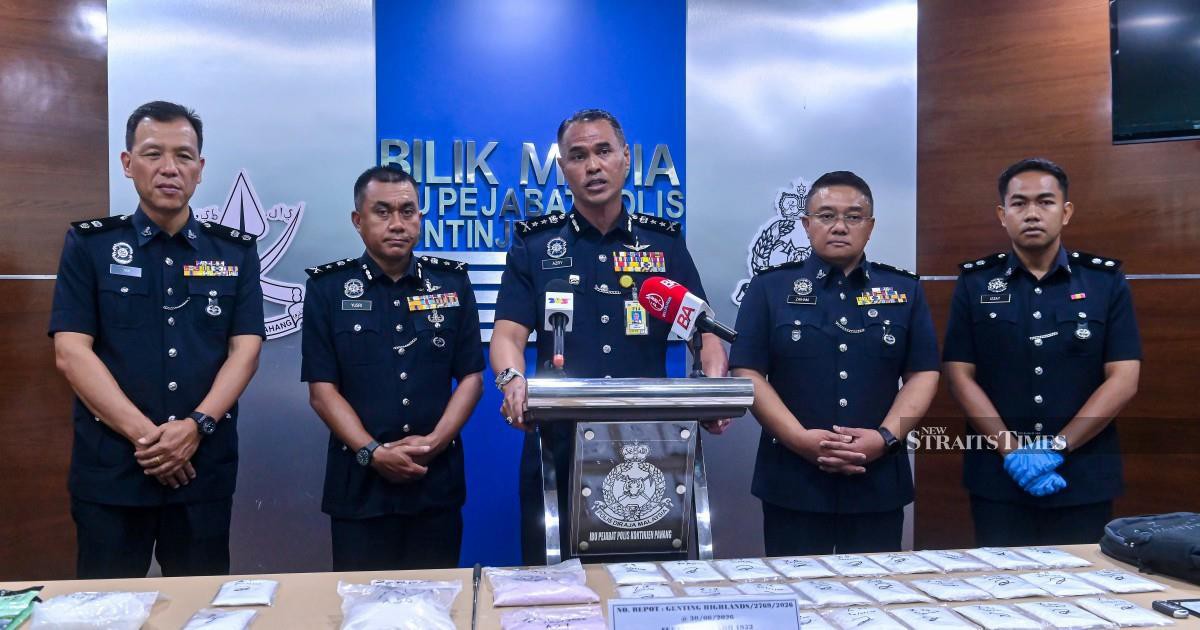
Pahang has delivered a significant blow to drug trafficking networks through Operation Hawk, an intensive enforcement drive that spanning three days targeted known drug distribution points across every district in the state. The coordinated statewide initiative culminated in the arrest of 333 individuals and the confiscation of drugs, currency and motor vehicles valued at more than RM500,000, according to police authorities in Kuantan.
The scale and comprehensiveness of the operation underscores the state police force's commitment to dismantling organised trafficking rings that have established footholds across Pahang's 11 districts. Rather than concentrating resources in urban centres alone, law enforcement teams deployed strategically throughout rural and semi-urban areas where drug markets have flourished with comparatively less scrutiny. This approach reflects lessons learned from previous enforcement campaigns, which demonstrated that dismantling supply chains requires simultaneous pressure across multiple jurisdictions rather than sequential raids that allow networks to relocate operations.
The involvement of all 11 districts—spanning from Kuantan in the east through to Gua Musang and Jeli on the Thai border, and from Pekan in the south to Raub and Bentong in the interior—indicates the pervasive nature of drug-related criminality in Pahang. Each district presents distinct operational challenges shaped by local geography, demographics and proximity to trafficking corridors. Border districts, for instance, face particular vulnerabilities as conduits for narcotics entering from neighbouring Thailand and potentially destined for distribution in peninsular Malaysia's more densely populated regions.
The seizure of goods totalling over RM500,000 carries implications extending beyond simple drug interdiction. When authorities confiscate narcotics alongside significant cash holdings and vehicles, they disrupt not merely the supply of drugs themselves but the financial infrastructure that enables trafficking organisations to function. Currency seized during such operations often represents proceeds from street-level distribution or payments awaiting transfer to higher-level suppliers and money launderers. Similarly, the recovery of vehicles removes transportation assets essential for moving contraband across district and state boundaries, temporarily fracturing logistical networks that sophisticated trafficking groups have spent months or years establishing.
The 333 arrests span likely a broad spectrum of involvement in the drug economy. Invariably such operations capture street-level dealers and users alongside mid-level distributors and occasionally individuals with managerial roles within trafficking hierarchies. The distinction matters considerably, as prosecution strategies and rehabilitation pathways differ markedly depending on the degree of criminal culpability. Lower-level offenders might benefit from treatment-oriented interventions, whereas those orchestrating distribution networks across multiple districts warrant more severe judicial responses designed to incapacitate organised criminal structures.
For Malaysian drug policy observers, Operation Hawk exemplifies the sustained enforcement approach that characterises contemporary anti-narcotics strategy under the purview of the Royal Malaysian Police and the National Anti-Drugs Agency. Yet enforcement action alone has historically proven insufficient to arrest the underlying dynamics driving drug demand and supply. The operation's success, while noteworthy, occurs within a context where addiction rates continue rising, particularly among younger demographics, and where supply chains have demonstrated considerable resilience and adaptability following previous large-scale police interventions.
The timing and coordination required to execute simultaneous operations across 11 districts necessitates substantial organisational infrastructure and intelligence gathering beforehand. Pahang police would have needed to identify priority targets across disparate geographical areas, deploy personnel efficiently given resource constraints typical of state police forces, and synchronise action across district boundaries to prevent suspects from fleeing jurisdiction before apprehension. This logistical complexity becomes even more pronounced in a state where terrain ranges from coastal lowlands to jungle-covered highlands, and where some districts remain relatively isolated from central coordination hubs.
From a Southeast Asian perspective, Pahang's position as a state with significant land borders and maritime access makes it strategically important within broader regional drug trafficking networks. Organised crime groups operating across Thailand, Laos and Cambodia have longstanding supply relationships with Malaysian distribution networks, with Pahang serving as both a transit point and a consumer market. Operations of this scale, when replicated across multiple states, contribute incrementally to the overall enforcement pressure that might eventually degrade the profitability and viability of trafficking operations seeking to service Malaysian markets.
The implications for neighbouring communities warrant consideration as well. Successful enforcement in Pahang may displace trafficking activity to adjacent states rather than eliminating it entirely, a phenomenon observed repeatedly in drug enforcement history. Consequently, the sustainability of Operation Hawk's gains depends substantially upon whether other state police forces maintain comparable enforcement momentum and whether federal agencies coordinating cross-state efforts maintain sustained pressure on trafficking routes and distribution networks.
Looking forward, the challenge facing Pahang law enforcement extends beyond periodic large-scale operations toward building sustained intelligence capabilities and community partnerships that enable identifying emerging trafficking patterns before they consolidate. The 333 arrests and RM500,000 in seizures represent tangible outcomes of concentrated enforcement effort, yet their durability as contributions toward meaningful drug control depends upon systemic responses addressing the broader conditions—poverty, limited economic opportunity, addiction vulnerability—that render some communities susceptible to participation in drug trafficking economies.

