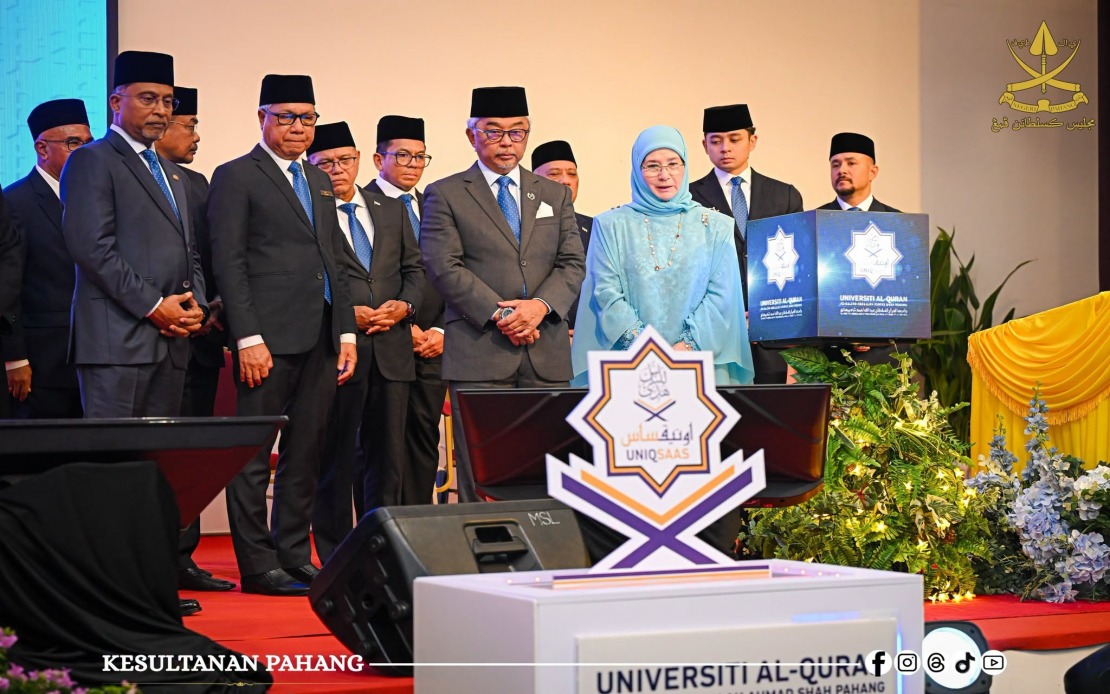
The Sultan of Pahang, Al-Sultan Abdullah Ri'ayatuddin Al-Mustafa Billah Shah, presided over the formal inauguration of Universiti Al-Quran Al-Sultan Abdullah Ahmad Shah Pahang (UNIQSAAS) in Kuantan on Tuesday, marking a significant milestone in the state's commitment to Islamic higher learning. The ceremony underscored the institution's transformation from its previous incarnation and its positioning as Malaysia's inaugural university dedicated to placing Quranic principles at the heart of academic and spiritual formation.
The proclamation event represented far more than a ceremonial change of name. When the Sultan consented to the rebranding in February, he framed the transition as a declaration of institutional purpose, transforming what was formerly known as Universiti Islam Pahang Sultan Ahmad Shah (UniPSAS) into an establishment with renewed identity and direction. This conceptual shift reflects evolving approaches to Islamic education in the region, where institutions increasingly seek to differentiate themselves through specialisation rather than general Islamic studies offerings.
Addressing attendees, the Sultan emphasised continuity with his father's educational vision, describing himself as custodian of Sultan Ahmad Shah's legacy in advancing Islamic scholarship throughout Pahang. He articulated a personal commitment to elevating the institution's standing within the state and positioning it as a source of pride for Pahang's residents and the broader Malaysian academic community. This intergenerational narrative carries weight in Malaysian governance culture, where royal patronage of educational institutions frequently intertwines with broader state development narratives.
The royal gathering reflected the ceremony's significance within Pahang's political and administrative hierarchy. Alongside the Sultan were members of the immediate royal family, including Tengku Ampuan Tunku Azizah Aminah Maimunah Iskandariah and Tengku Mahkota Tengku Hassanal Ibrahim Alam Shah. State leadership was well represented, with Menteri Besar Datuk Seri Wan Rosdy Wan Ismail and Higher Education Minister Datuk Seri Dr Zambry Abd Kadir present, alongside Deputy Economy Minister and Paya Besar Member of Parliament Datuk Mohd Shahar Abdullah. This constellation of officials underscored federal and state coordination in higher education development.
Central to the ceremony were formal appointments within the university's governance structure. The Sultan presented Tengku Hassanal with the instrument of appointment as Chancellor, a significant role that positions the Tengku Mahkota within the institution's strategic direction. Wan Rosdy and Tengku Amir Nasser Ibrahim Shah both received designations as Pro-Chancellors, embedding state government representation within the university's leadership apparatus. These arrangements reflect Malaysian higher education governance norms, wherein royal and government figures maintain formal oversight roles.
During the proceedings, the Sultan signed the proclamation plaque and officially launched what officials referred to as the state government's Quran, symbolic acts reinforcing the institution's Islamic educational mission. These ceremonial elements carry significance beyond their immediate symbolic value, as they publicly anchor the university's identity within Pahang's collective consciousness and establish public expectations regarding the institution's standards and priorities.
The Sultan's remarks to attendees conveyed both vision and pragmatism. He expressed confidence that university leadership would maintain operational effectiveness and ensure students received quality instruction befitting the institution's elevated status. More notably, he extended a direct invitation to the university administration and state officials to approach him personally should the institution require support or intervention. This accessibility reflects informal Malaysian governance patterns, where monarchical figures maintain approachability despite formal protocols, lending credibility to institutional requests for resource allocation or administrative flexibility.
The rebranding initiative itself deserves contextual examination within Malaysia's higher education landscape. The nation has comparatively few universities explicitly centred on Islamic studies, and fewer still with resources and royal patronage comparable to UNIQSAAS. As regional demand for Islamic education increases—driven by demographic trends and parental preferences for values-aligned institutions—UNIQSAAS positioning may attract student interest from Pahang and neighbouring states. For Southeast Asian education markets generally, the proliferation of specialised Islamic universities reflects broader recognition that religious and secular education need not remain mutually exclusive within institutional frameworks.
The Sultan's recognition of three decades of institutional development preceding the rebranding acknowledged the foundation upon which this transition rested. The institution's evolution from its initial establishment through its former identity to its current incarnation represents cumulative investment in infrastructure, faculty recruitment, and curriculum development. Institutional memory and established relationships with other Malaysian and international universities would continue supporting operations despite the formal name change.
Looking forward, UNIQSAAS faces the practical challenge of operationalising its rebranded identity while maintaining existing programmes and standards. The emphasis on Quranic foundations requires curriculum integration and faculty development that distinguishes it from conventional Islamic studies programmes. Success will depend on recruitment of scholars capable of bridging traditional Islamic scholarship with contemporary academic rigour, a perennial challenge for faith-based institutions navigating dual mandates.
The ceremony's timing and scale suggest Pahang views this initiative as central to state differentiation and economic positioning. As Malaysian states compete for education sector investment and student enrolment, distinctive offerings like UNIQSAAS potentially attract cohorts seeking religiously-grounded alternatives to secular institutions. This competitive dynamic within Malaysia's federal education system increasingly drives institutional innovation and specialisation.
The Sultan's closing remarks reaffirmed state commitment to the institution's success and resourcefulness in addressing operational challenges. His willingness to serve as institutional patron rather than distant figurehead signals serious long-term investment in UNIQSAAS's trajectory. For institutional stakeholders and prospective students, this direct royal endorsement carries tangible implications for stability, resource availability, and policy support within state governance structures.

