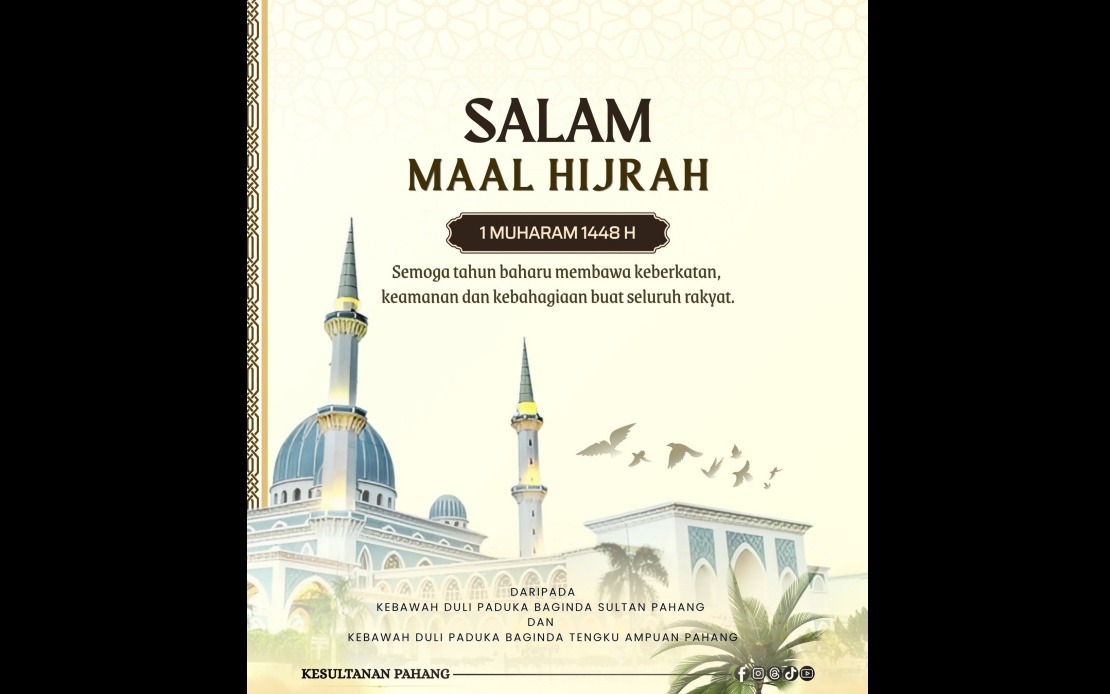
The Sultan of Pahang, Al-Sultan Abdullah Ri'ayatuddin Al-Mustafa Billah Shah, and the Tengku Ampuan of Pahang, Tunku Azizah Aminah Maimunah Iskandariah, have issued formal greetings marking the Islamic year 1448H, expressing aspirations for spiritual renewal across the state's Muslim population.
Through an official statement posted on the Kesultanan Pahang's social media channels, the royal couple conveyed their heartfelt wishes that the commencement of this lunar calendar year will usher in abundant blessings, tranquility and contentment for all inhabitants of the state. This gesture reflects the traditional role of the sultanate in providing spiritual leadership and setting the moral tone for the broader community during significant Islamic observances.
The Maal Hijrah celebration, which marks the Islamic new year, carries deep historical significance rooted in Prophet Muhammad's migration from Mecca to Medina. For many Malaysian Muslims, this occasion provides an opportunity to reflect on personal spiritual progress and recommit to religious principles, making the royal endorsement and encouragement particularly resonant during this period of introspection.
Pahang Menteri Besar Datuk Seri Wan Rosdy Wan Ismail similarly seized the occasion to communicate with constituents, framing the new Islamic year as a pivotal moment for the faithful to reassess their spiritual commitments. He encouraged Muslims throughout the state to view this threshold as a fresh starting point for intensifying their devotional practices, deepening their connection to Islamic teachings and expanding their charitable activities undertaken in pursuit of divine favour.
In his remarks, the Menteri Besar explicitly linked the observance to the foundational principles embodied in the Prophet Muhammad's Hijrah itself. He urged residents to embrace the transformative spirit underlying this historical migration by initiating meaningful personal and collective changes, emphasizing that such improvements should be directed toward noble objectives. The Menteri Besar's framing demonstrates how religious observances in Malaysia often intersect with civic messaging about social cohesion and state development.
The emphasis on strengthening communal bonds represents a significant dimension of how Malaysian leaders operationalise religious occasions. By invoking the values of unity and integrity during Maal Hijrah celebrations, both the royal household and state administration positioned the Islamic new year not merely as a personal spiritual exercise but as a catalyst for reinforcing the social fabric and collective commitment to shared prosperity. This approach reflects Malaysia's particular context as a Muslim-majority nation where Islamic observances carry dimensions extending beyond individual practice into the realm of national identity and governance.
The Menteri Besar's specific invocation of integrity and dedication to state development suggests an understanding that Maal Hijrah represents an appropriate moment for public officials to renew their own professional commitments and model ethical governance. His articulation of these principles during the occasion signals to the broader population that religious observance and responsible stewardship of public affairs are complementary rather than competing responsibilities. This messaging carries particular weight in Malaysian political culture, where leaders frequently anchor governance initiatives within Islamic ethical frameworks.
For Malaysian Muslims beyond Pahang, such official pronouncements from state and royal leadership typically serve as touchstones for broader reflective practice during the Islamic new year. The coordinated nature of greetings from multiple levels of government demonstrates how Maal Hijrah functions as an occasion for reinforcing hierarchical structures and shared values across administrative levels. Residents receive consistent messaging about the significance of the moment from their sultan, their chief administrator, and by extension, the broader apparatus of state authority.
The reference to seeking Allah's mercy and blessings in the context of state development illustrates how Malaysian Islamic practice frequently intersects with developmental nationalism. Religious devotion is framed not as withdrawal from worldly concerns but as a foundation for greater engagement in societal improvement, economic progress and collective well-being. This theological positioning has shaped Malaysian public discourse for decades, distinguishing the nation's particular approach to balancing religious observance with modernisation priorities.
Maal Hijrah 1448H arrives during a period when many Southeast Asian nations are navigating questions about the relationship between religious identity and national development. Pahang's leadership messaging reaffirms Malaysia's institutional commitment to positioning Islamic observances as occasions for recommitting to both spiritual discipline and civic responsibility. The prominence accorded to these greetings underscores the enduring centrality of Islam to Malaysian state identity and the importance placed on official guidance during significant religious moments. For Pahang residents and the broader Malaysian Muslim community, such coordinated encouragement from political and royal authorities reinforces the cultural and institutional significance of the Islamic calendar in shaping both individual practice and collective aspiration.