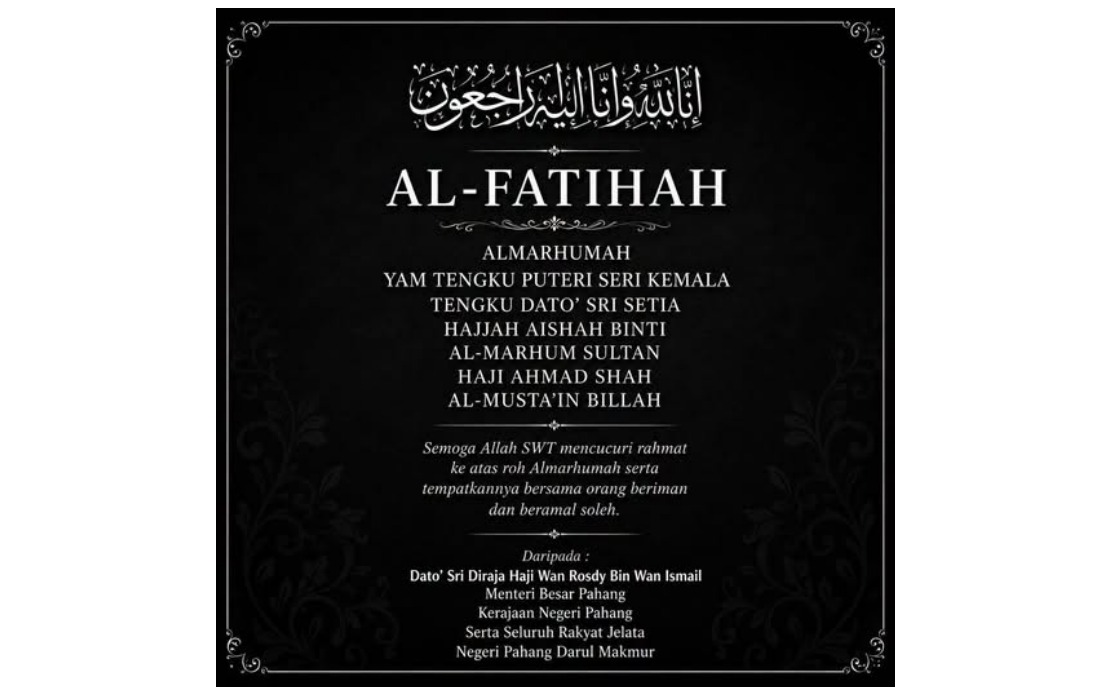
Pahang Menteri Besar Datuk Seri Wan Rosdy Wan Ismail has conveyed formal condolences following the death of Tengku Puteri Seri Kemala Tengku Datuk Seri Aishah, the elder sister of the Sultan of Pahang, who passed away on Tuesday evening at a hospital in Kuala Lumpur.
The Pahang state leader issued his statement through social media, acknowledging the significant loss experienced by the royal household. In his message, Wan Rosdy emphasised that the passing represented a profound bereavement not only for Sultan Al-Sultan Abdullah Ri'ayatuddin Al-Mustafa Billah Shah personally, but also for Tengku Ampuan Pahang Tunku Azizah Aminah Maimunah Iskandariah and the broader royal family of Pahang.
The timing of the announcement underscores the role of state leadership in providing official recognition during moments of royal loss. While the state government's formal role in royal ceremonies remains largely ceremonial, the Menteri Besar's public expression serves as an important bridge between the monarchy and the broader populace of Pahang, signalling the collective mourning of the state.
Tengku Datuk Seri Aishah expired at 9.15 pm on Tuesday evening at the Kuala Lumpur hospital facility. The funeral proceedings followed traditional protocols established for members of the royal household, with interment scheduled at the Pahang Royal Mausoleum located in Pekan.
In his condolence message, Wan Rosdy articulated a prayer invoking divine mercy upon the departed. The statement contained the traditional Islamic invocation requesting that Allah's compassion embrace her soul, absolve her of wrongdoing, accept her righteous actions, and grant her a place among the faithful and virtuous believers. This religious component reflects the integration of Islamic protocol within Malaysia's official state ceremonies and governmental expressions of sympathy.
The role of the Menteri Besar in expressing state-level condolences maintains an important institutional function within Malaysia's federal system of governance. While sovereignty over matters of royal protocol traditionally rests with the palace itself, the state executive's public acknowledgment of significant royal occurrences reinforces the constitutional relationship between the state administration and the monarchy. This practice ensures continuity between the administrative apparatus and the ceremonial functions of the throne.
Pahang, as one of Malaysia's constituent states with its own established royal house, maintains particular significance in the nation's constitutional framework. The Sultan of Pahang holds important ceremonial and constitutional responsibilities, and the broader royal family remains integral to the state's institutional identity. Deaths within the immediate royal circle consequently represent events of considerable constitutional and social importance throughout the state.
The funeral arrangements reflect the protocols typically observed for senior members of the Pahang royal household. The designation of Pekan as the burial location connects the deceased to the historical heart of Pahang's royal governance and administrative tradition. The Royal Mausoleum serves as the final resting place for significant figures within the state's ruling family, making it a site of considerable historical and dynastic significance.
Public expressions of grief from state officials following the deaths of royal family members represent a longstanding convention within Malaysian governance. These statements, while often relatively brief, carry substantial symbolic weight in affirming the bonds between the state administration and the monarchy. The Menteri Besar's role encompasses not merely administrative functions but also ceremonial and representational responsibilities that connect the government directly to the population during significant national and royal events.
The passing of Tengku Datuk Seri Aishah occurs within the broader context of Malaysia's established patterns of royal succession and family life. The state's recognition of such losses through official channels maintains important social cohesion and reaffirms the constitutional position of the monarchy within the peninsular states' governance structures. For Pahang specifically, such events emphasise the enduring significance of the royal institution within the state's contemporary political and social landscape.
The observance of traditional Islamic and Malay-Muslim protocols in funeral arrangements and official expressions reflects the integration of constitutional monarchy with Islamic governance principles that characterises Malaysian federalism. These practices ensure that state institutions operate in harmony with both secular administrative functions and religious and cultural traditions that remain fundamental to Malaysian society and governance.

