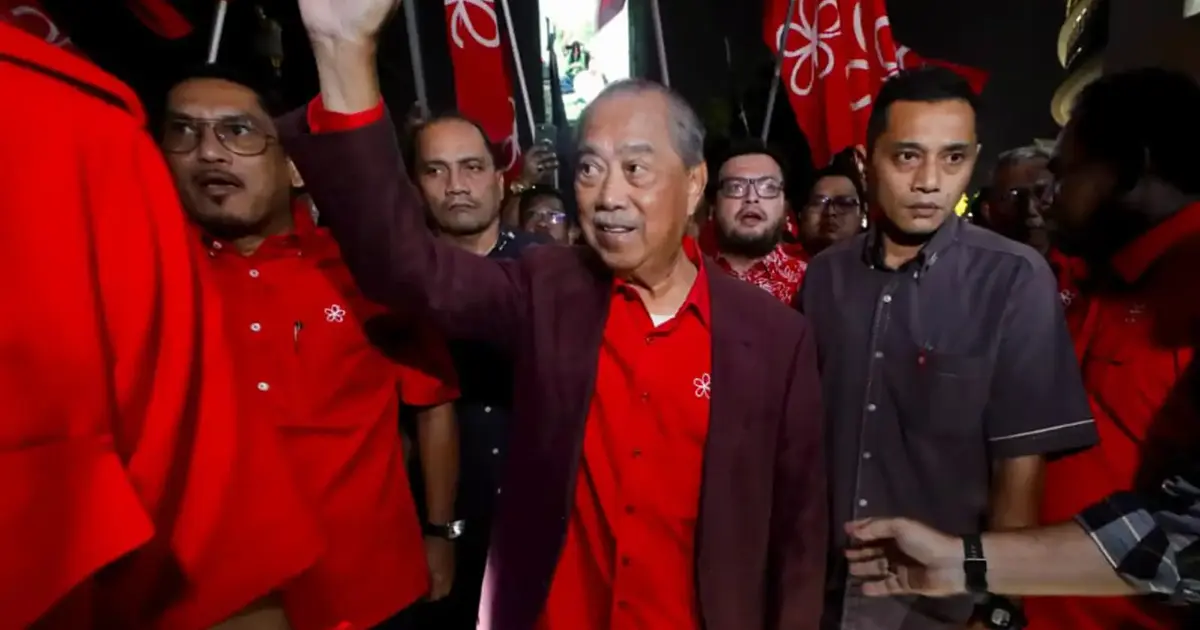
More than 200 Bersatu members gathered to demonstrate support for party leadership ahead of a significant internal meeting, signalling continued backing for party president Muhyiddin Yassin as the organisation navigates critical political decisions. The gathering reflects the party's attempt to project unity and mobilise grassroots enthusiasm during a period when internal cohesion has faced scrutiny from observers and rival factions.
The upcoming party meeting carries particular weight for Bersatu's future trajectory, as it will serve as a platform to strategise and coordinate efforts for the anticipated state elections in Johor and Negeri Sembilan. These electoral contests represent crucial opportunities for the party to strengthen its presence in key peninsular states and consolidate its standing within Malaysia's increasingly fragmented political landscape. Success or failure in these contests could significantly reshape the party's bargaining power within coalitions and its ability to influence national politics.
Bersatu's performance in regional politics has been closely watched, particularly given the party's evolution since its formation. Originally conceived as a vehicle for Muhyiddin's political ambitions following his departure from UMNO, the party has struggled to establish itself as an independent political force with substantial grassroots support across diverse constituencies. The rally demonstrates efforts to counter perceptions of weakness and reassure members that the leadership retains capacity to deliver electoral victories at the state level.
A second major agenda item involves clarifying and solidifying Bersatu's working relationship with PAS, an increasingly significant partner in Malaysia's Islamist political sphere. This alliance carries implications extending beyond Bersatu's immediate political interests, affecting broader coalition calculations and the trajectory of Islamist politics in the country. The nature of this partnership—whether it remains transactional or evolves into deeper structural integration—will influence how Bersatu positions itself relative to UMNO, PKR, and other major players.
The timing of this gathering and internal meeting is noteworthy given Malaysia's volatile political environment, where party-switching, coalition realignments, and leadership challenges have become routine occurrences. Bersatu has experienced its share of internal turbulence, with questions persistently raised about whether the party commands genuine grassroots loyalty or merely functions as an instrument for elite-level political manoeuvring. The show of support from over 200 members, while substantial, also underscores the modest scale of Bersatu's active membership compared to established parties like UMNO and PKR.
For Malaysian political observers, Bersatu's trajectory remains emblematic of broader transformations reshaping the country's party system. The party's attempts to build regional strongholds—particularly in Johor and Negeri Sembilan—must be understood against the backdrop of UMNO's continued dominance in rural and semi-urban Malay-majority constituencies. Bersatu's pitch to voters emphasises alternative leadership and distinct positioning within Malay-Muslim politics, though translating rhetorical appeal into sustained electoral performance remains persistently challenging.
The relationship with PAS warrants careful examination, as it reflects shifting alliances within Malaysia's Islamist political ecosystem. Both parties appeal to religiously-motivated voters and compete for support in constituencies with substantial Muslim majorities. Coordination between them could prove mutually beneficial in avoiding candidate splits that benefit secular opposition parties, yet collaboration also risks submerging Bersatu's distinct identity within a broader PAS-dominated Islamic political project. How party leadership navigates this tension will significantly shape electoral prospects in target states.
Negeri Sembilan and Johor represent strategically distinct challenges for Bersatu's expansion efforts. Negeri Sembilan, traditionally a competitive state where multiple parties maintain viable bases, offers opportunities for insurgent forces willing to invest organisational resources. Johor, conversely, remains UMNO's heartland despite recent erosion of its dominance, presenting a substantially steeper hill to climb. Success in either state would represent meaningful progress; success in both would signal genuine transformation of Bersatu's political capacity.
The mobilisation of party supporters also serves important internal functions beyond external signalling. Grassroots members require periodic reinforcement that their political investment remains worthwhile, particularly in a party lacking the institutional resources and historical depth of competitors. Rallies and mass gatherings fulfill psychological and organisational purposes, strengthening bonds between leadership and members while building momentum ahead of electoral campaigns.
Looking forward, observers should monitor whether the meeting produces concrete strategic outputs translating enthusiasm into institutional preparations. Meaningful discussions would address candidate selection processes, campaign resource allocation, messaging strategies tailored to regional contexts, and mechanisms for managing the PAS partnership without sacrificing Bersatu's organisational autonomy. The party's credibility depends on demonstrating that internal gatherings produce coherent action plans rather than serving purely as morale-boosting exercises.
For Southeast Asian political analysts, Bersatu's experience illustrates broader patterns observable across the region regarding the difficulties faced by newer parties attempting to displace established competitors and the precarious nature of personality-driven political organisations. Whether the party can evolve beyond its origins as a Muhyiddin vehicle into a durable institution commanding independent grassroots loyalty remains an open question with implications extending beyond Malaysia's borders. The coming state elections will provide important evidence regarding the party's viability and trajectory.