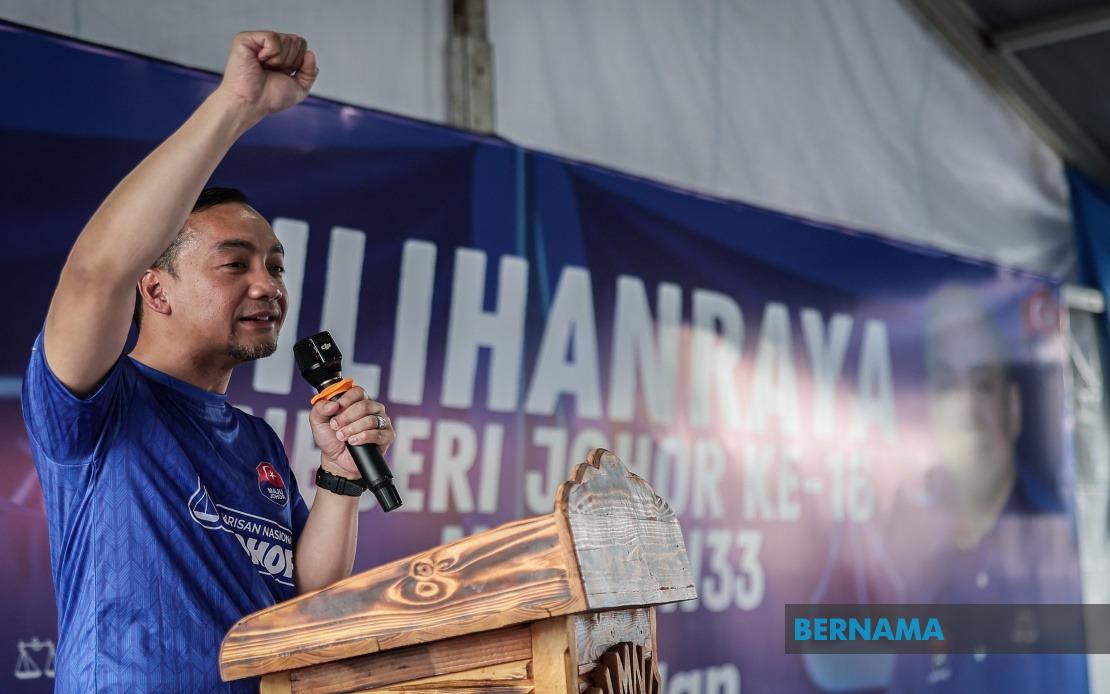
Barisan Nasional leadership is banking on buoyant grassroots enthusiasm in the Endau constituency to propel the coalition forward as polling approaches for the Johor state election on July 11. BN chairman Datuk Onn Hafiz Ghazi, who is also Johor's Menteri Besar, highlighted the exceptionally positive reception that local voters have extended to Alwiyah Talib, the coalition's candidate for the seat, describing the community engagement as notably heartening throughout the campaign trail.
Alwiyah, known colloquially as "Kak Awi", represents a significant tactical gain for BN in this contest. Her repositioning within the coalition carries symbolic weight for the broader Rumah Bangsa framework, a unifying concept championed by UMNO president Datuk Seri Dr Ahmad Zahid Hamidi that seeks to emphasise coalition cohesion and accommodate diverse political streams under one umbrella. This approach reflects BN's broader strategy to project an image of inclusivity and pragmatism, welcoming back figures who previously operated outside the coalition structure.
Onn Hafiz's remarks during the campaign event in Mersing underscored BN's narrative regarding Alwiyah's credentials as a proven administrator. Despite her prior association with the opposition, he stressed that her track record of community service remained unquestioned, and that such historical differences were immaterial compared to the shared objective of advancing Johor's interests. His comments suggest that BN is leveraging Alwiyah's defection as evidence of the coalition's appeal and stability, positioning the move as a natural realignment rather than a controversial recruitment.
The political lineage of the Endau seat itself provides instructive context for understanding its significance. Alwiyah originally won the constituency under the BN banner during the 14th General Election, before subsequently transferring her allegiance to Bersatu and contesting under the Perikatan Nasional banner in the 2022 Johor state election. That 2022 contest proved decisive, with Alwiyah securing a comfortable margin of 3,041 votes despite a five-way split in the electoral contest, demonstrating her personal political appeal transcends party affiliation and organisational machinery.
The machinery mobilisation across both Endau and the neighbouring Tenggaroh constituency signals BN's commitment to consolidating state-level control. Onn Hafiz's observation that party structures appear comprehensively organised and motivated carries operational significance, as grassroots efficiency often determines electoral outcomes in tightly-contested regional contests. The presence of Tenggaroh's BN candidate, Mohd Youzaimi Yusof, at the campaign event underscores the coalition's strategy of presenting a unified front across multiple constituencies in the Mersing area.
For Malaysian political observers and regional analysts, the Endau race exemplifies the fluid nature of coalition politics in Malaysian state elections. Unlike federal elections, which tend toward more rigid tribal loyalties, state contests frequently accommodate cross-party movement by candidates perceived to command significant local constituencies. Alwiyah's trajectory illustrates how individual political entrepreneurs can navigate changing alignments while maintaining electoral viability, a phenomenon particularly pronounced in constituencies with strong personalised voting patterns.
The timing of the campaign activity also reflects electoral calendar pressures. With polling scheduled for July 11 and advance voting arranged for July 7, the campaign window remains compressed, necessitating intensive ground engagement in the fortnight preceding the election. BN's emphasis on sustained momentum suggests the coalition believes the trajectory of voter sentiment remains favourable and requires reinforcement rather than last-minute intensive mobilisation.
Onn Hafiz's characterisation of the campaign environment as proceeding smoothly without significant incidents carries undertones regarding the political climate more broadly. In a Malaysian context where electoral campaigns occasionally generate friction between competing coalitions, his noting of peaceful proceedings serves a dual function: reassuring BN stakeholders of campaign safety whilst implicitly contrasting BN's conduct with any putative disorder from opponents. Such framing, though subtle, contributes to broader narratives about governance competence and political maturity.
The Rumah Bangsa concept invoked by Onn Hafiz represents an evolving BN positioning strategy at state level. Rather than emphasising Barisan's historic role as a stable governing coalition, the concept foregrounds flexibility, renewal, and inclusive politics—messaging designed to counter perceptions of a geriatric, inflexible political structure. Alwiyah's recruitment into this narrative serves as a practical demonstration that Rumah Bangsa extends beyond rhetorical flourish to encompass actual political reorganisation.
For Johor specifically, retaining or expanding BN's state legislative presence carries implications beyond regional administration. Johor represents one of Malaysia's most economically consequential states, and the state government's partnership orientation toward federal authorities and private investment flows substantially from coalition stability. Electoral outcomes in Johor consequently resonate across Malaysia's corporate and financial sectors, making constituencies like Endau consequential far beyond their direct electorate size.
The confluence of Alwiyah's defection, demonstrated electoral credibility, local community reception, and BN's organisational readiness collectively construct a narrative of coalition momentum entering the final campaign fortnight. Whether this optimism translates into victory across multiple constituencies will ultimately determine whether Onn Hafiz's confidence reflects genuine competitive advantage or aspirational leadership rhetoric. The July 11 election will provide definitive evidence regarding the authentic depth of voter sentiment toward BN's Johor agenda and the coalition's ability to mobilise that sentiment into legislative seats.

