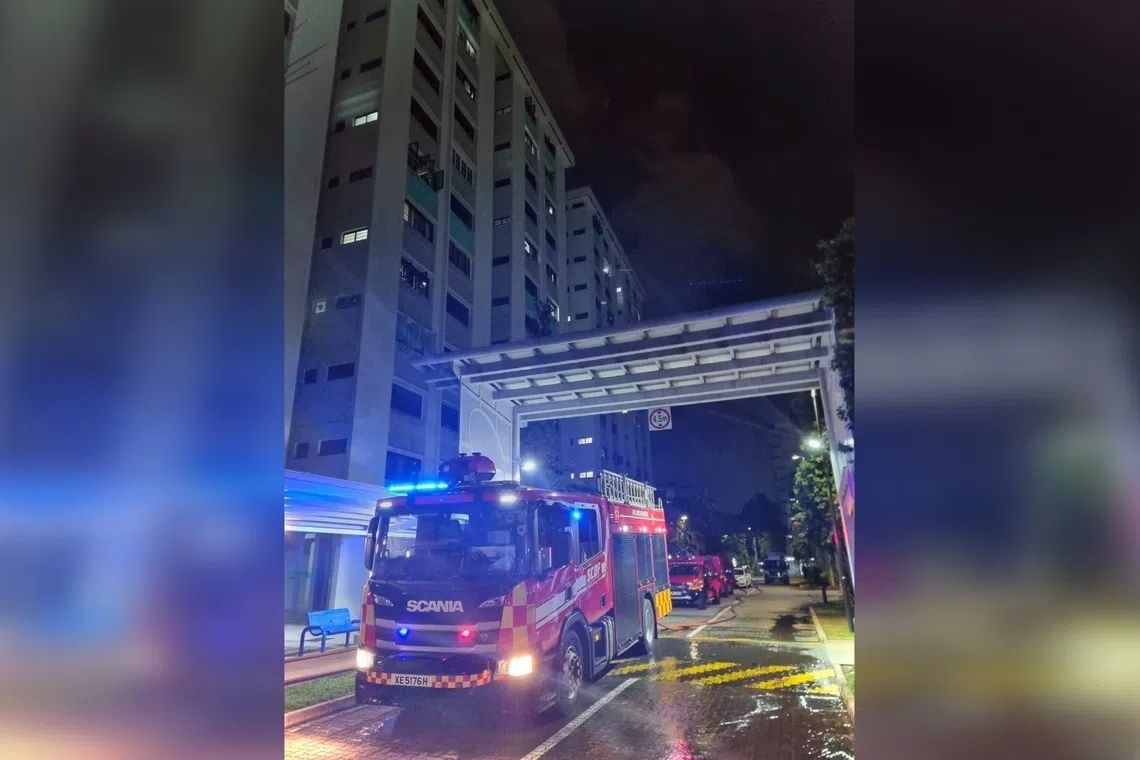
Singapore's Clementi neighbourhood experienced a tragic residential fire late on Friday evening when flames erupted in an eighth-floor unit at Block 309 Clementi Avenue 4, resulting in one fatality and injuries to emergency personnel. The Singapore Civil Defence Force received the alarm shortly after 11.10pm on July 31, and firefighters discovered active flames consuming furnishings in the living room upon arrival at the scene.
According to Holland-Bukit Timah GRC Member of Parliament Sim Ann, who represents the affected area, the victim was discovered unconscious in the kitchen and was rushed to Ng Teng Fong General Hospital, where the person was subsequently pronounced dead. Initial findings suggest the deceased resident had been living alone in the unit, adding to the tragedy of the incident. Emergency responders had to force entry into the flat to access the fire and bring out the trapped occupant.
The firefighting operation itself proved challenging and hazardous for emergency personnel. Crews deployed two water jets to contain and extinguish the blaze, which had taken hold of multiple items within the living room space. The physical demands and heat exposure of the operation took a toll on two firefighters, both of whom sustained burn injuries requiring medical attention at Singapore General Hospital. One of the injured firefighters was later discharged and sent home to recover, while the condition of the second firefighter remained under observation at the time of reporting.
Neighbouring residents faced disruption as a precautionary measure, with approximately 40 occupants from the building evacuated by police and civil defence personnel. However, the evacuation proceeded relatively smoothly, and most residents were permitted to return to their homes by 1.30am on August 1, suggesting that structural integrity and safety concerns were quickly assessed. Sim, who also holds the portfolios of Second Minister for Foreign Affairs and Second Minister for Home Affairs, confirmed that damage to other residential units and common property remained limited in scope.
The response to the incident drew praise from the MP, who publicly acknowledged the contribution of multiple agencies and community groups. Her commendation extended to the Singapore Civil Defence Force, police personnel, resident volunteers, the People's Association, and town council workers whose coordination facilitated the evacuation and recovery process. Such interagency collaboration represents standard procedure in Singapore's emergency response framework, though the coordination's effectiveness in this instance allowed residents to resume normal activities within hours.
Sim also indicated that the Housing and Development Board and local authorities would provide support to residents whose dwellings or personal possessions were damaged by the fire. This commitment reflects established protocols for assisting affected residents in public housing estates, a consideration that becomes especially important given Singapore's dense residential environment and the significant number of families living in such units.
The cause of the fire remains under investigation, with authorities yet to determine how the flames originated within the living room. Such investigations typically examine electrical systems, cooking equipment, smoking materials, and other potential ignition sources. The determination of causation will be critical not only for understanding this specific incident but potentially for implementing preventive measures across similar housing configurations.
This fatal fire occurs against the backdrop of concerning upward trends in Singapore's fire statistics. The Civil Defence Force released annual data in February indicating that both the frequency and human cost of fires have intensified. Comparing 2024 and 2025 figures reveals a three per cent increase in overall fire incidents, climbing from 1,990 to 2,050 cases respectively. More alarmingly, the number of people injured in fires has risen sharply, increasing from 80 to 94 during the same period, suggesting fires are becoming more severe or affecting more occupants per incident.
Fatality statistics similarly demonstrate cause for concern, with fire deaths declining marginally from seven in 2024 to six in 2025. While the slight decrease might suggest marginal improvement, the persistence of fatal fire incidents in a developed city-state with advanced emergency services highlights the persistent risks posed by residential fires. The Clementi incident exemplifies how rapidly fire can overwhelm a single occupant, particularly when the person is alone and may be incapacitated by smoke inhalation or flames before rescue becomes possible.
For Malaysian readers and regional observers, Singapore's experience underscores the vulnerability of high-density residential environments to fire hazards. Many Southeast Asian cities share similar building configurations and occupancy patterns, suggesting that lessons from Singapore's fire prevention and emergency response systems merit careful study. The region's rapid urbanisation has created numerous HDB-equivalent housing developments across countries including Malaysia, where comparable risks exist.
The incident also highlights the human dimensions of emergency response work, with firefighters routinely exposing themselves to life-threatening conditions. The injuries sustained by the two personnel in this operation represent occupational hazards that emergency services personnel accept as part of their professional duties. Their injuries, though survivable in this instance, underscore the physical dangers inherent in firefighting operations.
Looking forward, the investigation into the Clementi fire's origin will likely inform further refinements to fire prevention codes and emergency protocols across Singapore's public housing stock. Residents, particularly those living alone in high-rise units, may face recommendations regarding smoke detector maintenance, escape route familiarity, and early evacuation procedures. The tragedy serves as a sobering reminder of residential fire risks and the importance of preparedness in densely populated urban settings.

