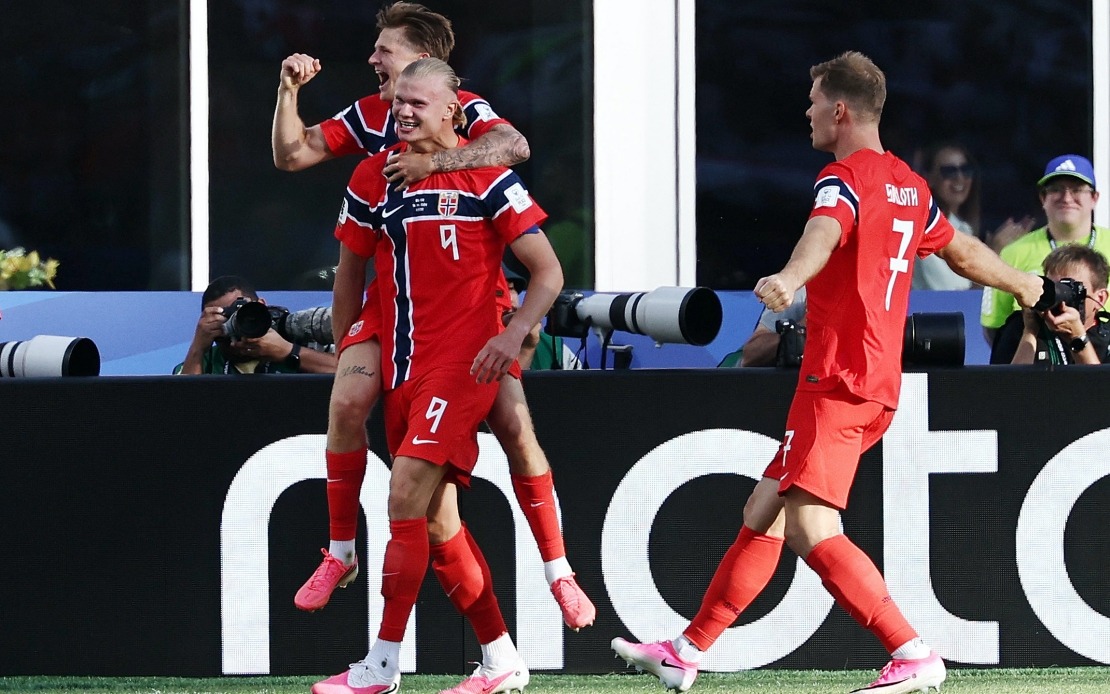
Norway's World Cup campaign carries a distinctive narrative thread running through its roster: three of its key players are sons of men who represented the nation in the 1994 tournament held in the United States. Erling Haaland, Alexander Sørloth, and Kristian Thorstvedt are driven by a shared desire to complete what their fathers could not—a run beyond the opening group matches. Their inherited motivation adds layers of intrigue to Norway's push for knockout stage qualification, particularly as the squad demonstrated considerable promise with a commanding 4-1 victory over Iraq in their opening fixture.
The historical parallel is striking and emotionally resonant for Norwegian football. The 1994 generation, which included Alf-Inge "Alfie" Haaland, Gøran Sørloth, and Erik Thorstvedt, departed the tournament at the group stage after failing to accumulate sufficient points to progress. For the sons now carrying forward their respective family legacies, the opportunity to exceed that achievement represents not merely a sporting objective but a chance to honour and surpass the accomplishments of the previous generation. This generational arc within international sport speaks to how football ambitions are often transmitted through family lines, with sons growing up hearing stories and lessons from fathers who once stood on the world's largest stage.
Erling Haaland, Manchester City's prolific striker and undoubtedly Norway's preeminent talent, has become something of a media focal point given his global prominence in club football. When presented with photographs of his father from the 1994 campaign, Haaland's reaction carried an endearing lightness—remarking on his father's youthful appearance and notably long hair at the time. The visual contrast between the young Alfie of three decades past and the contemporary footballing landscape underscores how much has changed, yet the fundamental drive to represent one's nation at the World Cup remains timeless. Haaland's trajectory has mirrored his father's path in certain respects, most notably through his employment by Manchester City, suggesting a continuity in the pursuit of excellence at sport's highest level.
While Haaland commands significant attention, the supporting cast proves equally significant to Norway's ambitions. Alexander Sørloth, currently plying his trade at Atletico Madrid, has expressed profound gratitude for his father's influence on his development as a footballer. In recent comments, Sørloth reflected on the privilege of participating in a World Cup as his father did, acknowledging that his father "has taught me everything I know about football." This sentiment transcends mere sentiment; it speaks to a deliberate transmission of footballing knowledge, tactical understanding, and professional discipline across generations. Sørloth's earliest World Cup memory originated not from personal participation but from watching the 2002 tournament in Japan and South Korea while holidaying in Denmark with his family—a memory suffused with excitement at witnessing the global spectacle alongside his father.
The upcoming fixture against Senegal on Monday provides an immediate opportunity for Norway to secure advancement to the knockout rounds, though the match itself carries logistical significance for another reason. Royal attendance is anticipated, with hereditary Princess Ingrid Alexandra and Prince Sverre Magnus—children of Crown Prince Haakon and Crown Princess Mette-Marit—expected to be present in New Jersey. Such royal patronage reflects the intense national investment in the campaign and underscores how Norwegian football has transcended the sporting realm to become a matter of genuine national cultural pride.
Norwegian supporter culture has similarly embraced the tournament with distinctive enthusiasm. A particular fan tradition rooted in Viking heritage has gained sufficient momentum to permeate even the corridors of Norwegian parliamentary power. Members of parliament, setting aside partisan divisions, collectively participated in a public display of support for the national team on Thursday—a remarkable instance of legislative body members uniting behind a sporting endeavour. This cross-party solidarity suggests that the national team functions as a unifying force within Norwegian society, capable of transcending typical political fractures.
The World Cup format requires Norway to navigate a challenging path ahead. Following the Senegal encounter, the team faces top-tier opposition in the form of France to complete their group stage obligations. France's presence in the group significantly elevates the difficulty of qualifying for the knockout stage, though Norway's strong opening performance against Iraq demonstrates capacity for producing competitive results against quality opposition. The mathematical and tactical complexities of group stage football mean that progression is far from assured, despite the early victory.
For Malaysian and Southeast Asian observers, the Norwegian campaign presents several points of interest beyond mere sporting competition. The generational narrative reflects universal football experiences—the desire of sons to honour paternal achievements while establishing their own legacies. Additionally, the integration of royal figures and parliamentary institutions into sporting support offers comparative perspective on how different nations mobilise their institutional structures around national teams. As a region where football commands passionate following and family legacies in the sport span multiple generations, the Malaysian audience can readily identify with the emotional and cultural dimensions of the Norwegian story.
The convergence of individual talent, inherited motivation, and national expectation creates compelling drama as Norway progresses through the tournament. Whether Haaland, Sørloth, Thorstvedt, and their teammates ultimately surpass their fathers' achievements remains uncertain, but the very attempt transforms their World Cup into something beyond conventional tournament participation—it becomes a story of generational succession, family pride, and the transmission of ambition across time. The outcome will reverberate not merely through Norwegian football but through the personal histories of three families whose connection to the sport spans decades.

