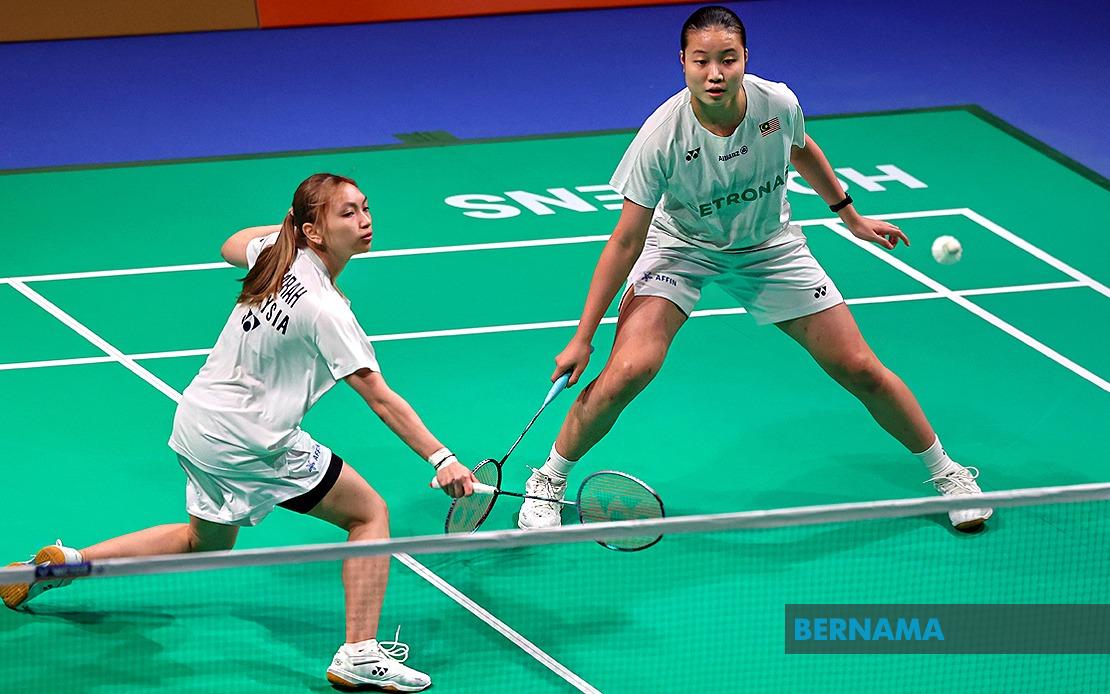
Malaysia's teenage badminton sensation Noraqilah Maisarah Ramdan and her partner Low Zi Yu are embracing a deliberate, step-by-step strategy as they work towards breaking into the world's elite rankings. Rather than chasing immediate breakthroughs into the sport's uppermost echelon, the pair have anchored their near-term ambitions on a more attainable milestone: cracking the top 50. At just 18 years old, Noraqilah's measured outlook reflects a maturing approach to competitive sport that prioritises sustainable development over premature pressure.
The decision to set incremental targets stems from a recognition that long-term success in women's doubles badminton requires building momentum gradually. While the top 32 ranking carries significant competitive advantages—particularly in tournament access and seeding for major events—Noraqilah has made clear that consolidating their current standing remains the priority. This philosophy contrasts sharply with the impatience that sometimes grips young athletes eager to prove themselves on the international stage. By focusing on progressive improvement rather than dramatic leaps, the partnership hopes to establish sustainable competitive foundations that will eventually propel them towards the elite rankings they aspire to reach.
Currently positioned at 70th in the world rankings, Noraqilah and Zi Yu have already begun demonstrating marked improvement in their ability to compete against higher-seeded opponents. The tactical refinement has become evident in their recent performances, where they have begun to impose genuine pressure on tennis pairings from badminton powerhouses they previously struggled to match. This incremental progress, while perhaps less dramatic than sudden breakthroughs, represents the kind of consistent development that typically characterises the most durable careers in professional badminton.
A particularly telling indicator of their advancement came during the Australian Open, where the Malaysian pair managed to defeat Taiwan's Hsieh Pei Shan and Hung En Tzu, a combination currently ranking eighth globally. This result carries significance beyond the immediate match outcome, as it demonstrates their ability to execute tactical plans and maintain composure against world-class opposition. For a partnership still in the early stages of their international trajectory, such victories against top-10 ranked teams provide both confidence and practical evidence of progress.
Noraqilah's observation about the quality of their opposition engagement over recent months reveals the tactical sophistication that distinguishes improving partnerships. Two months prior to the Australian Open encounter, the same Malaysian pairing had faced the Taiwanese team without achieving comparable results. The ability to perform substantially better in a rematch illustrates how consistent training, match analysis, and strategic refinement translate into tangible competitive gains. In badminton's technical environment, where court positioning, net play, and service strategy determine outcomes, such measurable improvements reflect genuine mastery development rather than fortune or random variation.
The partnership between Noraqilah and Zi Yu also represents an encouraging sign for Malaysian badminton's depth in women's doubles, a category where the nation has historically fielded competitive teams but struggled to consistently place representatives in world top rankings. Youth development programmes across Malaysian sporting agencies have increasingly focused on identifying talent early and nurturing capabilities through structured progression, and this pairing exemplifies that investment bearing fruit. Their pragmatic targeting of intermediate rankings rather than fantasy-league ambitions suggests coaching staff and the athletes themselves have internalised lessons about sustainable progression.
From a regional perspective, the emergence of competitive young Malaysian pairings carries implications for Southeast Asian badminton dynamics. Indonesia, Thailand, and Vietnam all maintain strong women's doubles programmes, and Malaysian success in this arena requires not only individual improvement but also ability to accumulate ranking points consistently across multiple tournaments. The top 50 breakthrough that Noraqilah and Zi Yu target would position Malaysia more prominently within regional competition hierarchies and strengthen qualification prospects for major tournaments including Southeast Asian Games and Commonwealth Games competitions.
The coaching philosophy evident in their approach—emphasising step-by-step advancement rather than heroic jumps—also reflects evolving understanding of athlete development in racquet sports. Research in sports science increasingly validates the superiority of incremental improvement models over aggressive target-setting that can produce psychological strain and performance plateaus. By psychologically anchoring themselves to achievable near-term goals while maintaining awareness of longer-term potential, athletes paradoxically often exceed distant targets more reliably than those who fixate obsessively on them.
Looking forward, the immediate focus for Noraqilah and Zi Yu remains clear: accumulating ranking points through consistent tournament participation, refining tactical patterns against varied opposition styles, and maintaining the physical conditioning necessary to compete at international standard. The pathway to the world top 32 inevitably follows from securing their top 50 position, and the pair's realistic framing suggests they understand that rushing this progression typically produces disappointment. For Malaysian badminton enthusiasts monitoring their development, the next 12 to 18 months will prove crucial in determining whether this partnership fulfils the considerable promise their recent performances have suggested.

