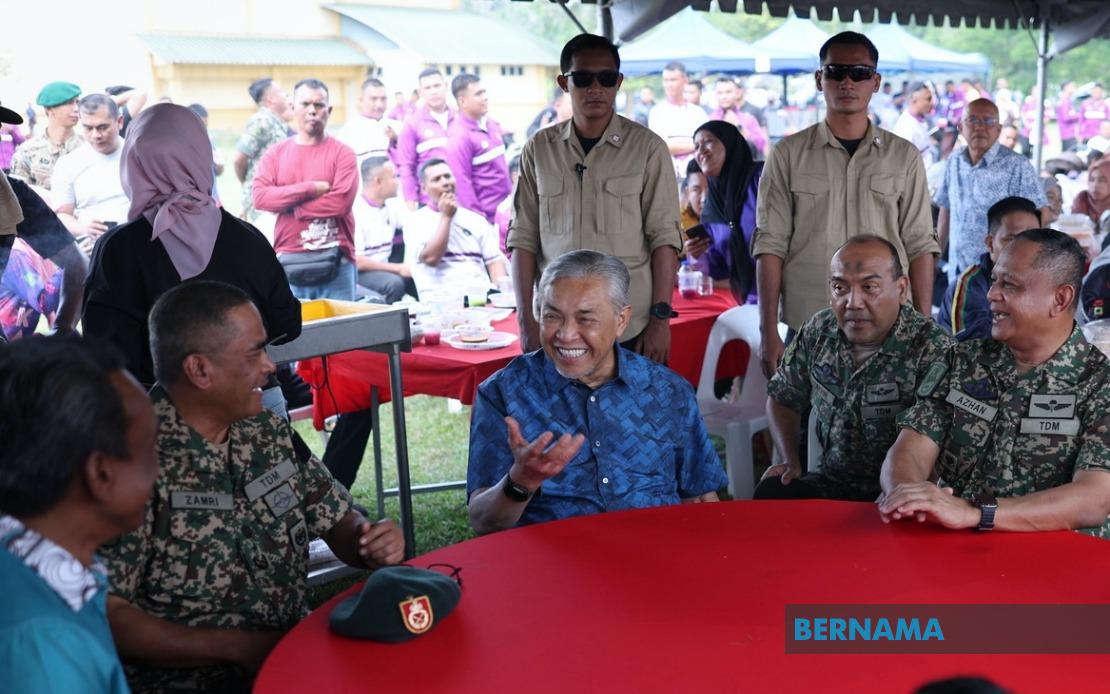
Deputy Prime Minister Datuk Seri Dr Ahmad Zahid Hamidi has made clear that the impending release of the Royal Commission of Inquiry report on Lembaga Tabung Haji will not shield anyone from legal accountability, regardless of their position or prominence. Speaking at an Armed Forces gathering in Gemas, Negeri Sembilan, the UMNO president and Barisan Nasional chairman underscored the government's determination to pursue wrongdoing through established legal channels should the RCI findings reveal misconduct.
Ahmad Zahid's remarks come as the Cabinet prepares to consider whether to publicly release the long-awaited RCI report, a document that has generated considerable speculation about potential implicated figures within government and financial circles. His emphasis on the rule of law reflects broader government messaging aimed at demonstrating resolve against corruption and institutional abuse, particularly as the administration faces scrutiny over its handling of major public institutions.
The Deputy Prime Minister outlined a comprehensive framework for addressing any irregularities that the RCI investigation might uncover. He indicated that should the report document instances of abuse of power, financial irregularities, criminal breach of trust, or other forms of malpractice, the government possesses multiple avenues for enforcement including police reports, commercial crimes investigations, and broader legal proceedings. This layered approach suggests the government anticipates potentially serious findings that may warrant action across several investigative and prosecutorial agencies.
Transparency emerged as a central theme in Ahmad Zahid's statement, with the minister repeatedly stressing that the RCI findings must be disclosed openly to the public. This position aligns with Prime Minister Datuk Seri Anwar Ibrahim's earlier indication that the Cabinet would likely approve public release of the report. The emphasis on openness represents a departure from the previous administration's approach, which had delayed the report's publication citing concerns that public disclosure might undermine confidence in Tabung Haji as a financial institution serving millions of Malaysian pilgrims and investors.
The timing of these statements carries particular significance given that Negeri Sembilan is currently in election mode, with early voting scheduled for late July and polling day set for August 1. Opposition figures and analysts have speculated that the release of the RCI report could influence voter sentiment, particularly if it reveals systematic mismanagement or corruption within government-linked institutions. However, Ahmad Zahid dismissed such concerns, expressing confidence that Negeri Sembilan voters possess the maturity and wisdom to make electoral decisions based on broader considerations rather than being swayed by the contents of an investigative report.
Prime Minister Anwar Ibrahim's earlier comments provided additional context for the government's shift toward transparency. Anwar, who also holds the Finance Ministry portfolio and thus direct responsibility for Tabung Haji, explained that the previous administration's reluctance to publicise the RCI findings stemmed from anxiety about institutional credibility. At that time, Tabung Haji faced significant operational and financial challenges that required careful management of public perception. However, Anwar indicated that circumstances have materially changed, with the institution now having undergone strengthening measures and achieved international recognition for its reforms and governance improvements.
This assessment reflects the government's argument that Tabung Haji has been placed on a more stable footing through recent interventions, making the institution sufficiently robust to withstand public scrutiny of its past operations. The backdrop includes substantial restructuring efforts and enhanced oversight mechanisms implemented over recent years, alongside international auditing and compliance reviews that have validated operational improvements. From this perspective, releasing the RCI report becomes less a threat to institutional stability and more an opportunity to demonstrate transparency and commitment to accountability.
The Royal Commission of Inquiry was established to investigate governance, financial management, and operational issues within Tabung Haji spanning a defined historical period. The investigation has examined alleged irregularities, questionable investments, and management decisions that may have contributed to the institution's earlier difficulties. For many Malaysians, particularly pilgrims who have entrusted savings to Tabung Haji for Hajj purposes, the RCI report represents an opportunity to understand what transpired and whether those responsible for any wrongdoing will face consequences.
Ahmad Zahid's reaffirmation that no one stands above the law carries weight given his own position as a senior government figure and UMNO leader, the party that governed Malaysia for decades before the 2018 electoral transition. The statement thus implicitly acknowledges the possibility that individuals from the previous administration or from within the current establishment could face legal action if implicated in the report. Such transparency in messaging, whether politically calculated or genuine, represents an important marker of how the current administration intends to manage expectations around a potentially controversial document.
The broader context involves Malaysia's ongoing struggle with institutional accountability and public trust. The 1Malaysia Development Berhad scandal and subsequent investigations established precedents for pursuing high-ranking officials when evidence of malfeasance emerged, lending credibility to official assurances that position offers no immunity. However, Malaysians have also witnessed instances where powerful figures navigated the legal system with apparent advantages, creating public cynicism about whether equal justice truly applies across social strata.
For regional observers, the handling of the Tabung Haji report offers insights into Malaysia's current governance trajectory and commitment to institutional reform. Southeast Asian nations increasingly face investor and international scrutiny regarding transparency, financial governance, and anti-corruption measures. Malaysia's approach to the RCI report—whether it delivers genuine accountability or becomes another episode of managed disclosure—will signal to both regional and international audiences the seriousness of the government's reform agenda.
The Cabinet's imminent consideration of whether to release the RCI report publicly marks a critical juncture. Should the government proceed with full transparency, it will demonstrate genuine commitment to accountability principles that extend even to potential high-ranking figures. Conversely, any redactions, delays, or selective disclosure could reinforce perceptions that institutional protection trumps individual accountability. The government's public positioning through statements by Ahmad Zahid and Anwar Ibrahim has largely foreclosed the option of indefinite secrecy, creating expectations that the report will indeed be made public in substantive form.

