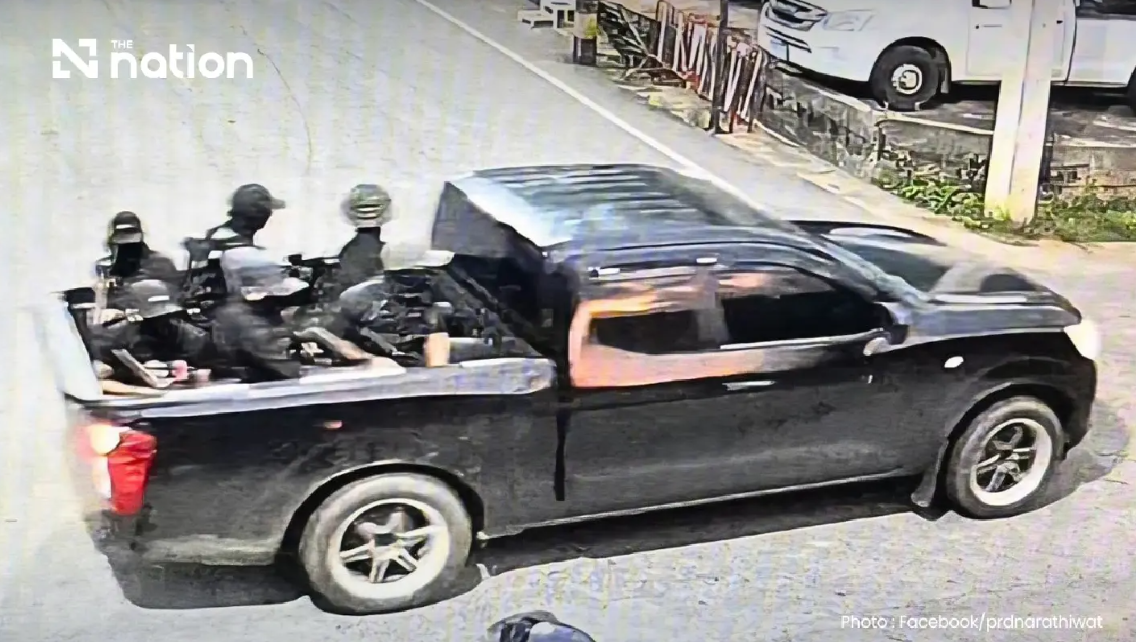
Nine attackers operating in two distinct teams carried out a devastating raid on the Bukeh Sami checkpoint in Narathiwat's Ra-ngae district on the evening of July 22, killing five paramilitary rangers and leaving six civilians injured in a coordinated assault lasting just 90 seconds. Security footage later contradicted initial police assessments that six people were involved, revealing instead a larger, more organised operation that suggests considerable planning and tactical coordination among the perpetrators.
The checkpoint, which sits in Village 7 of Tanyong Mat subdistrict and is staffed by the 4509th Ranger Company under the 45th Ranger Regiment Task Force, came under assault at approximately 6.45pm. A black Nissan pickup truck registered in Songkhla entered the area from the direction of Tanyong Mat market, slowing as it approached the position where three rangers stood guard at the roadside. Within moments, six men in the truck bed, dressed in black clothing that resembled paramilitary uniforms and broad-brimmed hats that obscured their identities, opened fire with M16 and AK-type rifles at close range. Those initial volleys brought down the three checkpoint guards before the vehicle stopped and additional members of the assault team dismounted to deliver suppressing fire towards the fortified bunker where two other rangers had taken positions.
The second team, consisting of two operatives on a red-and-white Honda Wave motorcycle, functioned as a rearguard element during the approach and subsequent withdrawal. The driver wore a white shirt and helmet and carried an 11mm pistol, while his passenger, disguised in a black women's hijab, wielded an AK-type rifle. This secondary unit provided crucial covering fire as the primary assault team conducted what appeared to be a deliberate search of the checkpoint, targeting weapons and equipment that were subsequently removed from the scene. The deliberate nature of the search suggests the attackers had prior knowledge of the checkpoint's layout and inventory.
As the raiders retreated from the compound, one attacker threw a pipe bomb towards an elevated structure adjacent to the bridge beside the checkpoint, adding an explosive component to what was already a heavy-weapons assault. Both vehicles then fled in the direction of Dusongyo subdistrict, leaving behind a scene of considerable violence. All five ranger casualties—Sergeant Major First Class Theerayut Somakerd, ranger volunteers Sakiriya Jena, Wimon Dabthong, Nattasit Kaewsena and Salahuding Pi—were killed at the location. Six civilians also sustained injuries during the attack, among them a ten-year-old boy, with wounded individuals transferred to regional medical facilities.
Forensic examination by combined security forces working through the night revealed the scale of firepower deployed during those 90 seconds of combat. More than 100 spent cartridge cases lay scattered across the checkpoint approaches and immediate vicinity, the debris field itself providing forensic investigators with a detailed record of the engagement. Ammunition casings associated with M16 rifles, AK-type weapons, and an 11mm pistol were recovered, along with additional rounds that appeared to have been expelled when the attackers cleared weapon malfunctions—a detail suggesting the team maintained discipline despite the intensity of the engagement. The checkpoint's concrete bunker bore obvious testimony to the assault, its walls and firing positions pockmarked with bullet impacts from multiple angles.
The inventory of weapons and equipment removed from the checkpoint reflected an apparent targeting of specific materiel. Investigators catalogued the loss of four folding-stock AK-type rifles, one 11mm pistol, and four ammunition magazines, along with four bulletproof vests. Security officials cautioned that the precise accounting remained incomplete as initial reports provided differing details regarding both the quantity and specification of items taken. This variation in details suggests the incident's immediate aftermath involved some confusion among survivors and witnesses, though the overall pattern—selective removal of functional weapons and protective equipment—indicates the attackers knew exactly what they were seeking.
The tactical execution of the assault demonstrated what security analysts would recognise as hallmarks of professionally planned operations. The use of two distinct teams with separate functions, the apparent pre-attack reconnaissance evident in the targeted nature of the weapon selection, the engagement timing that allowed minimal opportunity for organised defensive response, and the coordinated withdrawal through pre-planned escape routes all suggest planning beyond the capacity of spontaneous extremist action. The attackers' choice of vehicles—one registered locally in Songkhla, suggesting familiarity with the cross-border transportation network—and the deliberate destruction of the primary assault vehicle through burning indicate attempts to eliminate evidence and complicate identification and pursuit.
Narathiwat Governor Boonchuay Homyamyen arrived at the scene to oversee the overnight investigation, accompanied by senior military and police leadership including Provincial Police Region 9 commissioner Pol Lt Gen Piyawat Chalermsri, Narathiwat police chief Pol Maj Gen Prayong Khot Sakha, and Col Witthaya Sariya commanding the 45th Ranger Regiment Task Force. The gathering of such senior figures underscored the gravity officials attached to the incident. Bomb-disposal specialists, tactical police units, and forensic teams coordinated their efforts through the night to preserve evidence and reconstruct the sequence of events. Security forces simultaneously established checkpoints and roadblocks along suspected escape corridors in an attempt to intercept the fleeing attackers, though the timing of their deployment and the pre-planned nature of the assault suggested the perpetrators had anticipated such responses.
The incident occurs against the backdrop of Thailand's persistent security challenges in its southern border provinces, a region where separatist insurgency and criminal networks have long created an unstable security environment. The professionalism and coordination evident in this assault distinguish it from typical violence in the region, suggesting either a significant escalation in militant capability or the involvement of external actors with enhanced training and resources. For Malaysia and other Southeast Asian nations, the incident underscores the cross-border nature of security threats in the region and the challenges posed by armed groups capable of conducting sophisticated military-style operations across national boundaries. The stolen weapons and equipment may now circulate through networks extending beyond Thailand's borders, with potential implications for stability across the region.
The initial confusion regarding casualty figures—reports varying from two to five injured civilians before settling on six—reflects the chaotic immediate aftermath of such incidents and the challenges security forces face in rapidly assessing complex attack scenes. However, the consistency of the five ranger fatalities and the methodical forensic examination that followed demonstrated the authorities' commitment to establishing an accurate record of events. Investigators continued examining full inventory details as multiple initial accounts provided conflicting information about items missing from the checkpoint, suggesting that comprehensive damage assessment in an active military environment requires time and coordination across multiple agencies and levels of command.
The strategic implications of this attack extend beyond the immediate loss of life and equipment. The apparent targeting of a ranger checkpoint suggests the perpetrators' focus on degrading state security capacity in the province. Rangers represent a critical component of Thailand's counterinsurgency apparatus in the south, operating as both security forces and intelligence assets. The successful removal of weapons, ammunition, and protective gear means that capabilities intended for state security operations have been placed in the hands of non-state actors, potentially shifting the military balance in localised areas. The symbolic dimensions of such an attack—demonstrating the ability to strike protected military positions and escape with weapons and personnel—carry significant weight in the internal dynamics of separatist movements and may influence recruitment and morale among various armed groups operating in the region.

