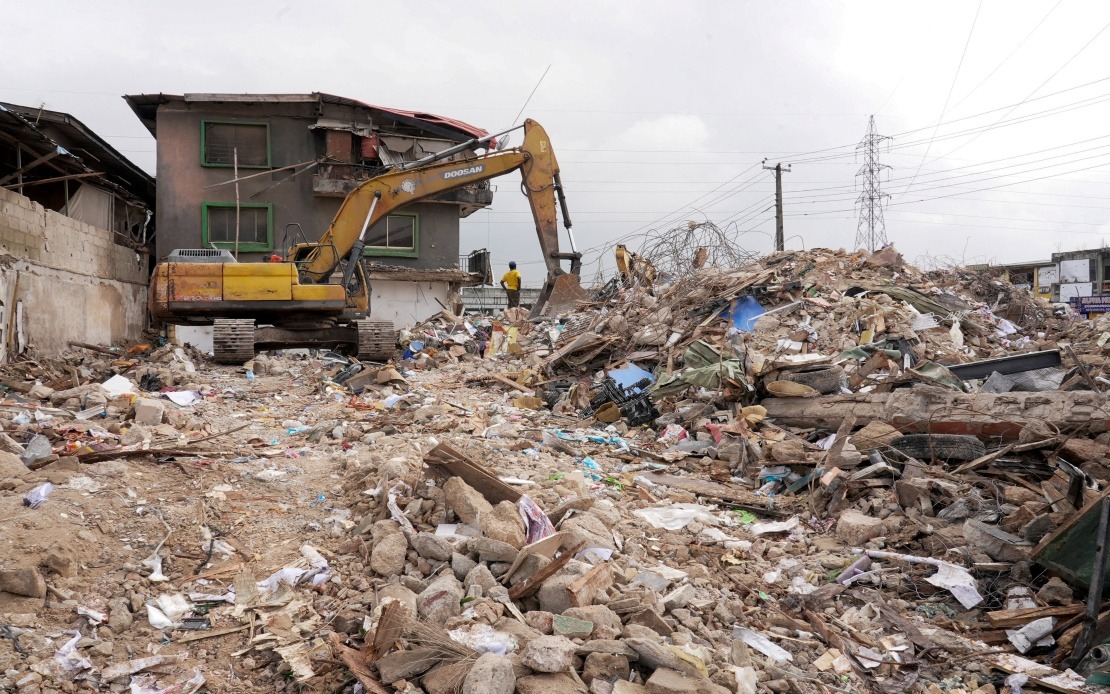
A three-storey shopping complex in the Alakija district of Lagos, Nigeria collapsed on Thursday morning, claiming at least nine lives and leaving 27 others requiring medical attention. The incident unfolded in a fast-growing satellite town positioned along the heavily trafficked Lagos-Badagry Expressway, a critical commercial corridor in Nigeria's most populous state. Rescue personnel launched an immediate large-scale operation to extract trapped individuals from the rubble, with work continuing throughout Thursday and concluding early Friday morning as emergency responders exhausted all possibilities of locating additional survivors.
Olufemi Oke-Osanyintolu, the permanent secretary of the Lagos State Emergency Management Agency, confirmed the final casualty count and rescue figures during a telephone conversation with news agencies on Friday. He explained that rescue teams maintained continuous operations around the clock, methodically working through the collapsed structure to locate and safely remove anyone buried beneath the debris. The intensity and duration of the operation underscored the scale of the disaster and the complexity involved in safely extracting victims from such unstable environments without causing additional harm to survivors or rescue personnel.
Among those rescued, the majority sustained injuries ranging from minor to severe, requiring immediate transport to medical facilities for treatment and observation. The victims represented a cross-section of people present at the shopping complex at the moment of collapse. Most were business proprietors and customers engaged in routine commercial transactions when the structure gave way. Additionally, several residents from neighbouring residential areas were caught in the disaster, having been nearby when the building failed unexpectedly.
The rescue operation benefited from coordinated efforts among multiple government agencies and private sector participants. Notably, the China Civil Engineering Construction Corporation, currently executing a railway infrastructure project in the Lagos area, deployed equipment and personnel to assist in extraction and recovery efforts. This international cooperation proved valuable given the technical challenges of dismantling unstable rubble while locating and removing victims safely.
The precise cause of the collapse remains undetermined at this stage, though local authorities have initiated a formal investigation into the circumstances surrounding the structural failure. Engineers and investigators will examine the building's construction history, structural integrity, and any factors that may have contributed to its sudden collapse. Understanding the root cause is essential not only for holding accountable those responsible but also for preventing similar incidents across Lagos and Nigeria.
The incident reflects a persistent pattern affecting Nigeria's built environment. Structural collapses occur with troubling frequency throughout the country, representing a significant public safety concern. When building failures do occur, they frequently reveal a cluster of underlying problems that have accumulated over time. Industry experts consistently identify three major culprits: the deterioration of aging structures that lack adequate maintenance and inspection, systematic disregard for established building codes and safety regulations, and the widespread practice of using substandard or inferior construction materials to reduce costs.
Lagos, despite being Nigeria's economic powerhouse and the continent's largest metropolitan area, remains particularly vulnerable to such catastrophic failures. The state experiences relentless development pressure as rapid urbanization drives construction activity. However, the rush to build often conflicts with rigorous enforcement of building standards. Corruption in permitting processes, inadequate inspection regimes, and the financial incentives favouring cost-cutting create a hazardous environment where structural failures become almost inevitable.
For Malaysian observers and regional readers, the Lagos collapse serves as a cautionary case study in the consequences of insufficient regulatory oversight in the construction sector. Malaysia's own building code enforcement, while stronger than many developing nations, still faces challenges from unscrupulous developers and inadequate local authority inspection capacity. The Lagos incident demonstrates how even in major economic hubs, systemic deficiencies in construction oversight can suddenly claim multiple lives and generate economic disruption.
The social and economic impact of such collapses extends far beyond immediate casualties. The shopping complex that collapsed likely employed numerous workers and served as a commercial hub for the surrounding community. Its destruction eliminates livelihoods, disrupts local commerce, and generates trauma among survivors and families of those who perished. The incident also undermines public confidence in the safety of commercial buildings and residential structures throughout Lagos and raises broader questions about the adequacy of governance and regulation in Nigeria's construction industry.
Moving forward, the investigation findings will likely prompt renewed calls for stricter building code enforcement, more rigorous inspection protocols, and accountability for developers and contractors who compromise safety standards. However, translating such demands into sustained institutional reform remains challenging in contexts where financial pressures and governance capacity constraints persist. The tragedy in Alakija, while devastating for those directly affected, may prove transformative only if it catalyzes systematic changes in how Lagos and Nigeria approach building regulation, inspection, and enforcement—a transformation that remains uncertain despite the human cost already exacted.

