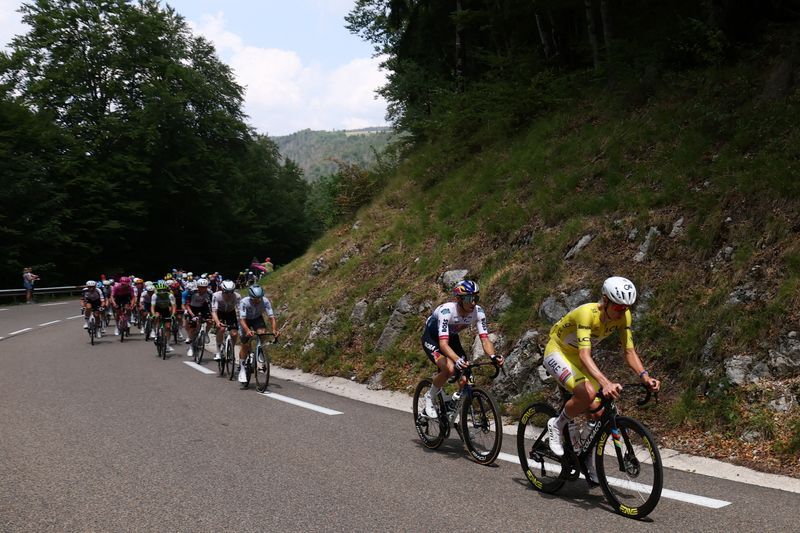
Jonathan Vaughters, a former professional cyclist turned team owner, has entered the contentious debate surrounding pre-dawn doping tests at this year's Tour de France by arguing that unannounced middle-of-the-night controls represent one of sport's most potent weapons against systematic cheating. Vaughters' intervention comes as multiple elite riders, including race leader Tadej Pogacar and second-ranked Jonas Vingegaard, have complained about being awakened in the early hours of Sunday morning for surprise anti-doping examinations before the 15th stage, raising questions about the fairness and safety of such intrusive testing protocols.
The controversy gained further momentum when several top contenders spoke publicly about the physical toll of these nocturnal checks. Vingegaard, who was tested at 2 a.m., reported losing approximately 40 minutes of sleep before tackling a demanding mountain stage where he subsequently crashed and fractured his collarbone. Pogacar fared somewhat better but still managed only four hours of sleep after being tested at 5 a.m. Remco Evenepoel, who won the stage in question, characterised the entire practice as "inhuman," reflecting the growing frustration among competitors who view the disruption as potentially undermining their performance and wellbeing during the sport's most gruelling event.
Vaughters brings particular credibility to this discussion given his extensive experience within professional cycling's darkest chapter. During his racing career spanning the late 1990s and early 2000s, he competed as a teammate of Lance Armstrong on the U.S. Postal Service team, an outfit that would later become synonymous with one of sport's most elaborate doping conspiracies. Rather than distancing himself from this chapter, Vaughters subsequently admitted to using performance-enhancing substances, including EPO, during his professional years. He later cooperated fully with the U.S. Anti-Doping Agency's groundbreaking investigation into Armstrong, providing testimony that proved instrumental in establishing the scope and sophistication of the systematic cheating programme that had corrupted professional cycling for years.
Arm strong's eventual downfall in 2012, when he was stripped of his seven Tour de France titles following USADA's determination that he had orchestrated the most sophisticated doping operation the sport had ever witnessed, marked a watershed moment for cycling. However, Vaughters' perspective is that even this seismic reckoning might have been prevented entirely had modern testing protocols existed during the height of the blood-doping era. On social media, he articulated this argument directly, contending that "2am testing is one of the very effective ways to prevent peptide and testosterone micro-dosing," referring specifically to EPO and human growth hormone protocols that were central to systematic doping in his era.
Vaughters extended this logic with a pointed counterfactual that underscores his conviction about the deterrent value of night-time testing. He stated that had the UCI implemented such testing in 2001, the entire pack of professional cyclists engaged in micro-dosing would have faced immediate suspension, potentially sparing the sport from 25 years of revelations, scandal, and institutional damage. This assertion carries weight precisely because Vaughters was himself implicated in the very practices he suggests such testing would have eliminated, lending authenticity to his analysis of how micro-dosing operated and why predictable testing schedules enabled it to flourish.
The scientific rationale underpinning Vaughters' position reflects genuine concerns within anti-doping circles about a critical vulnerability in testing regimes. Substances such as EPO and human growth hormone are known to clear the body within hours, making them exceptionally difficult to detect through standard daytime testing windows when riders are competing, training, or otherwise occupied with scheduled activities. Anti-doping experts have long acknowledged that dopers could time their micro-dosing to coincide with periods when testing was unlikely, creating a window of pharmacological advantage that left no trace. Night-time testing disrupts this calculus by introducing unpredictability into when athletes might be examined.
Since founding Cannondale-EF, Vaughters has cultivated a public identity as an advocate for clean racing and institutional reform within professional cycling. The team has become associated with higher ethical standards and transparency, positioning itself as a counterweight to the sport's tainted history. This transformation from admitted doper to clean-racing advocate has lent him a platform from which to speak about anti-doping measures, though it also exposes him to accusations of retrospective moralising. Nonetheless, his experience spanning both sides of cycling's doping divide provides insights that purely external commentators cannot offer.
The International Testing Agency, which administers doping controls on behalf of the UCI, has defended the necessity of night-time testing despite acknowledging the disruption it causes. In a statement, the ITA recognised that "night-time testing may be disruptive to riders' rest and recovery" but insisted that effective anti-doping oversight must occasionally occur "outside daytime hours" in what it describes as "limited and justified circumstances." This formulation represents a deliberate trade-off, prioritising the integrity of competition and the prevention of systematic cheating over the comfort and recovery of individual riders.
The tension between these competing interests—fairness to athletes versus effectiveness of anti-doping measures—represents one of professional cycling's enduring dilemmas. Riders and their representatives argue that elite competition at the Tour de France is sufficiently demanding without the added burden of sleep disruption that could materially affect performance and safety. Anti-doping authorities counter that without such measures, the sport risks returning to the systematic cheating that characterised earlier decades. Vaughters' intervention suggests that from the perspective of those who lived through cycling's blood-doping era, the inconvenience of night-time testing pales beside the catastrophic reputational and competitive damage wrought by undetected systematic doping.
For Southeast Asian audiences, this debate carries significance beyond cycling's internal politics. The region is developing increasingly sophisticated sporting infrastructure and ambitions across multiple disciplines, from football to badminton to emerging Olympic sports. How established sports like cycling manage the tension between athlete welfare and anti-doping effectiveness provides a template that Asian sporting administrators will likely grapple with as their own competitions achieve greater prominence and stakes. The principles at stake—balancing competitive integrity against individual rights—transcend cycling and speak to broader questions about governance and accountability in sport globally.

