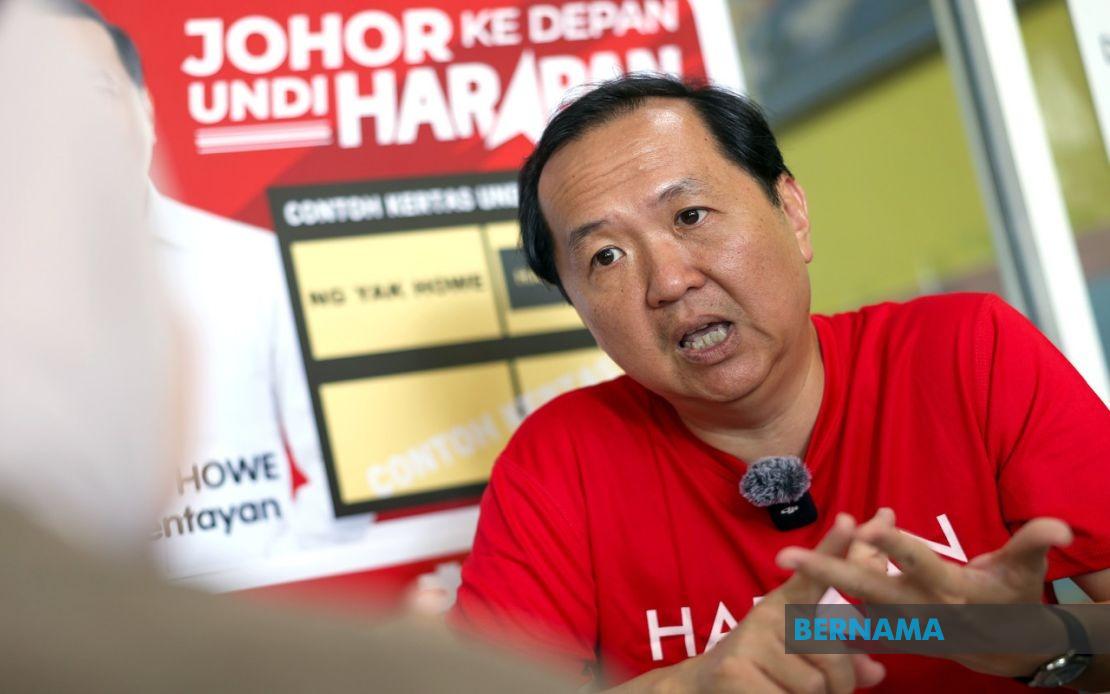
Ng Yak Howe, the Pakatan Harapan candidate contesting the Bentayan state assembly seat in Johor, has zeroed in on urban regeneration as the cornerstone of his campaign message. The incumbent assemblyman has identified the gradual hollowing out of Muar town centre as a critical challenge requiring immediate intervention, with his focus on reversing decades of commercial and residential decline that have characterised the heart of this historic Johor town.
The problem Ng seeks to address is a familiar one across Malaysia's older urban centres. Muar town, which once thrived as a vibrant commercial hub, has gradually emptied as residents relocated to newer, more convenient suburban developments on the town's periphery. This migration pattern has left behind a patchwork of shuttered shops, abandoned offices, and underutilised street frontage—a phenomenon that compounds as businesses follow customers away from the core. The Bentayan constituency encompasses more than half of the town centre, placing Ng's electoral division at the epicentre of this urban revitalisation challenge.
Ng characterised the problem with particular clarity during his engagement with local traders and residents. The town centre experiences a peculiar rhythm: daytime commercial activity creates an illusion of vitality, with offices bustling and shops serving customers. But as evening descends and workers return to their suburban homes, the streets empty dramatically, leaving the infrastructure of commerce operating at a fraction of its capacity. This boom-and-bust dynamic within a single day illustrates the structural nature of the challenge—it is not merely a matter of business decline but rather a fundamental rupture between where people work and where they live.
To catalyse a reversal of this trend, Ng has emphasised the importance of attracting younger demographic groups back into the town centre, viewing youth-focused initiatives as essential to creating a sustainable, vibrant urban environment. The younger generation's preferences for amenity-rich, walkable neighbourhoods with mixed-use development—combining residential, commercial, and entertainment functions—represent both a challenge and an opportunity. Rather than fighting demographic trends, Ng's strategy implicitly acknowledges that modern urban regeneration must align with contemporary lifestyle expectations, particularly among digital-native populations.
Practical initiatives already underway demonstrate Ng's collaborative approach to urban revitalisation. Working alongside Tan Hong Pin, the Bakri Member of Parliament, Ng has implemented cash voucher and lucky draw schemes designed to incentivise consumer spending within Muar town centre businesses. These demand-side interventions aim to redirect purchasing power back to the town core, benefiting the remaining 82 per cent of commercial premises still in operation. Such measures, while modest, signal a commitment to tangible, immediate economic stimulus rather than purely aspirational policy promises.
Ng's background provides insight into his policy orientation. As a former quality assurance engineer with more than a decade of industrial experience, he brings a technical, process-oriented mindset to political challenges. This professional foundation contrasts with purely political careers, potentially explaining his emphasis on measurable, implementable solutions rather than grand rhetorical gestures. His quarter-century involvement in political activism suggests sustained commitment beyond electoral cycles, a factor that may differentiate him from candidates treating the position as a temporary opportunity.
The Bentayan constituency presents a competitive electoral environment. With 34,205 registered voters, the seat remains a straight contest between Ng and Chua Lee Huat, the Barisan Nasional candidate. The absence of a three-cornered fight simplifies the electoral calculus but also intensifies the direct comparison between competing visions for the constituency's future. Both candidates must articulate compelling narratives addressing the town centre's decline, though their proposed solutions may reflect differing approaches to urban policy and resource allocation.
The broader Johor state election context provides important framing for Ng's campaign. With 172 candidates contesting across 16 state seats, and polling scheduled for 11 July with early voting on 7 July, the electoral exercise represents a significant political event for the state and carries implications for federal coalitional dynamics. Muar town centre's fortunes, while locally specific, reflect broader questions about urban development patterns across Malaysia, including the sustainability of older commercial cores and the challenge of managing urbanisation pressures.
Ng's emphasis on Muar town centre revitalisation also resonates with post-pandemic urban policy discussions. The COVID-19 pandemic accelerated remote work adoption and online commerce, further pressuring traditional retail and office precincts. Urban centres globally grapple with adapting commercial districts to this shifted reality. Ng's focus on mixed-use, people-centred urbanism—drawing residents back through attractive public spaces and amenities rather than solely commercial operations—reflects evolving best practices in urban regeneration across developed Asian economies.
The economic dimensions warrant deeper examination. Vacant commercial premises represent both lost tax revenue for local authorities and diminished property values for existing owners, creating a negative feedback loop where deteriorating conditions justify further disinvestment. Breaking this cycle requires coordinated intervention spanning multiple actors: the local authority, private property owners, small business operators, and resident communities. Ng's strategy of leveraging voucher schemes and drawing campaigns, while relying on governmental coordination mechanisms, suggests recognition that purely market-driven recovery may prove insufficient.
Looking forward, Ng's campaign messaging demonstrates how local electoral politics increasingly foreground urban quality-of-life issues rather than purely distributive promises. Younger voters, particularly those with tertiary education and professional careers, increasingly evaluate political candidates partly on their vision for urban renewal and sustainable development. This shift reflects Malaysia's maturation as an economy and society, where basic service provision has become table-stakes and differentiation emerges through higher-order policy ambitions. The success or failure of Ng's Muar town centre revival agenda will likely influence electoral narratives across comparable older urban constituencies throughout Malaysia.

