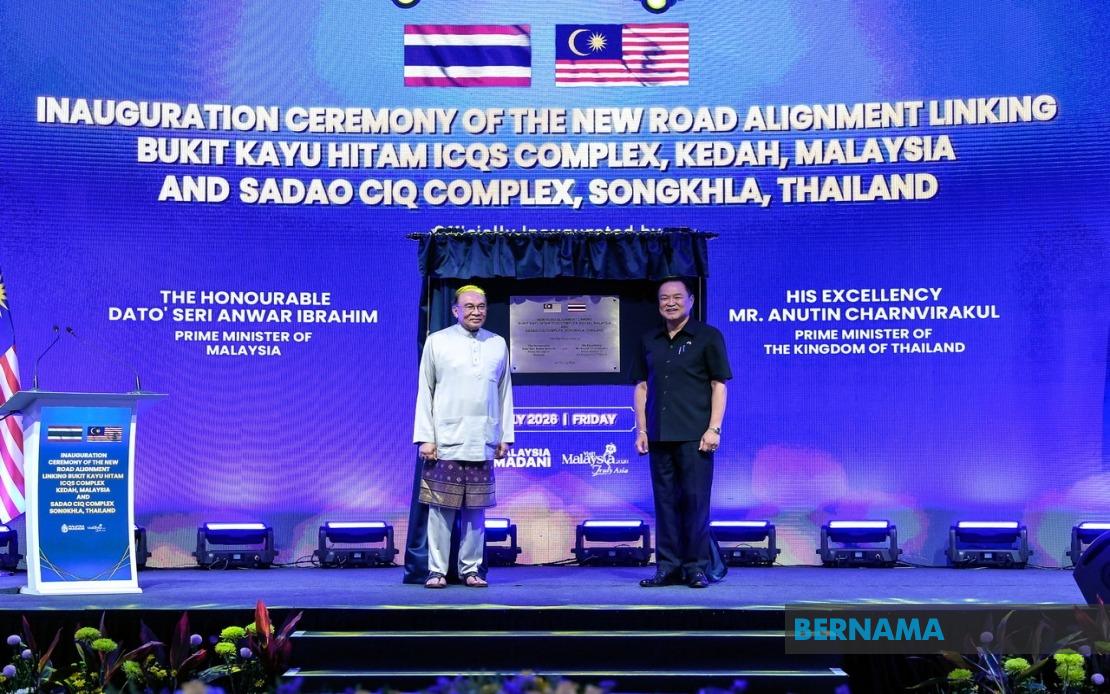
Prime Minister Datuk Seri Anwar Ibrahim has hailed the inauguration of a new road corridor linking Malaysia's Bukit Kayu Hitam Immigration, Customs, Quarantine and Security Complex in Kedah with Thailand's Sadao Customs, Immigration and Quarantine Complex as a transformative initiative for cross-border economic development. The project, jointly launched by Anwar and Thailand's Prime Minister Anutin Charnvirakul at the border today, represents a pivotal step in strengthening bilateral relations and facilitating seamless movement of goods and people between the two nations.
The infrastructure initiative carries substantial symbolic weight beyond its immediate logistical function. Anwar characterised the venture as a historical milestone in Malaysia-Thailand relations, emphasising that it would establish a foundation for enhanced trade flows, investment activities, and cooperative economic frameworks. The two leaders' joint presence at the ceremony underscored the political commitment from both capitals to translate aspirations for regional prosperity into concrete reality.
Central to Anwar's vision is the establishment of a special economic border zone encompassing northern Malaysia and southern Thailand. This concept extends far beyond conventional cross-border arrangements, contemplating a coordinated development framework that would unlock economic potential in peripheral regions often overlooked by national policy priorities. The Prime Minister acknowledged that such transformative undertakings require sustained effort and cannot be realised through hasty implementation, indicating a measured yet determined approach to this ambitious agenda.
The new road alignment directly benefits five Malaysian states positioned along or near the northern corridor: Perlis, Kedah, Kelantan, Perak, and Penang. These regions, which have historically experienced slower development trajectories compared to more industrialised areas, stand to gain substantially from enhanced connectivity and reduced transaction costs associated with cross-border commerce. For Malaysian businesses and manufacturers seeking to access Thai markets or integrate into regional supply chains, the infrastructure improvement removes critical bottlenecks that previously constrained trade competitiveness.
Anwar and Anutin have committed to accelerating resolution of longstanding bureaucratic obstacles that have impeded bilateral commerce. These include harmonisation of customs procedures, streamlining of immigration protocols, coordination on fisheries management, and alignment of trade regulations. The Prime Minister indicated that intensive bilateral negotiations conducted during Anutin's two-day official visit achieved substantial progress on multiple fronts that had previously consumed years or even decades of diplomatic dialogue. This acceleration reflects evolving pragmatism in how both nations approach regulatory harmonisation.
The bilateral trade target of USD30 billion by 2027 provides a quantified benchmark against which the effectiveness of these infrastructure and procedural improvements can be measured. Current trade volumes fall considerably short of this aspiration, suggesting substantial untapped commercial potential. Enhanced border connectivity and reduced administrative friction should materially contribute to closing this gap, though sustained effort across multiple policy domains remains essential. The target represents not merely a numerical goal but a manifestation of deeper economic integration ambitions.
For Malaysian companies, particularly small and medium enterprises concentrated in northern states, the new arrangements carry implications that extend beyond merely accessing Thai markets. The special economic border zone concept envisions reciprocal benefits, with Thai businesses similarly gaining improved access to Malaysian territory and regional distribution networks. This mutual benefit structure creates incentives for both nations to invest in complementary infrastructure and regulatory frameworks that facilitate rather than obstruct cross-border commercial activity.
Anwar's emphasis on understanding the needs of border communities outside major urban centres reflects a recognition that equitable development remains an ongoing challenge in both nations. Border regions frequently experience infrastructural deficits and economic marginalisation despite their potential strategic importance. By positioning this initiative as an instrument for improving livelihoods in communities historically peripheral to national economic narratives, Anwar articulated a development philosophy that connects infrastructure investment to human welfare outcomes rather than abstract economic metrics.
The resolution of outstanding issues affecting fisheries deserves particular attention given the historical tensions between Malaysian and Thai fishing communities operating in shared maritime zones. Such disputes often carry dimensions extending beyond purely commercial considerations, touching on resource sovereignty, environmental sustainability, and cultural livelihood patterns. Progress in this domain would demonstrate whether the political momentum evident at today's ceremony translates into practical resolution of contentious sectoral issues.
Thailand's perspective on this initiative reflects broader regional positioning within Southeast Asian economic architecture. Thai interest in strengthening northern border connectivity aligns with Bangkok's efforts to develop its own peripheral regions and rebalance development away from the capital and central regions. For Thailand, enhanced commerce with Malaysia offers opportunities to expand manufacturing and trading hubs in provinces such as Songkhla and Satun, creating employment and investment opportunities in areas that have experienced relative economic stagnation.
The timing of this initiative occurs within a broader regional context of intensified economic competition and supply chain reconfiguration following pandemic disruptions. Nations throughout Southeast Asia have recognised that infrastructure connectivity represents a critical competitive advantage in attracting manufacturing investment and facilitating e-commerce expansion. The Malaysia-Thailand border initiative positions both nations to capitalise on these trends while strengthening intraregional economic interdependence.
Looking forward, the practical implementation phase will prove decisive in determining whether today's ceremonial launch translates into substantive economic transformation. Border infrastructure alone cannot overcome all obstacles to commerce; complementary investments in digital connectivity, financial integration, and human capital development remain necessary. Nevertheless, the political alignment evident between Anwar and Anutin provides essential foundation for advancing these broader initiatives. The measure of success will ultimately rest not on ceremonial gestures but on whether border communities experience improved livelihoods and whether bilateral trade figures demonstrate meaningful growth trajectories toward the 2027 target.

