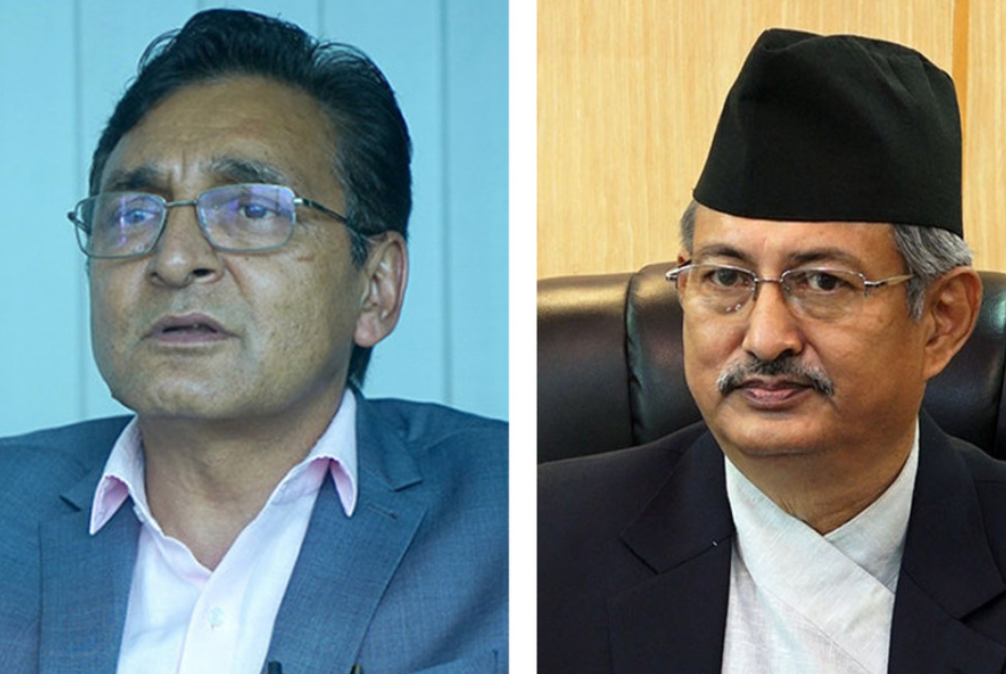
A district court in Kathmandu has convicted two former government ministers of orchestrating a refugee resettlement fraud that exploited international humanitarian programmes. The verdicts, delivered late Tuesday, mark a significant moment in Nepal's ongoing anticorruption campaign under its newly elected administration. Former Deputy Prime Minister and Energy Minister Top Bahadur Rayamajhi received a four-year sentence on charges including offences against the state, fraud, and involvement in organised crime, while former Home Minister Bal Krishna Khand was sentenced to two years as an accomplice to the scheme. The rulings underscore mounting pressure on Nepal's political establishment to address systemic corruption that has plagued the country's governance structures.
Rayamajhi, currently in custody, and Khand, who remains free on bail, have consistently denied participation in the scam despite the court's findings. Rayamajhi's legal team, represented by lawyer Dharma Raj Regmi, has signalled plans to challenge the conviction, arguing that the former minister "never involved in policy making for the refugees" and was therefore wrongfully implicated. Khand's counsel, Pankaj Karna, has similarly indicated an intention to pursue an appeal. These legal manoeuvres suggest the case will likely extend through Nepal's appellate system, potentially delaying final resolution for months or years. The appeals process reflects both the complexity of the charges and deeper questions about how high-ranking officials orchestrated the fraudulent operation across multiple government departments.
Beyond the two former ministers, the Kathmandu court convicted fourteen additional individuals complicit in the scheme, including a retired senior bureaucrat from the home ministry and a former leader of the Bhutanese refugee community in Nepal. These co-conspirators received sentences of up to four years, indicating their varying degrees of involvement in the falsification operation. The breadth of the conspiracy reveals how extensively the scam had penetrated Nepal's refugee management apparatus, suggesting that document forgery at this scale required cooperation across administrative levels and institutional boundaries. The court's decision to prosecute this wider network demonstrates judicial willingness to pursue systemic corruption rather than treating the affair as the work of isolated bad actors.
The exact number of Nepali nationals successfully resettled in the United States under false Bhutanese refugee credentials remains unclear. The Kathmandu district court has not released definitive figures on how many fraudulent applications were processed or accepted by American immigration authorities before the scheme was discovered in 2023. This information gap is significant for both Nepal and the United States, as it affects the integrity of third-country resettlement programmes that depend on reliable documentation and vetting. The opacity surrounding the true scope of the fraud complicates assessment of whether security or humanitarian processes were compromised, and raises questions about how the scheme persisted undetected for what appears to have been an extended period.
The refugee situation underlying this scandal stems from decades-long tensions between Bhutan and its Nepali-origin population. Since the early 1990s, approximately 120,000 Bhutanese nationals of Nepali descent fled the Himalayan kingdom to Nepal, seeking greater political freedoms in a country that has long prioritised cultural homogeneity and Buddhist traditions. Bhutan's restrictive approach to citizenship and political participation prompted mass emigration, creating one of Asia's most enduring refugee populations. The majority Buddhist nation, with fewer than 800,000 total inhabitants, implemented policies that marginalised its ethnic Nepali minority, eventually triggering the humanitarian crisis that drew international attention and Western resettlement offers.
International resettlement frameworks subsequently emerged as the primary solution when bilateral repatriation negotiations between Bhutan and Nepal repeatedly stalled. Nearly 113,000 Bhutanese refugees have been accepted for permanent settlement across multiple Western nations, including the United States, Canada, and Australia, through a coordinated third-country resettlement programme that bypassed direct bilateral arrangements. The United States alone has accepted approximately 100,000 refugees from Nepal under this scheme, making it by far the largest single recipient country. However, these successful resettlements created perverse incentives for individuals desperate to escape Nepal's poverty and limited economic opportunities, who fraudulently claimed Bhutanese refugee status to access Western immigration pathways.
Several thousand Bhutanese refugees remain housed in camps across eastern Nepal, their resettlement prospects exhausted while their desire to return to Bhutan has become complicated by time, changed circumstances, and Bhutan's continued refusal to accept repatriation. These camp dwellers represent a forgotten population caught between nations, ineligible for Bhutanese citizenship and unwilling or unable to integrate further into Nepali society. The discovery of the resettlement fraud case has cast additional scrutiny on the refugee camps themselves, raising questions about identity verification and administrative oversight in those facilities. This demographic persistence underscores how deeply the refugee crisis has embedded itself within Nepal's social fabric and regional dynamics.
The conviction of the former ministers reflects wider trends in Nepal's political trajectory, particularly the country's recent pivot toward youth-led, anticorruption governance. Youth-led demonstrations in September last year, which claimed 76 lives, catalysed the collapse of the previous government and created momentum for systemic reform. The uprising attracted predominantly young, urban Nepali citizens increasingly intolerant of entrenched corruption among the country's political and bureaucratic elite. This generational pressure produced the March election that brought former musician Balendra Shah, age 36, to power as prime minister of a new administration explicitly mandated to dismantle corruption networks established under predecessor governments.
Shah's government has positioned anticorruption prosecutions as central to its legitimacy and reform agenda. The conviction of two former ministers, alongside their fourteen co-conspirators, demonstrates that the new administration is following through on campaign promises to hold previous officials accountable. However, the refugee resettlement fraud also exemplifies why systemic anticorruption efforts remain incomplete: despite months of investigation and prosecution, fundamental details about the scam's scale and international dimensions remain unresolved. For Malaysia and other Southeast Asian nations observing Nepal's governance transformation, the case illustrates both the potential and limitations of anticorruption campaigns when addressing fraud spanning multiple institutions and international borders.
The broader implications of this case extend beyond Nepal's domestic politics into regional security and international humanitarian frameworks. Fraudulent refugee resettlement programmes potentially compromise the reliability of identity verification systems relied upon by Western nations accepting international displaced persons. If significant numbers of Nepali nationals entered the United States under false Bhutanese refugee claims, this creates precedent for questioning the integrity of third-country resettlement schemes across the region. Southeast Asian nations and South Asian governments participating in international refugee programmes must now grapple with how thoroughly their own documentation and vetting procedures protect against similar fraud, while Western receiving nations reassess their due diligence protocols. The Kathmandu convictions thus serve as a cautionary reminder of how corruption at the administrative level can undermine the credibility of humanitarian systems designed to assist genuinely vulnerable populations.

