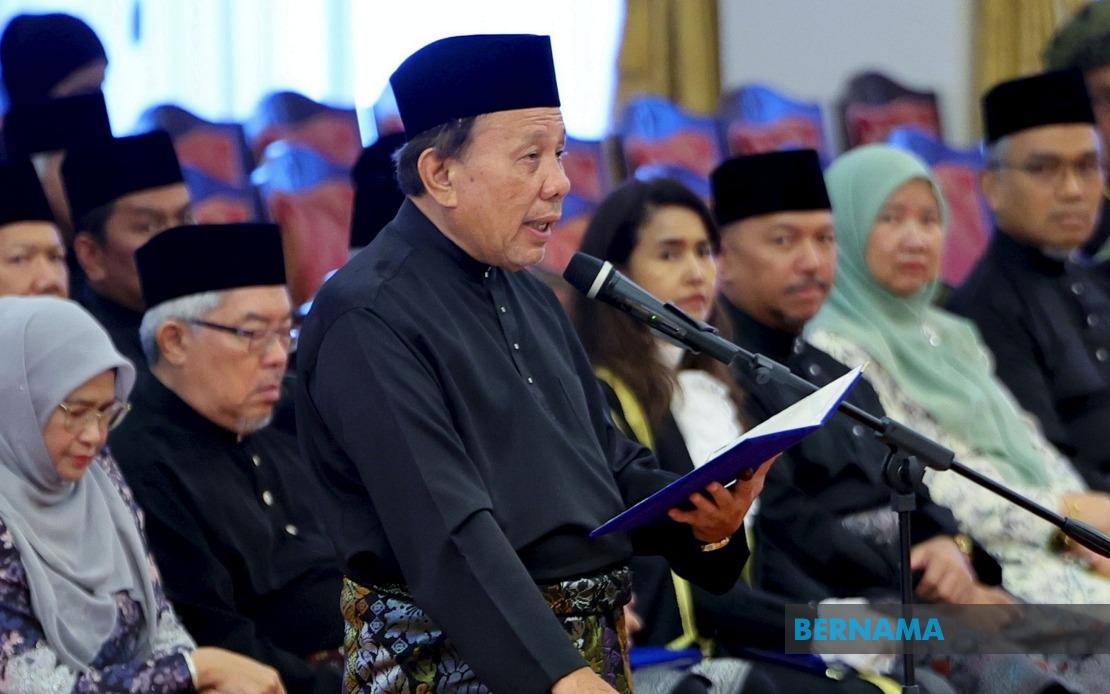
Datuk Ismail Lasim took the oath as Negeri Sembilan's fresh Menteri Besar during a formal ceremony at Istana Besar Seri Menanti, where he made sweeping commitments to honour the mandate delivered in the recent 16th state election. Speaking before Yang Dipertuan Besar Tuanku Muhriz Tuanku Munawir, Ismail framed his appointment as both an honour and a weighty responsibility, pledging that his administration would serve the public with diligence, fairness and openness whilst remaining responsive to grassroots concerns.
The outgoing electoral mandate represents a crucial turning point for the central peninsular state. Ismail positioned the public's backing not as a ceremonial endorsement but as a solemn compact binding his government to perform with integrity and accountability. He emphasised that earning continued trust would require consistent demonstration of competent, transparent governance rather than merely holding office. This framing reflects broader conversations within Malaysia's political landscape about rebuilding institutional confidence following years of governance concerns at both federal and state levels.
Central to Ismail's vision is anchoring state policies in Negeri Sembilan's distinctive constitutional and cultural inheritance. The state's Adat Perpatih system—a customary legal framework unique to the Minangkabau-influenced community—emphasises consensus, fairness, collective wisdom and social cohesion. Ismail vowed to preserve and transmit these principles to future generations, integrating them into modern governance frameworks. This approach positions the state as defending its heritage while adapting to contemporary administrative demands, a balance many emerging Asian economies struggle to achieve.
Economic revitalisation emerged as a core pillar of his platform. Ismail committed to strengthening sectoral competitiveness, recruiting quality foreign and domestic investment, and generating employment pathways for residents. The emphasis on job creation reflects persistent concerns about rural-urban economic disparities within the state, where agricultural communities in districts like Kuala Pilah have experienced slower income growth relative to more urbanised areas. His pledge to simultaneously improve standards of living, expand healthcare and educational infrastructure, and bolster agricultural productivity suggests an attempt to address these regional imbalances systematically rather than through isolated projects.
A notable dimension of Ismail's inaugural statement concerns his interpretation of development metrics. Rather than conflating progress solely with infrastructure projects and economic statistics—a common trap in Southeast Asian governance—he explicitly articulated a broader conception encompassing public welfare, social stability, institutional strength and democratic legitimacy. This rhetorical positioning aligns with contemporary international development discourse emphasising human development indices over GDP-centric measures, though translating such principles into budgetary allocations and policy priorities will prove challenging in practice.
Ismail's commitment to civil service modernisation underscores recognition that administrative effectiveness depends on bureaucratic professionalism. He pledged to ensure state personnel maintain dedication, technical competence and a strong service ethic—prerequisites often neglected in developing administrations where patronage influences hiring and retention. Strengthening institutional capacity has particular relevance for a state working with limited resources relative to larger economic hubs in Selangor or Kuala Lumpur, requiring Negeri Sembilan to maximise organisational efficiency to deliver services comparable to wealthier jurisdictions.
The incoming Menteri Besar signalled openness to constructive dissent and alternative perspectives, acknowledging that consensus-building and receptiveness to criticism constitute foundations for sustainable governance. In Malaysia's sometimes adversarial political environment, where state governments frequently dismiss opposition viewpoints, this rhetorical commitment to inclusive deliberation represents a modest departure. Whether such principles translate into actual consultation mechanisms involving opposition representatives, civil society organisations and marginalized communities will serve as important metrics for assessing the administration's authenticity.
Ismail's emphasis on coordination between royal institutions, state apparatus, federal authorities, the private sector and community stakeholders reflects awareness that contemporary governance challenges transcend bureaucratic silos. Economic development increasingly requires collaboration between government agencies and business enterprises; social welfare delivery demands partnerships with NGOs and religious organisations; environmental sustainability necessitates cooperation across multiple jurisdictional levels. This systemic perspective suggests a sophisticated understanding of governance complexity, though implementing such integrated approaches requires sustained political will and institutional coordination mechanisms that frequently prove elusive.
Acknowledging his predecessor Datuk Seri Aminuddin Harun's contributions while positioning himself as extending rather than abandoning previous development trajectories reveals astute political navigation. Rather than symbolically repudiating the former administration, Ismail framed continuity as respecting institutional legacy whilst introducing fresh leadership energy. This approach potentially mitigates policy discontinuity that might disrupt ongoing initiatives, while simultaneously claiming mandate for necessary reforms. For Malaysian and regional observers, such transitions offer instructive case studies in managing peaceful power transfers within democratic systems.
Ismail's repeated invocation of transparency, integrity and justice signals intent to distance his governance from the governance deficits that have plagued Malaysian politics at various levels. However, rhetoric requires institutional embedding through concrete mechanisms: public accounts scrutiny, conflict-of-interest declarations, whistleblower protections and independent auditing. The coming months and years will reveal whether Ismail's administration transforms these laudable principles into binding administrative practices that meaningfully constrain official misconduct and enhance public accountability.
The new Menteri Besar's invocation of constitutional monarchy principles and deference to royal guidance underscores Negeri Sembilan's particular constitutional architecture. Unlike federal arrangements elsewhere, the state's Yang Dipertuan Besar retains more substantial executive influence than figurehead status in several ceremonial democracies. Ismail's respectful positioning towards the monarchy reflects both Malaysian constitutional traditions and practical governance wisdom, as maintaining harmonious royal-executive relations remains crucial for administrative stability in the Malaysian system.
For Negeri Sembilan residents, Ismail's inaugural commitments will ultimately prove meaningful only through implementation tracking and measurable outcomes in education quality, healthcare access, employment generation and infrastructure development. Regional observers examining Malaysian state governance will monitor whether his administration demonstrates superior transparency, accountability and public responsiveness compared to other state governments. The administration's performance over the coming electoral term will substantially influence perceptions of whether contemporary Malaysian political transitions can deliver improved governance outcomes alongside peaceful democratic succession.

