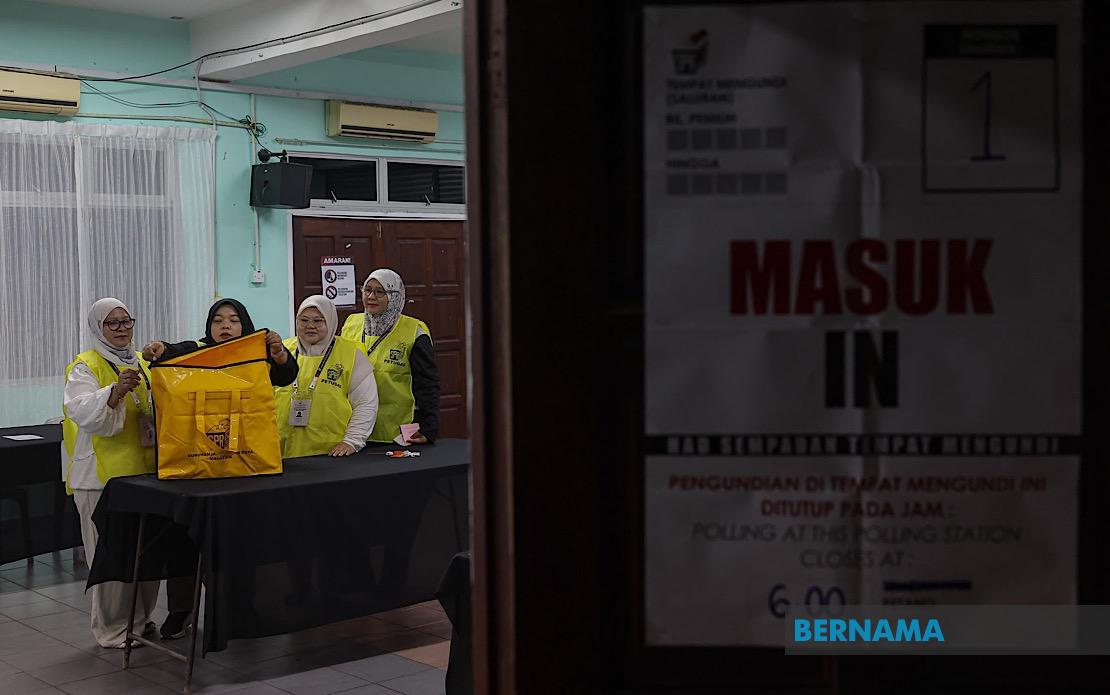
Voters across Negeri Sembilan exercised their democratic mandate today in a pivotal state election, marking the first major electoral test since the dissolution of the state assembly on June 5th. The 16th State Election drew nearly 860,000 registered voters to determine which political coalition would secure the right to govern Malaysia's smallest state by population, following an intensive two-week campaign that concluded at midnight the previous evening.
The electoral machinery mobilised across 401 polling stations statewide, organised into 1,668 separate voting streams to accommodate the substantial turnout. Polling commenced promptly at 8:00 am and remained open until 6:00 pm, providing voters in the districts of Seremban, Jempol, Jelebu, Kuala Pilah, Tampin, Port Dickson, and Rembau with a ten-hour window to cast their ballots. The Election Commission had set an optimistic target of between 72 and 75 percent voter participation, reflecting expectations of strong public engagement with this intermediate state-level contest.
Preliminary counting was scheduled to commence immediately after polling stations closed, with the commission aiming to announce comprehensive results before midnight—a timeline that would allow Malaysian media and regional observers to assess the political implications within hours. Initial indications were anticipated by 10:00 pm, though officials cautioned that the full tallying would require additional time given the number of contests and voting streams involved.
Weather conditions presented a potential variable for voter participation throughout the day. The Malaysian Meteorological Department forecast clear skies across Negeri Sembilan's seven districts during morning and early afternoon hours, conditions generally favourable for voting. However, forecasters warned of heavy afternoon rainfall and thunderstorms developing across most districts, a pattern that could influence turnout rates, particularly among elderly and less mobile voters in the later hours.
Advanced voting procedures held on Tuesday had demonstrated strong participation, with over 91 percent of eligible early voters—comprising military and police personnel plus their spouses—fulfilling their electoral obligations. This high rate among uniformed service members historically signals broader engagement across the electorate and suggested that today's overall turnout might approach or exceed the commission's projections.
The contest featured significant fragmentation across the 36 state legislative assembly seats, reflecting Malaysia's complex and increasingly competitive political landscape. Pakatan Harapan fielded the maximum possible slate of 36 candidates, attempting to consolidate its 2023 victory when the coalition won 17 seats. Barisan Nasional, the traditional governing force that held 14 seats from the previous election, nominated 25 candidates in a scaled-back campaign reflecting its diminished position in the state. Perikatan Nasional, which retained five seats in 2023, fielded 11 candidates, while Parti Pribumi Bersatu Malaysia, the political vehicle of former prime minister Mahathir Mohamad, contested 24 seats.
The remaining contest space included three minor parties—Berjasa, the Orang Asli Malaysia Party, and the Socialist Party of Malaysia—each running single candidates, alongside four independent hopefuls seeking to represent their constituencies outside partisan structures. Across the 36 seats, no single contest featured a simple two-candidate race, demonstrating the degree to which Malaysian electoral competition has become genuinely competitive at the state level. Twenty-two seats witnessed three-way contests, eleven featured direct two-candidate battles, while two seats each had four and five candidate slates respectively. This splintered candidacy pattern increases unpredictability and makes seat projection challenging for analysts.
Negeri Sembilan's political significance extends beyond its modest population and single-digit seat count in parliament. As one of Malaysia's remaining competitive state contests where no single coalition enjoys overwhelming dominance, the state serves as a genuine political bellwether. The 2023 result represented a substantial recovery for Pakatan Harapan from earlier electoral reverses, while simultaneously signalling that Barisan Nasional retained meaningful support despite national difficulties. The performance of Perikatan Nasional in Negeri Sembilan has attracted particular attention from analysts tracking the Islamist-leaning coalition's trajectory in urban and semi-urban constituencies where it has struggled compared to rural areas.
For Malaysian political observers and the broader Southeast Asian region monitoring democratic processes across the region, today's Negeri Sembilan election carries implications for understanding coalition dynamics ahead of the next general election scheduled for 2027. The state provides a test of whether Pakatan Harapan can consolidate recent gains and expand its seat share, whether Barisan Nasional retains capacity to recover lost ground through targeted campaigns, and whether Perikatan Nasional can compete effectively in multi-cornered contests against established coalition machinery.
The choice facing Negeri Sembilan voters reflected not merely local governance issues but broader national questions about the direction of Malaysian politics, including debates over Islamisation, democratic institutions, economic management, and constitutional reform. State elections in Malaysia's decentralised federal system provide electorates with the opportunity to deliver verdicts on specific governing coalitions while maintaining the broader national government, permitting voters to execute fine-grained political judgement without wholesale shifts in national direction.
As counting progressed through the evening hours, political parties activated their respective war rooms to assess performance across constituencies and districts. The results would determine not only which coalition governed Negeri Sembilan for the subsequent term but also shape narrative momentum heading toward the next phase of Malaysian electoral competition, with particular implications for opposition coalition cohesion and government coalition configurations.

