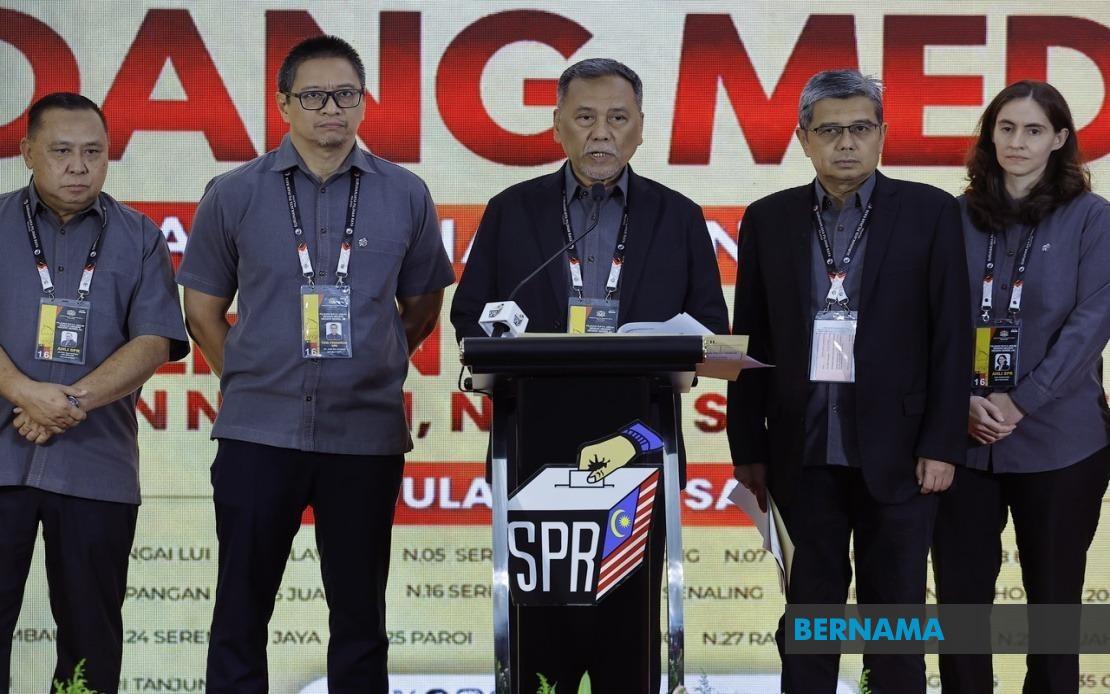
The Negeri Sembilan state election is shaping up as a closely contested affair, with the Election Commission confirming on July 18 that 103 candidates have been verified as eligible to contest across the 36-seat state assembly. The announcement came after nominations closed at eight centres nationwide, with EC chairman Datuk Seri Ramlan Harun unveiling a fragmented political landscape that promises intense competition in multiple constituencies.
The composition of candidates reflects the current state of Malaysian politics, where coalition allegiances and party restructuring have created fluid contest dynamics. Pakatan Harapan commands the largest presence with 36 candidates fielded across the state, positioning the coalition as the frontrunner in terms of breadth of contest. Barisan Nasional, the traditional governing force in many states, trails with 25 candidates, while the Perikatan Nasional-aligned Bersatu has entered the fray with 24 candidates, demonstrating the continued three-way division that has characterised Malaysian politics since 2022. Perikatan Nasional proper contributes 11 additional candidates, fragmenting the opposition vote further.
Beyond the major players, smaller parties are contesting to make their mark on the state's political stage. Barisan Jemaah Islamiah Se-Malaysia, the Malaysian Orang Asli Party, and the Socialist Party of Malaysia each fielded one candidate, while four independents are running. This proliferation of candidates reflects broader democratic participation, though it also creates scenarios where the winning candidate in some constituencies may secure victory with relatively modest vote shares, particularly where anti-establishment sentiment is fragmented across multiple parties.
The geographic distribution of contests reveals significant variation in electoral competitiveness across the state. Of the 36 seats, 21 will see three-way contests, the most common scenario, indicating that voters in more than half the state will have genuinely competitive choices between multiple viable candidates. Eleven seats will feature straight two-way fights, typically pitting the strongest PH and BN candidates directly against each other. The truly crowded contests emerge in Nilai and Sri Tanjung, where five candidates will compete for each seat, and Jeram Padang and Rahang, which will host four-cornered battles. These multi-candidate contests introduce significant uncertainty into seat projections, as vote-splitting becomes a critical factor in determining outcomes.
The candidate profile reveals the continued gender imbalance in Malaysian electoral politics, despite growing discourse around women's representation. The 103 candidates comprise 94 men and only nine women, representing approximately 8.7% female participation. This disparity persists across both established and emerging political forces, suggesting systemic barriers to women's political candidacy at the state assembly level. Age demographics show breadth, with candidates ranging from a 23-year-old Bersatu representative in Sri Tanjung to a 70-year-old Pakatan Harapan contender in Gemencheh, though the prevalence of older candidates in competitive positions underscores how seniority and party loyalty often determine candidacy in Malaysian politics.
The electoral framework governing this contest encompasses a substantial but geographically dispersed voter population of 889,490 registered electors. This electorate comprises diverse segments including 867,151 ordinary voters, 16,884 military personnel and their spouses, and 5,455 police officers. The inclusion of serving military and police personnel in the electoral rolls, while procedurally routine, carries significance for contests where security forces are concentrated geographically, potentially influencing outcomes in certain constituencies. The ordinary voter base of approximately 867,000 across a 36-seat assembly yields an average of roughly 24,000 voters per constituency, though this masks considerable variation between rural and urban seats.
The dissolution of the Negeri Sembilan state assembly on June 5 set the election machinery in motion, with the EC establishing a compressed timeline that prioritises democratic renewal without extended campaigning. The schedule mandates early voting on July 28, accommodating voters who will be away from their constituencies on polling day, a particularly important consideration in states where voters commute to federal territories for employment. The main polling day is scheduled for August 1, providing campaign periods of roughly six weeks from dissolution to voting, a timeline increasingly standard for Malaysian state elections. This compression reduces the duration of campaign-related disruptions and expenditures while maintaining sufficient periods for candidate campaigning and voter deliberation.
For Pakatan Harapan, the substantial candidate advantage—fielding candidates in all 36 seats compared to Barisan Nasional's 25—potentially provides a strategic edge in seat distribution and voter choice. However, the coalition's dominance in candidate numbers does not automatically translate to electoral victory, particularly given the presence of Bersatu and PN candidates who may fragment the opposition vote in constituencies where PH lacks strong local incumbency or organisational presence. The strategic calculus for BN centres on concentrating resources in winnable seats rather than attempting universal coverage, a defensive posture reflecting its weakened position in several former strongholds.
The electoral contest in Negeri Sembilan also serves as an important gauge of voter sentiment across one of Malaysia's more competitive state battlegrounds. The state has alternated between coalition dominance and more balanced competition over recent electoral cycles, making it a bellwether for national political trends. The specific outcome—whether PH extends its influence following the 2022 federal transition, whether BN recovers ground, or whether PN makes significant inroads—will carry implications for federal politics as Malaysia approaches potential parliamentary elections within the next two years. The data on voting patterns, demographic shifts, and coalition performance in multi-way contests will provide valuable insights into the sustainability of current political configurations.
The declaration of eligible candidates concludes the nomination process and inaugurates the official campaign phase, during which the 103 contenders will seek to persuade voters across 36 constituencies with varying demographic, geographic, and economic characteristics. The outcomes will reflect not merely party strength but the local viability of individual candidates, ground organisation capabilities, and voters' assessments of governance performance and future policy directions. For Malaysian observers and political analysts, the Negeri Sembilan election represents a substantive democratic exercise with both state-specific consequences and broader implications for the nation's evolving political landscape.

