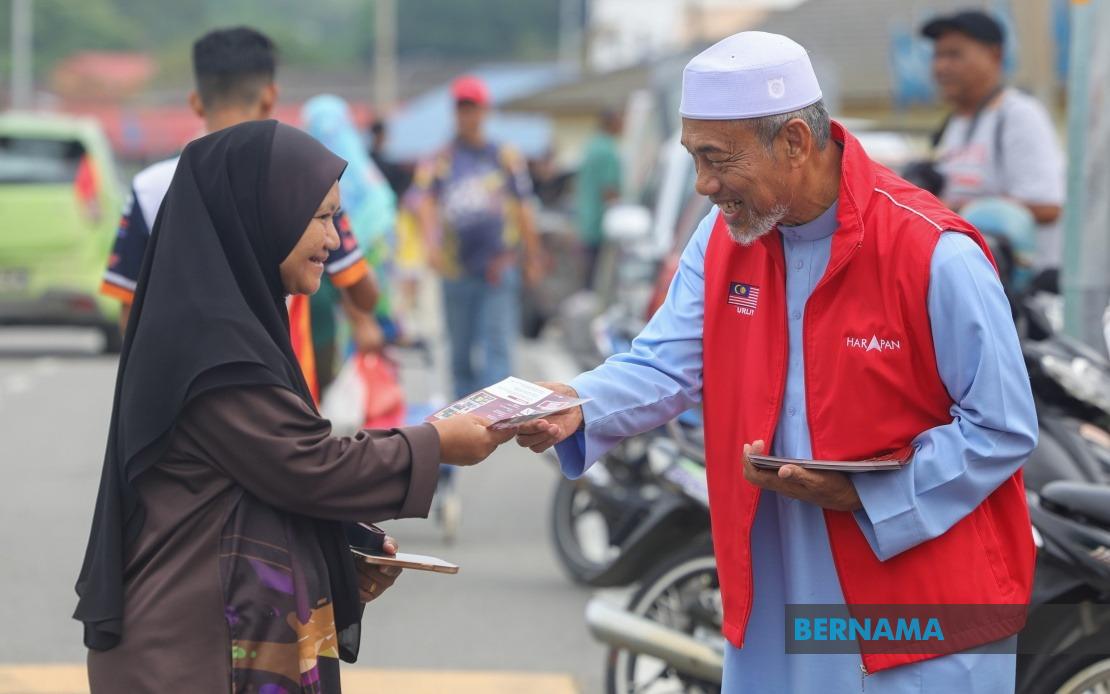
Political campaigns across Negeri Sembilan entered their second week with renewed urgency as candidates deployed comprehensive ground strategies to connect directly with constituents ahead of the August 1 polling day. The 16th state election, triggered by the dissolution of the State Legislative Assembly on June 5, has set into motion one of the region's keenly watched political contests, with candidates recognising that personalised engagement remains fundamental to electoral success in a state where traditional grassroots politics retains considerable influence.
Menteri Besar Datuk Seri Aminuddin Harun, contesting the Linggi seat for Pakatan Harapan, exemplifies the intensity of current campaign operations. His campaign itinerary demonstrates the granular approach being adopted across constituencies: beginning with prayers at Masjid Jamek Pasir Panjang before dawn, the PKR vice-president systematically worked through residential areas including Pasir Panjang town, Taman Setia, Taman Kekatong, Rumah Rakyat Telok Pelandok and Kampung Telok Pelandok. Beyond routine walkabouts, his schedule incorporated targeted community meetings, including a specific engagement with the Indian community bloc. This multi-layered approach reflects an understanding that contemporary electoral politics requires addressing diverse demographic segments while maintaining the personal touch that voters increasingly expect.
The timing of these intensified efforts carries particular significance given the compressed campaign window. With just 12 days separating the second campaign day from election day, candidates have strategically compressed their activities into punishing daily schedules, with some fielding up to nine separate engagements per day. This acceleration underscores recognition that early momentum in state elections can substantially influence media coverage and voter perception, particularly in a state of Negeri Sembilan's size where coverage in three major English and Malay newspapers, Chinese dailies, and broadcast outlets collectively shapes the electoral narrative.
Aminuddin's characterisation of his walkabouts as opportunities to hear directly from constituents about their concerns and aspirations extends beyond political rhetoric. In Negeri Sembilan, where economic activity remains concentrated in specific urban centres while rural constituencies retain distinct development challenges, the capacity to articulate constituency-specific development programmes has proven electorally significant. The Menteri Besar's emphasis on translating these encounters into actionable commitments positions Linggi as a test case for whether PH can maintain its 2023 state-level momentum or face the consolidation that frequently occurs during mid-term state elections.
On the Pakatan Harapan side, DAP secretary-general Anthony Loke brought particular profile to his Chennah campaign, commencing with a market walkabout at Seremban Central Market before evening-time community programming. Loke's personal involvement in a state election signals the significance PH attaches to retaining its state government position, particularly given the complex political dynamics that have characterised Negeri Sembilan since the last state election. Similarly, Kamarul Ariffin Wafa's eight-programme schedule for Seri Menanti and Yaacob Mahmood's engagement strategy in Serting reflected a coordinated approach emphasising direct voter contact over media-dependent campaigning.
The Barisan Nasional campaign apparatus, meanwhile, deployed its own intensive ground operations with different emphases. Datuk Seri Mohamad Hasan, the incumbent Rantau assemblyman and BN deputy chairman, conducted his campaign from the Polling District Centre in Taman Kelab Tuanku, Mambau, reflecting BN's traditional reliance on ground machinery and organisational infrastructure. Datuk Seri Jalaluddin Alias's progression from a youth sepak takraw tournament to Orang Asli community engagement in Kampung Utara Putra demonstrated BN's attention to multiple community segments, particularly indigenous constituencies that historically have responded to targeted engagement.
The electoral landscape confronting both coalitions encompasses 889,490 registered voters distributed across constituencies of varying demographic composition. This voter profile comprises 867,151 ordinary voters alongside 16,884 military personnel and their spouses plus 5,455 police personnel. The military and police voter contingent, which cast ballots early on July 28, potentially influences final results in constituencies where these uniformed personnel constituencies constitute significant portions of registered voters. Both PH and BN have historically competed intensely for these demographically and occupationally distinct voter groups.
The campaign intensity evident across Negeri Sembilan reflects evolving expectations about state-level electoral competition in Malaysia. Unlike federal elections, where national narratives frequently dominate, state elections increasingly turn on local development records, constituency service delivery, and personal candidate profiles. The candidates' emphasis on breakfast meetings, market engagements, and targeted community outreach responds to voter expectations that politicians maintain continuous engagement rather than appearing only during campaign periods. This shift reflects broader changes in Malaysian political culture where accumulated perceptions of accessibility and responsiveness increasingly determine electoral outcomes.
Negeri Sembilan's political significance extends beyond its own legislative boundaries. As a state where PH currently governs following 2023 electoral outcomes, the August 1 contest will provide early indicators regarding whether the coalition can stabilise its political position or faces renewed challenges. Similarly, BN's campaign intensity signals its determination to reclaim state control and demonstrates renewed organisational coherence following its 2023 federal electoral losses. The state's voting patterns frequently align with broader Malaysian political trajectories, making electoral results there subject to considerable external attention.
The compressed campaign schedule, combined with candidates' relentless engagement pace, will likely produce clearer indications of constituency sentiment as polling day approaches. Early voting on July 28 for military and police personnel, followed by general voting on August 1, creates a bifurcated voting process that complicates campaign planning while potentially influencing final outcome predictions. Candidates have therefore structured their activities to maintain momentum through both voting periods, recognising that cumulative voter impressions rather than single dramatic moments typically determine state election outcomes.
As the campaign enters its third week, the intensity evident in second-week activities appears likely to persist. Both coalitions have demonstrated comprehensive commitment to ground-level engagement, suggesting that August 1 results will reflect voter responses to sustained, personalised campaign efforts rather than media-dominated positioning. For Malaysian observers tracking state-level democratic competition and coalition performance, Negeri Sembilan's electoral outcome will provide substantive data regarding contemporary voter preferences and the efficacy of traditional grassroots campaigning techniques in contemporary political environments.

