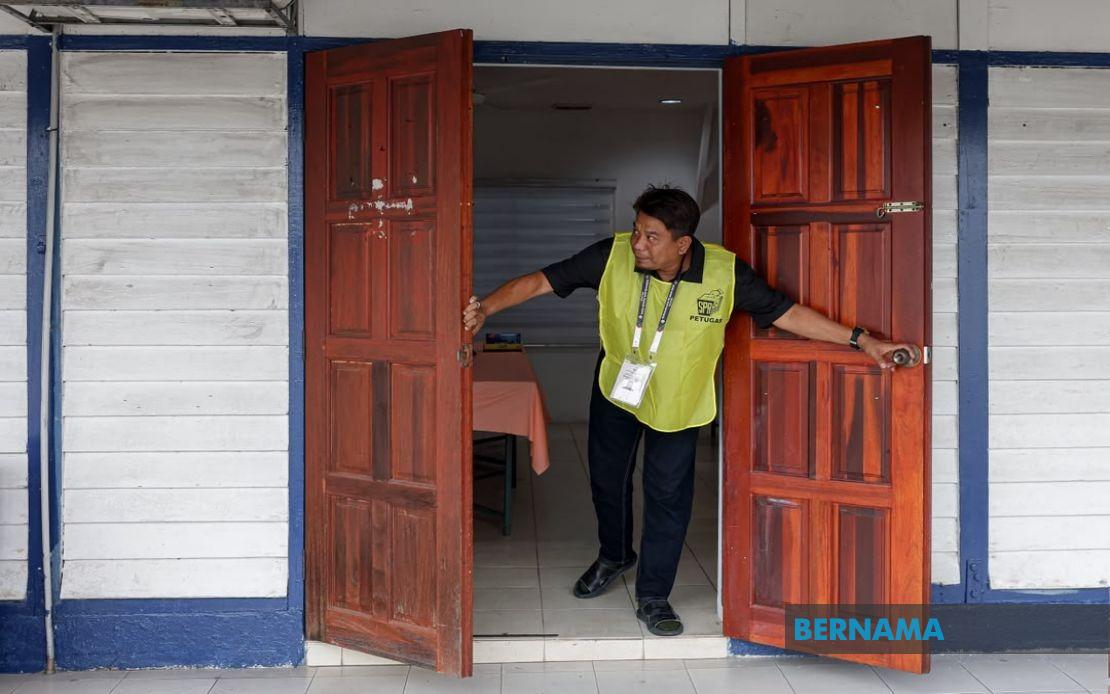
The opening phase of voting for Negeri Sembilan's 16th state election wrapped up on Sunday with a strong showing from the security establishment. All 38 polling centres accommodating early voters—comprising military and police personnel along with their spouses—shut their doors by 5 pm following a full day of operations that began at 8 am. The staggered closure schedule reflected varying voter volumes and geographical considerations, with the Election Commission overseeing the carefully managed wind-down across multiple locations.
The early voting mechanism represents a longstanding electoral practice in Malaysia, designed to accommodate uniformed personnel and their families who may face deployment or operational constraints during the main polling day. This two-tier voting system ensures that security force members, essential to maintaining order during elections themselves, have opportunity to participate in the democratic process without compromising their service obligations. For Negeri Sembilan, this proved particularly significant given the state's administrative importance and the cross-cutting concerns facing its electorate.
Election Commission chairman Datuk Seri Ramlan Harun confirmed that preliminary tallies demonstrated substantial participation levels. By mid-afternoon, approximately 14,651 individuals had successfully voted, representing 88.97 per cent of the eligible early voters—a figure approaching the commission's internal target of 90 per cent turnout for this preliminary phase. The figure comprised 9,827 military personnel and their spouses alongside 4,824 police officers and their family members, offering an institutional snapshot of the security sector's electoral engagement.
The broader early voting pool encompassed 22,339 registered voters who qualified for advance balloting procedures. Of these, 16,467 cast votes in person across the distributed polling network, while the remainder participated through postal ballot mechanisms—a provision recognising the reality that some personnel operate under deployment constraints preventing physical attendance at voting locations. The personal voting cohort itself subdivided into 11,293 military-affiliated voters and 5,174 police-affiliated voters, underscoring the substantial security presence within Negeri Sembilan's electoral machinery.
Staggered centre closures reflected operational efficiency principles adopted by the Election Commission. Initial closures occurred at noon affecting 18 locations, followed by two additional centres shuttering at 2 pm. This phased approach prevented bottlenecks while allowing commissioners to progressively concentrate resources and manage final procedural confirmations. The methodology acknowledged that early voter turnout, while predictable in aggregate terms, varied considerably across individual centres based on local security force deployment patterns and family circumstances.
Negeri Sembilan's state election carries particular resonance within Malaysia's broader political landscape, representing the thirteenth state-level contest since the 2018 general election and the third within the current calendar year. The state's political dynamics have historically reflected the complex interplay between federal coalitions and localized power structures, with implications extending beyond state administration into questions of parliamentary coalition mathematics at the national level. A total of 103 candidates are contesting the 36 available state assembly seats, indicating competitive races across multiple constituencies.
The completion of early voting establishes the foundation for Saturday's general polling day, when the broader 889,490 registered voters across Negeri Sembilan will determine the state's political future. This significantly larger cohort represents the decisive phase of the electoral process, though early voting participation rates often signal broader engagement levels and anticipated turnout patterns. The security sector's nearly 90 per cent participation suggests organized institutional participation, potentially indicative of similar enthusiasm within the general electorate.
For Malaysian readers and regional observers, state elections like Negeri Sembilan's carry implications beyond territorial governance. State assemblies control substantial resources, including land administration, local infrastructure, and economic development policies affecting daily life. Furthermore, state election outcomes provide crucial barometers for national political momentum, frequently influencing federal coalition calculations and ministerial positioning within Putrajaya's power structures. The composition of the Negeri Sembilan state assembly will therefore resonate through both state-level governance and national political dynamics.
The Election Commission's management of the early voting phase demonstrates the institutional infrastructure supporting Malaysia's electoral processes. Coordinating simultaneous voting across 38 centres while managing security force scheduling, maintaining ballot integrity, and achieving near-target participation levels reflects substantial logistical and administrative coordination. This institutional capacity, refined through numerous elections across the federation, underpins the credibility and reliability Malaysia's electoral system maintains within the Southeast Asian region.
As voters prepare for Saturday's main polling, the early voting completion milestone marks a transition from preliminary institutional participation to the decisive phase determining Negeri Sembilan's next government. The strong early turnout establishes a momentum trajectory suggesting considerable voter engagement with the electoral process. Saturday's general polling will reveal whether this preliminary enthusiasm translates into broader participation across the state's diverse constituencies, ultimately determining which coalition configurations will shape Negeri Sembilan's governance trajectory and influence Malaysia's evolving political equilibrium.

