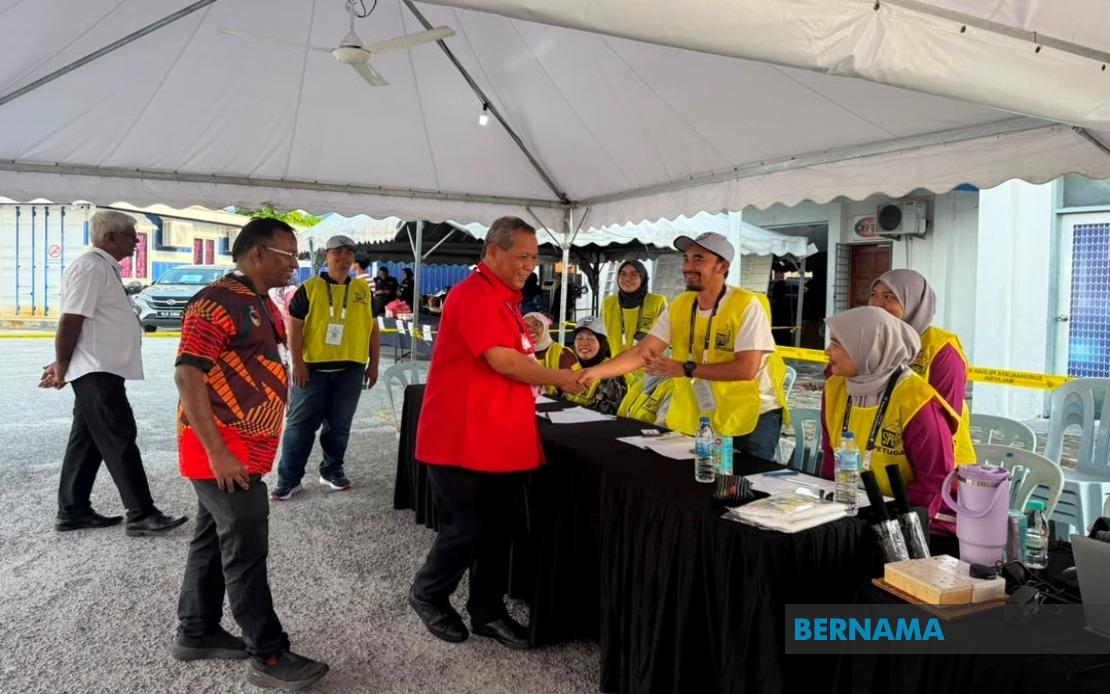
The Negeri Sembilan state election campaign entered its final stretch on July 28 as candidates from competing coalitions took the opportunity to observe the early voting process unfold across multiple polling stations. Throughout the morning, the voting proceedings operated without incident, reflecting careful coordination between election authorities and law enforcement agencies tasked with facilitating this crucial segment of the democratic process.
Menteri Besar Datuk Seri Aminuddin Harun, the Pakatan Harapan standard-bearer for the Linggi constituency, made his way to the Port Dickson District Police Headquarters in the early morning hours to witness the early voting operation firsthand. Arriving at 9 am, Aminuddin engaged with the police officers and other personnel who were themselves exercising their right to vote before the general polling day. His presence underscored the high-profile nature of this particular election, with senior state leadership keen to ensure the integrity and accessibility of the voting mechanisms.
In his remarks to assembled journalists, Aminuddin expressed satisfaction with the turnout and efficiency observed at the Port Dickson venue. He particularly highlighted the professionalism demonstrated by the police contingent, recognising their dual role as both election officials and participants in the democratic franchise. His comments reflected a broader emphasis on institutional competence and the seamless functioning of Malaysia's electoral machinery, themes that resonate strongly with voters concerned about the credibility of the election process itself.
Parallel to these observations in Port Dickson, the Barisan Nasional coalition was similarly represented at early voting stations across the state. In the Jelebu constituency, Datuk Seri Jalaluddin Alias, the BN candidate for the Pertang seat, arrived at approximately 8 am to inspect proceedings at the Jelebu District Police Headquarters. His visit followed a comparable pattern to that of Aminuddin, combining direct observation of voting operations with courtesy interactions with the officials and personnel present. Such visits, while routine aspects of electoral campaigns, carry symbolic weight in demonstrating a candidate's attentiveness to procedural fairness and transparency.
The early voting phase typically encompasses police officers, military personnel, and other essential service workers who cannot easily participate in regular polling day activities. This mechanism ensures broader participation across all segments of society and has become a standard feature of Malaysian elections at both federal and state levels. The smooth progression of these early voting arrangements in Negeri Sembilan suggests that election authorities had properly coordinated logistics and staffing across multiple venues, a prerequisite for maintaining public confidence in electoral outcomes.
The visibility of senior candidates at early voting centres serves multiple purposes within the context of electoral politics. Beyond the practical utility of observing that procedures function correctly, such visits generate positive media coverage and reinforce the notion that political leaders are invested in supporting free and fair elections. For voters who observe candidates maintaining such vigilance, it can enhance perceptions of legitimacy and commitment to democratic norms, irrespective of political affiliation.
Negeri Sembilan, a state with a relatively compact but politically significant electorate, has served as a meaningful testing ground for both major coalitions in recent electoral cycles. The state's electoral mathematics often reflect broader trends visible across Malaysia, making its contests more than parochial affairs. The smooth functioning of early voting procedures bodes well for the main polling day and provides an early indicator of administrative preparedness.
The presence of both Pakatan Harapan and Barisan Nasional representatives at different venues, each observing independently and providing their own assessments, creates a form of mutual accountability. When candidates from opposing camps both confirm that voting proceeded orderly and professionally, such convergent observations carry credibility that might be questioned if only a single partisan source provided commentary. This cross-partisan observation thus serves an important democratic function in validating the integrity of the process itself.
Looking forward, the momentum of the campaign will likely intensify in the final days before the main election. The early voting observations may set the tone for final campaign messaging, with both coalitions able to point to efficient administration as evidence of their respective commitment to Malaysian democratic values. For voters still undecided, the professionalism demonstrated by election administrators can sometimes influence perceptions of whether a particular government can be trusted with continued stewardship of public institutions, an underlying consideration in many electoral decisions.

