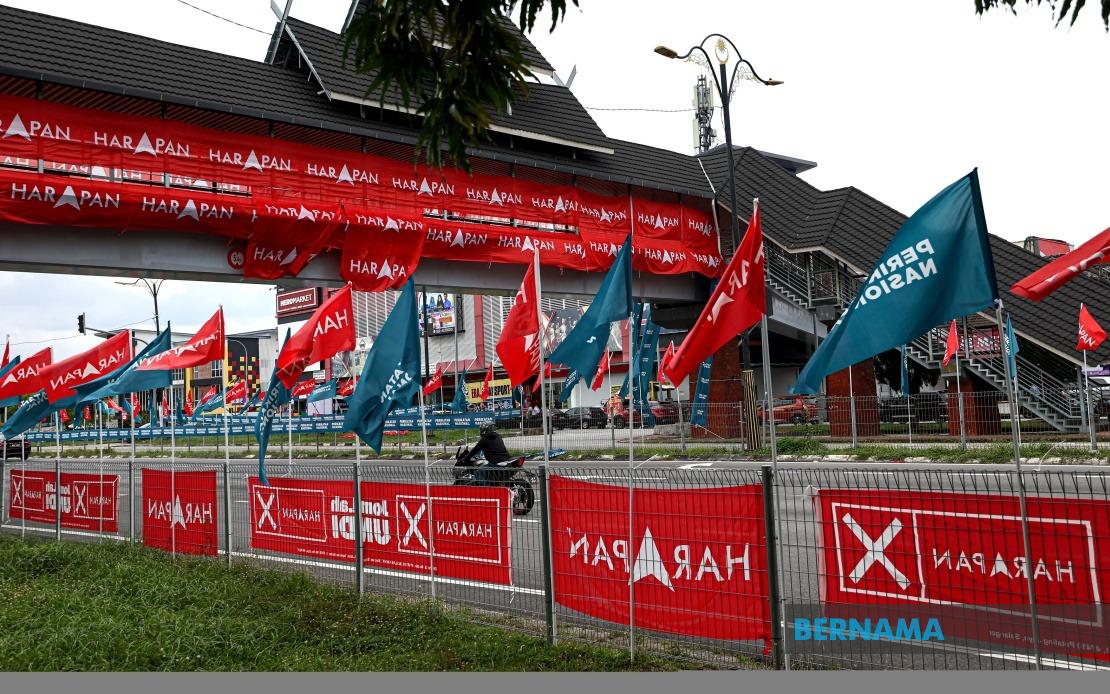
The opening week of Negeri Sembilan's 16th state election campaign has proceeded at a measured pace, with the major political coalitions employing cautious, ground-level strategies rather than the high-visibility spectacles that have traditionally marked the opening salvos of electoral contests. As the campaign entered its second week starting July 25, observers and political analysts anticipated a notable shift in intensity, with party operatives expected to deploy more senior leaders and escalate coordination across the 36 contested state seats.
Traditional campaign markers that typically dominate the opening phase—the "flag war" of partisan signage and banners adorning public spaces—have been notably subdued throughout this first week. The visual competition between rival coalitions has instead concentrated itself in discrete locations: neighbourhood community halls, village roads, major traffic thoroughfares, and elevated thoroughfares where specific voter concentrations gather. This selective approach reflects a strategic calculation that broad decorative campaigns yield diminishing returns compared to precision targeting of persuadable voters, a calculation that increasingly shapes electoral strategy across the region.
Both the Pakatan Harapan coalition and Barisan Nasional have thus far emphasised intimate voter contact over mass rallies or elaborate public events. Prime Minister Datuk Seri Anwar Ibrahim, serving as PH chairman, has made two visits to Negeri Sembilan during the campaign period to support candidates and coordinate messaging. Deputy Prime Minister Datuk Seri Dr Ahmad Zahid Hamidi, leading the BN machinery, has deployed himself more frequently with three visits to the state, suggesting a recognition that hands-on leadership presence remains essential for motivating ground-level party workers and communicating coalition priorities to local party structures and candidate teams.
The campaign's opening days have unfolded through familiar mechanisms of electoral persuasion: house-to-house canvassing expeditions that allow candidates to engage voters in informal settings, attendance at congregational prayers that provide organic access to community gathering spaces, and neighbourhood walkabouts designed to establish personal familiarity between candidates and constituents. These micro-level interactions serve a dual purpose within contemporary electoral strategy. They generate the direct voter contact that survey research suggests now carries greater weight with undecided voters, whilst simultaneously creating opportunities for candidates to appear accessible and engaged—qualities that increasingly matter to electorates across Southeast Asia.
Menteri Besar Datuk Seri Aminuddin Harun, who is defending his Linggi state constituency seat under the PH banner, has explicitly framed the opening-week strategy as deliberate micro-campaigning focused on systematic voter engagement rather than headline-grabbing activities. He has acknowledged that PH would intensify operations moving into the second and third weeks of the campaign calendar, though he has cautioned against premature seat projections, recognising the volatile nature of electoral forecasting in a three-way contest featuring PH, BN, and Perikatan Nasional as significant forces.
Barisan Nasional's coordination structures have likewise emphasised the consolidation of organisational presence across all contested constituencies. Datuk Seri Mohamad Hasan, serving as BN deputy chairman and currently representing the Rantau state seat whilst holding the Foreign Minister portfolio, has stressed the importance of sustained grassroots momentum and continuous voter contact as prerequisites for securing what BN hopes will be a competitive showing. His remarks underscore BN's awareness that Negeri Sembilan represents strategically important electoral terrain, with outcomes potentially influencing broader national political dynamics given the state's status as a traditionally competitive battleground.
Datuk Seri Jalaluddin Alias, the UMNO liaison chairman for Negeri Sembilan and incumbent Pertang assemblyman, has reported positive campaign momentum within the Jelebu parliamentary division, noting that BN candidates have progressively expanded their voter outreach operations to achieve broader constituency coverage. These operational updates from senior BN figures reflect an organisational approach centred on systematic ground presence and candidate visibility as the foundations of electoral success, a methodology that remains resilient despite evolving communication technologies.
Political scientists observing the campaign trajectory have begun identifying emerging contest dynamics. Dr Mujibu Abd Muis, a senior Political Science lecturer at Universiti Teknologi MARA's Seremban campus, has noted that the electoral landscape is crystallising into a predominantly two-coalition contest, with Perikatan Nasional still in early stages of momentum-building. PH's deployment of targeted micro-campaigning strategies—focused engagement with specific voter segments rather than undifferentiated appeals—represents a notable methodological choice reflecting broader shifts in voter behaviour and campaign efficiency.
These strategic evolutions point toward fundamental changes in how Malaysian voters evaluate political choices. Rather than being swayed primarily by traditional political rhetoric or large-scale campaign spectacles, contemporary electorates increasingly assess candidates based on demonstrated community engagement capacity and personal accessibility. Voters now prioritise candidates' ability to listen to localised concerns and maintain direct communication channels over their delivery of scripted political messages. This attitudinal shift carries profound implications for candidate recruitment, campaign training, and resource allocation across political parties, favouring those organisations capable of deploying multiple candidates with genuine community roots rather than relying on imported political personalities.
Electoral analysts have highlighted that the campaign's final week typically determines outcomes, as fence-sitters and genuinely undecided voters consolidate their choices during the closing phase. The second and third weeks will thus prove decisive in shaping candidate momentum and voter sentiment. Political parties recognised this dynamic and were preparing to significantly escalate their visible campaign presence, deploying more senior leaders and intensifying coordination across their respective organisations.
The candidate field itself reflects Negeri Sembilan's political diversity. A total of 103 candidates are contesting the 36 state seats across multiple political formations. Pakatan Harapan has fielded the most comprehensive slate with 36 candidates covering every contested seat, establishing the organisational density necessary for comprehensive voter contact. Barisan Nasional has nominated 25 candidates, Bersatu 24 candidates, and Perikatan Nasional 11 candidates, with smaller parties including Barisan Jemaah Islamiah Se-Malaysia, Parti Orang Asli Malaysia, and Parti Sosialis Malaysia each fielding individual candidates alongside four independent contenders. This fragmented field creates complex dynamics where second-place finishes in three-way contests could determine ultimate seat distributions.
The electoral calendar provided parties with specific operational milestones. Early voting was scheduled for July 28, providing an opportunity for advance voting turnout analysis that could inform final-week campaign adjustments. Polling day itself was set for August 1, creating a compressed campaign period where parties needed to achieve maximum voter contact and persuasion within limited timeframes. This compressed schedule intensified competition for candidate visibility and voter attention, encouraging parties to deploy limited resources with maximum strategic precision rather than through wasteful broad-based expenditure.

