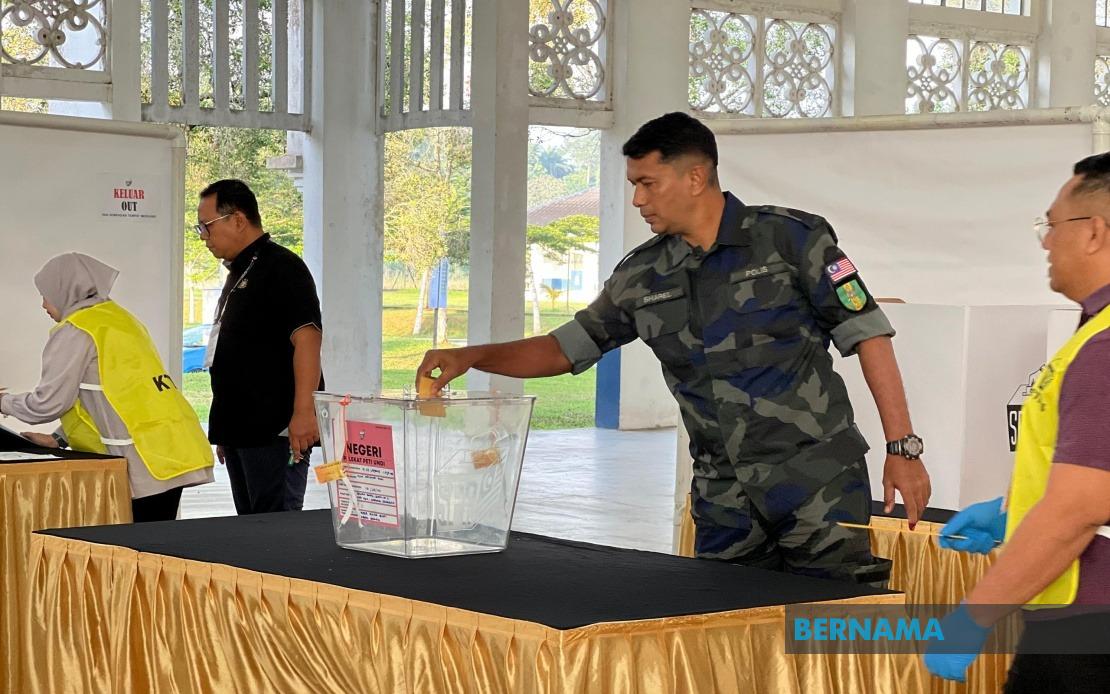
Close to 25,000 members of Malaysia's armed forces and police personnel cast their votes early on July 7 in the lead-up to Johor's 16th state election, underscoring the logistical complexity of accommodating voters in uniform across the peninsular state. The early voting exercise involved 24,751 eligible electors, comprising military servicemen and women alongside police and paramilitary officers, along with their respective spouses. This group accessed ballots at 64 designated polling centres strategically positioned throughout Johor, facilitating participation by those whose operational duties during the main polling day on July 11 would otherwise prevent them from voting.
The composition of the early electorate revealed the significant security apparatus dedicated to maintaining order during state elections. The Malaysian Armed Forces contingent numbered 12,041 personnel and family members, while the police and General Operations Force brought 12,710 voters to the polls. Within the police cohort, 12,067 individuals cast ballots in person at their assigned centres on the early voting date, with an additional 643 having exercised postal voting privileges in advance. This bifurcated approach to police voting reflected the diverse operational schedules and deployment patterns across PDRM and GOF units.
The physical infrastructure supporting early voting illustrated the administrative demand placed upon Johor's election machinery. Police established 53 dedicated polling centres across the state, while the military operated 11 facilities to service personnel. All venues opened simultaneously at 8 am, creating a coordinated voting environment that reduced congestion and ensured uniform procedural implementation. However, closing times varied considerably depending on voter concentration, ranging from noon for locations with minimal electorates to 6 pm for high-traffic stations.
Certain polling locations recorded exceptionally small voter populations, highlighting the geographical distribution of security personnel across Johor. Tenang Police Station in the Tenang state constituency accommodated merely six voters, whilst Bukit Besar Police Station in the Pasir Raja constituency served eleven. These modest numbers meant such centres could complete operations by midday and secure their premises efficiently. Conversely, major hubs including Muar District Police Headquarters, Kahang Police Station in the Kahang constituency, and Johor Bahru Utara IPD maintained operations until the evening deadline to process their larger rosters.
Securing the early voting exercise required substantial police deployment and coordination. The force mobilised 3,565 personnel for election duties, comprising 647 commissioned officers, 2,806 rank-and-file constables, and 112 civilian administrative staff. Their responsibilities encompassed perimeter security at polling centres, physical escort of sealed ballot boxes, traffic management in surrounding areas, preventive crime patrols to deter disruptions, operation of command centres, surveillance of sensitive locations, and law enforcement throughout the electoral period. This deployment underscored the security-conscious approach Malaysian authorities adopt during state elections.
Balances between accessibility and security protocols governed the handling of early ballots. Once voters deposited their marked papers, ballot boxes entered secure custody at designated police stations under controlled conditions. These sealed containers remained unopened and unexamined until after polling closed on Saturday, July 11, at regular voting stations. This delayed count ensured early and ordinary votes mixed together during tabulation, preventing any temporal manipulation of results and maintaining the integrity of the electoral process.
The 16th Johor state election represented a substantial electoral exercise extending beyond early voters. A total of 172 candidates competed for 56 state assembly seats, seeking the mandate of 2.7 million registered voters. Johor's size as Malaysia's second-largest state by population necessitated meticulous planning to accommodate such numbers. The early voting window for security personnel represented a small but essential component of this broader democratic exercise, acknowledging the constitutional right of uniformed service members to participate whilst accommodating their operational schedules.
Johor has historically served as a critical testing ground for Malaysian politics, with state elections often foreshadowing broader political shifts in the peninsula. The July 11 polling date would see voters across multiple constituencies evaluate incumbent and challenger parties, with potential ramifications for federal politics. Early voting procedures demonstrated institutional commitment to inclusive participation, even as the security forces' prominent role in early voting reflected the state's reliance upon uniformed services for election administration and security.
The logistical achievement of conducting early voting across 64 centres simultaneously showcased Johor's electoral infrastructure. Coordinating military and police personnel participation required communication across multiple agencies, venue preparation, poll worker training, ballot distribution, and security briefings. The successful execution of this phase presaged the larger polling day operations, where similar coordination would extend across all constituencies. For Malaysian readers, this exercise exemplified the institutional mechanics underlying democratic elections, revealing the considerable bureaucratic effort undergirding what voters experience as a single day of balloting.

