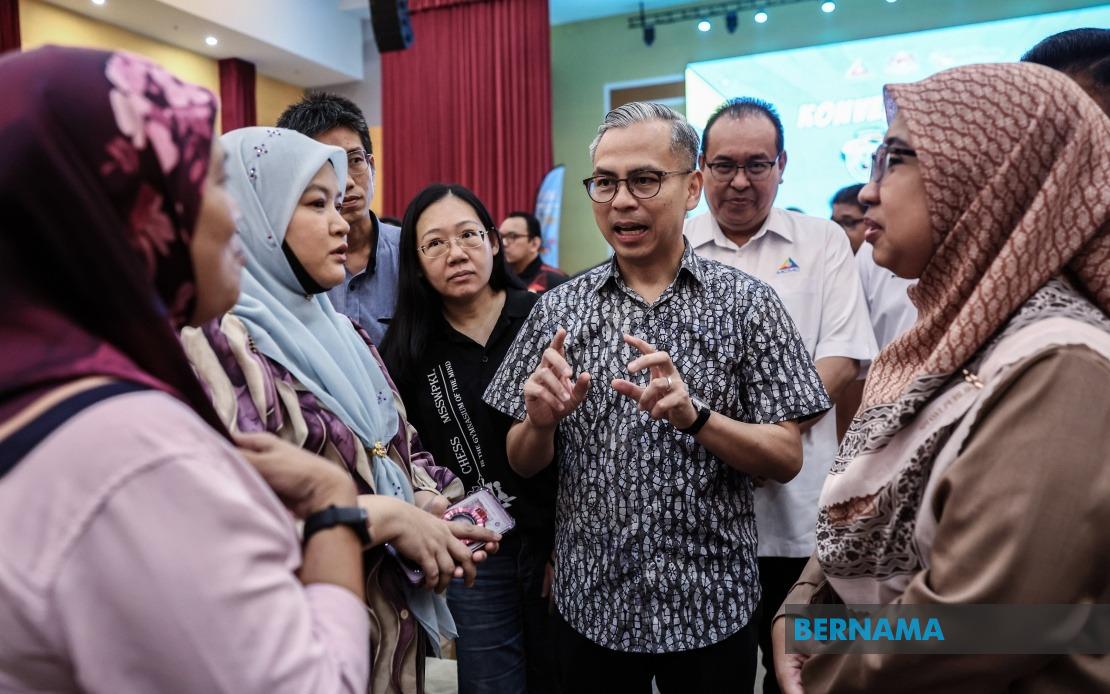
The Malaysian government has moved to draw a clearer line between public resources and political patronage by reaffirming that the MyKhas fund exists solely to benefit ordinary voters and residents within parliamentary constituencies, not to enrich individual Members of Parliament. Communications Minister and PKR Information Chief Datuk Seri Fahmi Fadzil made this distinction explicit during a media briefing in Kuala Lumpur on Thursday, emphasising that the special allocation operates under the direct control of Prime Minister Datuk Seri Anwar Ibrahim and is formalised within Malaysia's budget and planning frameworks.
The clarification comes as part of a broader governance message from the MADANI administration regarding the proper use of state resources. Fahmi stressed that no elected representative, himself included, possesses personal rights to MyKhas funds. Instead, the mechanism functions as a direct channel through which the Prime Minister's office channels support to communities based on identified needs within their electoral divisions. This positioning reflects Anwar's repeated assertion that government allocations fundamentally belong to the people they serve, not to the politicians who represent those areas.
The MyKhas structure, according to Fahmi, draws its legitimacy from its formal recognition in Malaysia's budget documents and medium-term planning instruments. Rather than being an ad hoc political tool, the fund operates within established administrative parameters that specify how disbursements may be allocated. The Prime Minister retains discretion over the distribution mechanism, but that discretion is exercised with a view to addressing constituency-level welfare concerns such as educational facilities, religious infrastructure, municipal services, and essential repairs to public amenities like drainage systems.
This governance framework carries particular significance for Malaysia's federal system, where the distribution of resources between ruling and opposition-controlled areas has historically been a source of political tension. By anchoring MyKhas in Prime Minister-level administration rather than allowing individual MPs to control it, the government aims to create a buffer against the perception that public funds are withheld from constituencies represented by opposition members. Fahmi acknowledged this dynamic by noting that applications for assistance in opposition-held states can be processed through the Implementation Coordination Unit under the Prime Minister's Department, establishing a formal pathway that does not depend on the political affiliation of local representatives.
The emphasis on this distinction reflects international best practices in governance, where separating the legislative functions of elected representatives from their ability to personally allocate public resources is seen as essential to reducing corruption and patronage systems. In Southeast Asian democracies, the blurring of lines between personal and public resources has frequently undermined institutional trust. Malaysia's move to formalise MyKhas as a Prime Minister-administered mechanism rather than an MP prerogative represents an effort to strengthen that boundary, though implementation and public perception remain important variables.
Anwar's statements on this matter, delivered publicly the day before Fahmi's press conference, underscored the administration's commitment to this messaging. The Prime Minister outlined how constituency allocations might be deployed across diverse infrastructure and social needs—schools, religious institutions, places of worship, and public works—suggesting that the funds are intended to address genuine community requirements rather than to benefit individual politicians or their patronage networks. This framing positions government resource allocation as a technocratic exercise responsive to constituency needs rather than a political transaction.
For Malaysian voters and constituents, the practical implication is that access to MyKhas support should theoretically depend on the merits of an application and the genuine needs of a community, not on whether the local MP belongs to the ruling coalition or the opposition. This represents a departure from past governance patterns in which opposition-held constituencies sometimes faced resource disadvantages. The creation of a formal application process through the Prime Minister's Implementation Coordination Unit provides opposition representatives with a mechanism to petition for their constituents' needs without depending on the goodwill of their MPs.
However, the effectiveness of this system depends on how transparently and impartially the Prime Minister's office processes and approves applications. Public confidence in the mechanism requires not only the formal rules governing MyKhas but also demonstrated adherence to those rules in practice. Fahmi's explicit statement that even he, a senior government minister, cannot access MyKhas for personal benefit sets a stated standard of conduct, though whether such standards are uniformly observed across all government levels will likely invite scrutiny from civil society and opposition watchdogs.
The distinction between MyKhas as a public welfare mechanism and as a form of political entitlement also resonates within the broader MADANI administration framework, which has positioned itself as committed to institutional reform and the reduction of executive patronage. The ruling coalition's messaging emphasises that governance structures should prioritise public welfare over political advantage, a principle that Fahmi's clarification seeks to operationalise through the MyKhas framework. This ideological commitment, whether fully realised in practice, shapes the discourse around how public resources should be distributed in Malaysia's electoral democracy.
For opposition-held states and constituencies, the clarification potentially opens avenues for resource access that might otherwise be closed if MyKhas functioned purely as an MP-controlled discretionary fund. The existence of a centralised application process suggests that opposition representatives can advocate for their constituents' needs without fearing that their political opposition will automatically disqualify them from accessing government allocations. This is particularly relevant in Malaysia's competitive federal politics, where the composition of state and federal governments does not always align, creating governance complexity that formalised resource-distribution mechanisms can help navigate.
The timing of this clarification, delivered during a Safe Internet convention, also reflects the administration's broader communication strategy around governance and institutional integrity. By repeatedly and publicly stating that public allocations are not personal entitlements, government leaders seek to establish a normative standard that shapes both internal bureaucratic behaviour and public expectations. In a democracy where informal networks and patronage relationships have historically exercised significant influence, such explicit verbal commitments serve as benchmarks against which government performance can be measured.
Looking forward, the MyKhas framework's success will depend on sustained implementation consistency, transparent reporting on how funds are distributed, and the willingness of opposition parties and civil society organisations to hold the government accountable for adherence to the stated principles. The clarification that MyKhas serves constituencies rather than individual MPs represents a governance position that can be tested, verified, and evaluated—making it more than merely rhetorical if the administration demonstrates commitment to these principles through its allocation decisions across all parliamentary constituencies regardless of political control.

