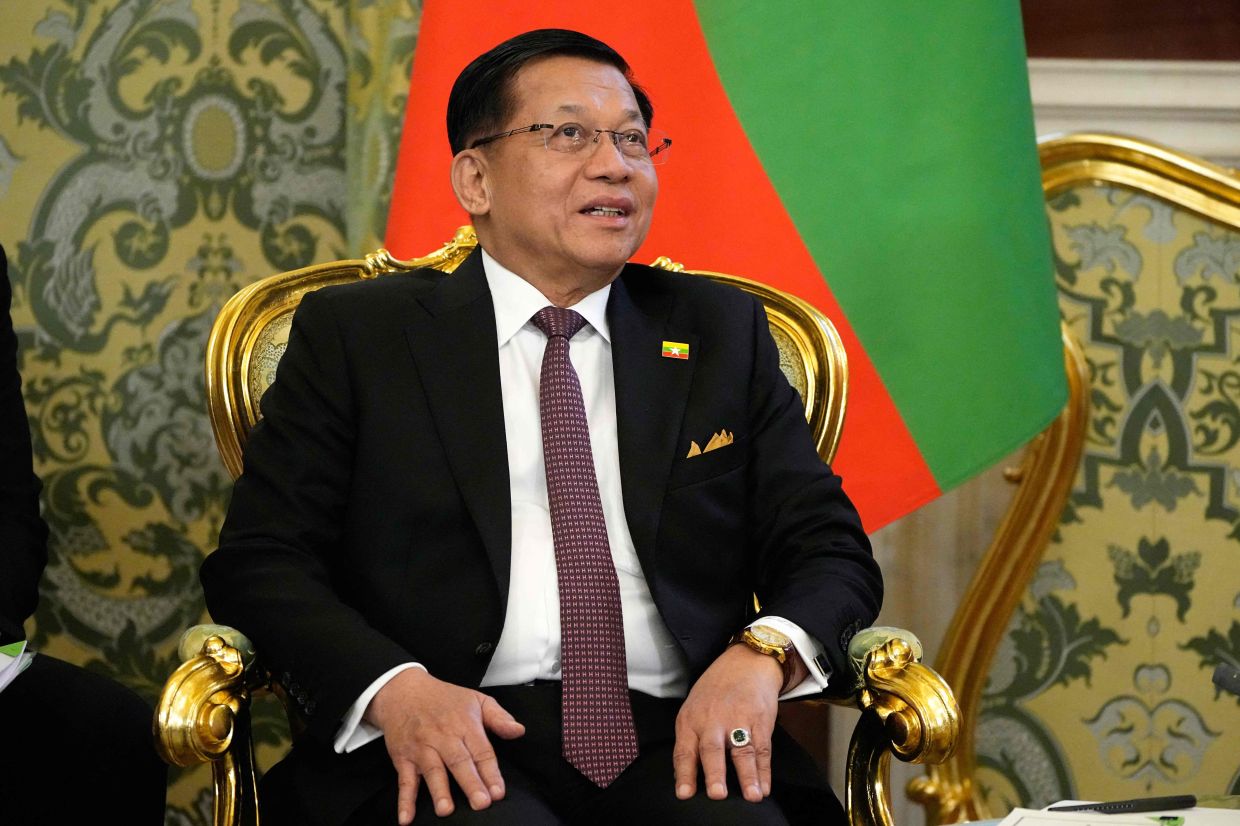
Myanmar's military leader Min Aung Hlaing is set to visit Cambodia in early September, according to an announcement confirmed by Cambodia's Senate. The trip marks another step in an international diplomatic campaign that has already taken the general across Asia, including visits to Russia, China, India and Thailand. Officials from Cambodia have described the visit as an opportunity to deepen ties between the two Southeast Asian neighbours and expand bilateral cooperation on matters of shared interest.
The Cambodian government has begun preparations for the visit, with Senate officials including Kuy Sophal, Minister of the Royal Palace, and Chin Ketna, permanent deputy chairman and secretary-general of the National Committee for Organising National and International Festivals, examining suitable venues for receiving the Myanmar delegation. A Senate spokesperson told media that the engagement reflects a commitment to nurturing "the friendship between Cambodia and Myanmar" and emphasised that mutual cooperation benefits both nations.
Min Aung Hlaing's international travel agenda has accelerated dramatically since his election as president in April following a controversial military-controlled poll that observers and democracy advocates widely dismissed as lacking legitimacy. Within months of assuming office, he has already embarked on official visits to India, China, Laos, Thailand and Russia, establishing himself as an active participant in regional diplomacy. The rapid succession of foreign engagements has prompted scrutiny from international observers who view these trips as a calculated strategy to present the military leader as Myanmar's legitimate civilian authority on the global stage.
This diplomatic offensive occurs against a backdrop of mounting international criticism regarding Myanmar's human rights record under military rule. Since the February 2021 coup that deposed elected civilian leader Aung San Suu Kyi, Myanmar has faced accusations of systematic abuses including arbitrary detentions of thousands of activists, dissidents and democracy advocates. Ms Suu Kyi herself remains imprisoned, and her continued detention has become a focal point for international concern about the country's governance and respect for fundamental freedoms.
The consequences of these developments have reverberated throughout the Association of Southeast Asian Nations (Asean), the regional bloc to which Myanmar belongs. Citing concerns over the coup and subsequent human rights violations, Asean member states have excluded Myanmar's delegation from summit-level meetings, a significant diplomatic sanction that reflects regional disapproval of the military takeover. Despite Myanmar's membership in the bloc, the country remains isolated within Asean's formal proceedings, underscoring the diplomatic isolation that Min Aung Hlaing faces within his own region.
Kin Phea, president of Cambodia's International Relations Institute, offered a nuanced assessment of the forthcoming visit, characterising it as serving mutual interests rather than solely benefiting the Myanmar leader. He noted that Cambodia itself has demonstrated commitment to Myanmar's political situation, particularly during Cambodia's tenure as Asean chair in 2022 when Phnom Penh attempted to facilitate dialogue and ease regional tensions. From this perspective, the visit represents a continuation of Cambodia's diplomatic engagement with its neighbour, rather than merely providing a platform for legitimacy-seeking.
Yet Kin Phea acknowledged the broader context of Min Aung Hlaing's diplomatic travels, observing that the Myanmar leader's international circuit pursues legitimacy consolidation through accumulated state-level recognition. The strategy appears designed to gradually normalise his position internationally and counter the perception that he leads an illegitimate military regime. Cambodia's willingness to host such a visit can be interpreted as tacit acceptance of Min Aung Hlaing's authority, even if implicit rather than explicitly stated.
Cambodia's own experience with political transition, reconciliation and national reconstruction offers potential lessons for Myanmar, according to Kin Phea, who suggested that bilateral exchanges could facilitate knowledge-sharing on peace-building and unity initiatives. However, he cautiously noted that external diplomatic engagement alone cannot resolve Myanmar's underlying political challenges, which demand substantive internal reforms and genuine commitment from within Myanmar itself.
Crucially, Kin Phea highlighted that individual countries' decisions to receive Min Aung Hlaing, including Cambodia's upcoming visit, operate independently of Myanmar's broader standing within Asean. The regional bloc's commitment to Myanmar's political trajectory remains anchored in Asean's five-point consensus on Myanmar, a framework agreed by member states as a condition for Myanmar's reintegration into Asean's highest-level forums. Whether the military leader can return to Asean summits and fully restore Myanmar's standing depends not on bilateral visits or recognition by individual nations, but on Myanmar's compliance with this collective regional agreement. Cambodia's diplomatic reception of the Myanmar leader, therefore, represents a distinct gesture from Asean's formal institutional position on Myanmar's status within the bloc.

