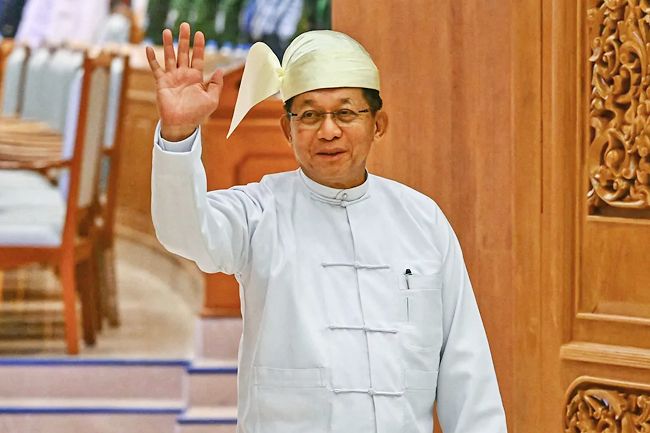
Myanmar's military leader Min Aung Hlaing will travel to Bangkok on August 6 and 7 for bilateral meetings with Thai Prime Minister Anutin Charnvirakul, Thailand's foreign minister Sihasak Phuangketkeow announced this week following diplomatic consultations in Manila. The scheduled visit underscores Thailand's determined push to maintain dialogue with its neighbour despite Myanmar's pariah status within the regional bloc, a stance that has proven contentious among ASEAN members.
The announcement came after what Sihasak characterised as a frank discussion among Southeast Asian foreign ministers regarding the pathway for Myanmar's rehabilitation within the Association of Southeast Asian Nations. Though Myanmar retains nominal membership, it has been effectively sidelined from all major ASEAN gatherings since the junta's 2021 coup dismantled the democratically elected government of Aung San Suu Kyi. This institutional limbo has created persistent friction within the bloc, with member states adopting divergent approaches to engagement with the military administration.
Thailand's geographical and humanitarian circumstances distinguish its position from other ASEAN members. The country shares an extensive border with Myanmar, currently wracked by internal armed conflict, and hosts a substantial refugee population displaced by the ongoing civil war. These realities have motivated Bangkok to pursue what it frames as pragmatic bilateral diplomacy rather than maintaining the collective freeze endorsed by more critical ASEAN voices. Such unilateral engagement, however, has generated tension with nations favouring a unified regional response.
Sihasak characterised the upcoming visit as part of a "dual-track approach," which attempts to balance immediate practical concerns with ASEAN's broader strategic objectives. Thailand intends to address pressing bilateral issues ranging from transnational organised crime and cross-border fraud schemes to drug trafficking, challenges that directly affect Thai national security and public order. These concrete concerns provide Thailand with justification for maintaining channels of communication, framing engagement not as political normalisation but as essential cross-border cooperation.
Yet Thailand insists its bilateral diplomacy does not entail abandoning ASEAN's established five-point peace framework, a position likely designed to assuage critics within the bloc. The framework, originally proposed to guide Myanmar's transition, emphasises dialogue, humanitarian aid, and national reconciliation. Sihasak's reassurance suggests Thailand views its individual outreach as complementary rather than contradictory to collective ASEAN strategy, though sceptics may question whether bilateral accommodation inadvertently undermines collective leverage.
Central to Thailand's recalibrated approach is redefining what constitutes meaningful progress in Myanmar's political trajectory. Rather than demanding immediate comprehensive reforms, Sihasak proposed incremental benchmarks: whether the junta grants ASEAN's special envoy access to the detained former leader Aung San Suu Kyi, or whether violence diminishes along the Thai-Myanmar border. This gradualist framework acknowledges Myanmar's entrenched military control while creating measurable waypoints for engagement. The philosophy reflects a pragmatic acknowledgement that transformative change cannot be imposed externally or rapidly achieved.
Sihasak's candid admission that progress "is not going to happen overnight" signals Thai acceptance of a protracted timeline for Myanmar's rehabilitation. Such patience diverges markedly from the approach favoured by some ASEAN members who maintain that sustained pressure remains necessary to incentivise democratic transition. Thailand's willingness to invest in incremental gains, however modest, potentially undermines unified ASEAN conditionality, yet Bangkok evidently judges that sustained isolation produces fewer tangible benefits for regional stability.
The junta's recent elections, which formalised Min Aung Hlaing's status as president despite widespread international criticism and a military-dominated parliament, might paradoxically create openings that Thailand intends to exploit. Sihasak expressed cautious optimism that these developments could facilitate renewed dialogue with Myanmar's armed ethnic groups and democratic opposition forces, particularly those operating along the Thai border. Thailand's proposed role as facilitator of such conversations reflects its strategic interest in reducing cross-border instability and demonstrates how bilateral engagement might serve broader regional peace-building objectives.
Meanwhile, the Philippines raised the possibility of establishing a permanent, full-time ASEAN special envoy to Myanmar, acknowledging that the existing rotating annual system has proven ineffective. This institutional reform proposal, if adopted, would formalise the diplomatic effort that currently lacks sustained institutional weight. A dedicated envoy could maintain consistency in messaging and relationship-building, potentially lending credibility to ASEAN's engagement efforts and providing a permanent channel for dialogue that transcends the limitations of annual rotations.
The broader context reveals deep fissures within ASEAN regarding Myanmar policy. Thailand's bilateral activism represents one pole; other members favour maintaining stronger conditions for re-engagement. These divisions expose fundamental questions about ASEAN's cohesion and its capacity to coordinate foreign policy responses to major regional crises. Myanmar's ongoing civil war, humanitarian catastrophe, and strategic position bordering China and India guarantee that the nation will remain a focal point for intra-ASEAN tension and competing strategic calculations. Thailand's August meetings with Min Aung Hlaing will likely prove emblematic of these broader challenges.
For Malaysia and other Southeast Asian economies, Myanmar's continued instability carries practical consequences. Refugee flows, drug trafficking, transnational crime, and the spillover effects of armed conflict create security challenges that transcend national borders. Whether ASEAN can forge a coherent approach that combines diplomatic engagement with principled conditionality remains uncertain. Thailand's pragmatic bilateralism may succeed in reducing immediate tensions, or it may inadvertently enable indefinite military rule by reducing external pressure for genuine political change. The outcomes of Bangkok's August discussions with the junta leader will offer clarifying signals regarding which trajectory regional diplomacy is likely to follow.

