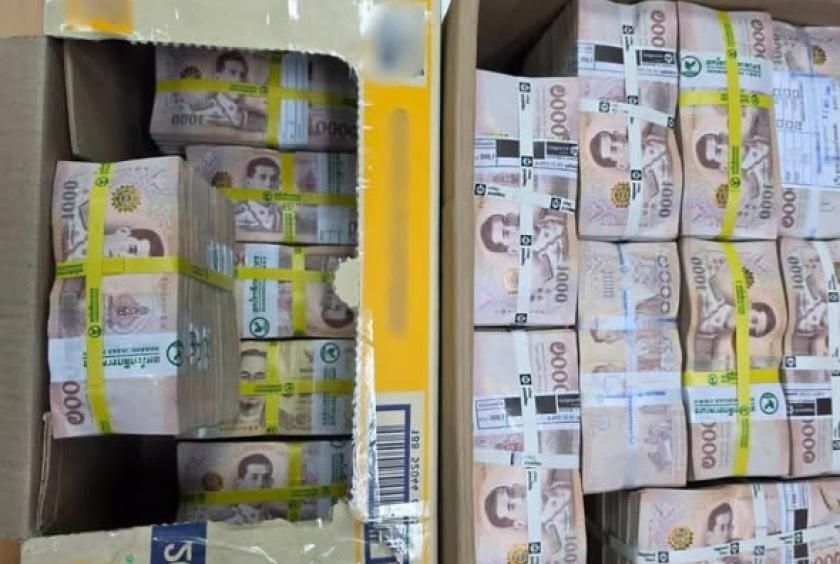
Authorities in Thailand have apprehended a Myanmar driver suspected of attempting an illegal currency smuggling operation across the Thai-Myanmar border. The arrest took place at the Mae Sai checkpoint on the Friendship Bridge, where customs officials discovered Thai currency hidden in unconventional packaging during a routine vehicle inspection. The interception highlights ongoing concerns about illicit cash movements through Southeast Asia's porous border regions and the methods criminals employ to circumvent currency controls.
The incident unfolded when customs officials stopped a privately owned vehicle displaying Myanmar licence plates as it approached the Mae Sai border crossing. During a standard inspection procedure, officers became suspicious of the vehicle's cargo and conducted a thorough examination of the contents. Their investigation revealed bundles of 1,000-baht banknotes secreted inside cartons ostensibly containing dried fish and potatoes—a concealment method designed to evade detection by combining bulk legitimate goods with contraband currency.
The quantity of cash discovered was substantial. Officers found approximately 17 million baht concealed within the first carton, while a second container yielded an additional 6.023 million baht, bringing the total seized amount to 23.023 million baht, equivalent to roughly US$689,077. The currency had been systematically packed in plastic bags and arranged within the food packaging to distribute weight and minimize visual detection. This methodical approach suggests some level of planning and experience in smuggling operations rather than an opportunistic attempt.
The 31-year-old driver now faces serious legal consequences stemming from the alleged violation of multiple Thai statutes. Authorities have charged the suspect under Thailand's Customs Act, which governs the movement of goods across international borders, as well as the kingdom's stringent foreign exchange control regulations. These laws are designed to prevent the unauthorized movement of currency, which authorities argue can facilitate money laundering, terrorism financing, and other illicit financial activities that destabilize the region.
Currency smuggling across the Thai-Myanmar border remains a persistent challenge for regional law enforcement. Unlike small-scale informal money transfers, organized operations involving millions of baht suggest connections to larger criminal networks or financial schemes requiring investigation. The location of the interception at the Mae Sai crossing is particularly significant, as this border point has historically served as a transit route for both legitimate commerce and illicit activities given its relatively high traffic volume and geographical accessibility.
For Malaysian readers familiar with similar enforcement operations at our own borders, the discovery underscores how currency controls operate across Southeast Asia. Thailand, like Malaysia, maintains restrictions on the amount of local currency that can be transported across borders without declaration and permission. These regulations aim to maintain monetary sovereignty and prevent capital flight that could destabilize national economies. The methods used in this case—hiding cash in food containers—represent tactics law enforcement agencies across the region increasingly encounter.
The investigation now extends beyond the apprehended driver. Thai authorities have indicated they are working to identify accomplices and network members connected to the smuggling scheme. Such operations rarely function in isolation; they typically involve facilitators on both sides of the border, arrangers who coordinate logistics, and recipients who utilize the smuggled currency. Unraveling these connections requires sustained investigative work and potentially cross-border cooperation between Thai and Myanmar authorities, though such collaboration can be complicated by geopolitical tensions and differing law enforcement capabilities.
The broader context of this arrest reflects mounting pressures on Southeast Asian border security. The region faces challenges from drug trafficking, weapons smuggling, and financial crimes that exploit inadequate border infrastructure and porous crossing points. While major checkpoints like Mae Sai benefit from improved surveillance and staffing, remote and informal crossing points remain vulnerable. Myanmar's ongoing political instability has further complicated border management, with increased economic uncertainty potentially driving citizens to move funds across borders through illicit channels.
From a financial crime perspective, large-scale currency smuggling often connects to money laundering networks that require movement of bulk cash to convert illicit proceeds into usable funds. The destination of these 23 million baht and the intended use remain unknown, but the substantial quantity suggests involvement in significant criminal or corruption-related activity. Regional banking authorities and intelligence agencies view such interceptions as valuable intelligence opportunities to map larger criminal networks and financial flows.
The suspect's detention at Mae Sai Police Station indicates the commencement of formal legal proceedings. In Thailand's judicial system, currency smuggling cases typically proceed through criminal courts, where convictions can result in substantial prison sentences and fines proportional to the amounts involved. The severity of charges reflects Thai government priorities regarding financial security and sovereignty. For comparable regional enforcement, Malaysian authorities operate under similarly strict provisions regarding unauthorized currency movement.
This case serves as a reminder of the ongoing sophistication and scale of organized smuggling operations in mainland Southeast Asia. While individual interceptions represent law enforcement successes, the persistence of such attempts suggests that criminal organizations continue identifying routes and methods they perceive as viable despite border security improvements. For travelers and businesses operating across regional borders, it reinforces the importance of understanding and complying with foreign exchange regulations to avoid inadvertent involvement in illicit activities.

