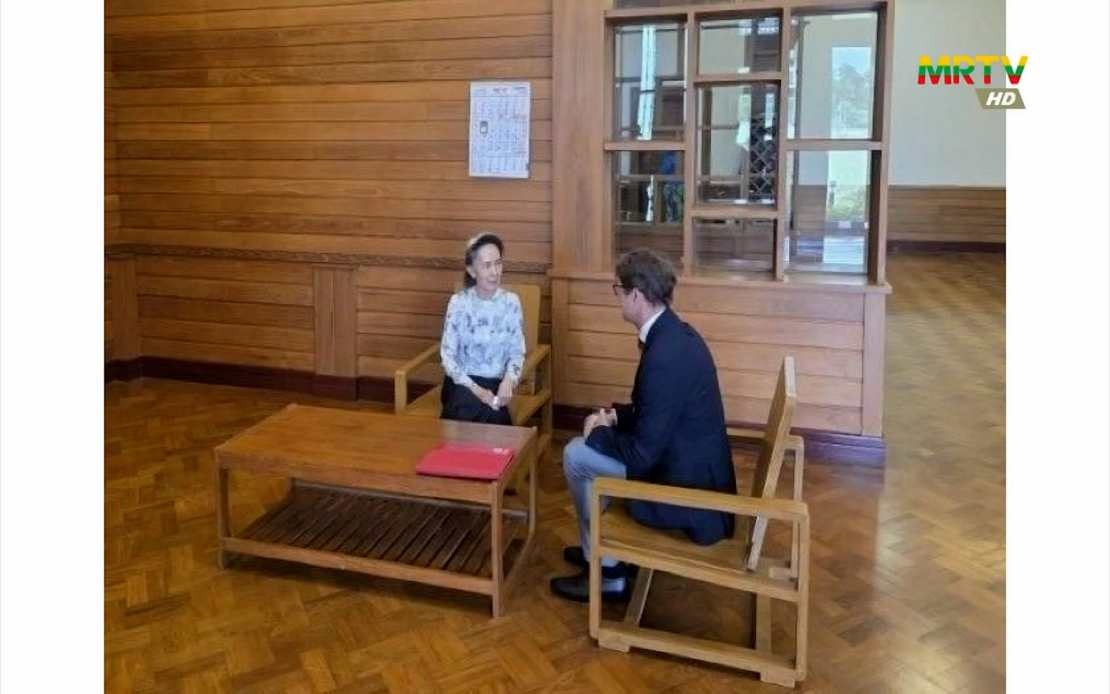
Myanmar's government announced that detained former leader Aung San Suu Kyi had met with Arnaud de Baecque, the International Committee of the Red Cross Resident Representative to Myanmar, in the capital Naypyitaw on Monday. The meeting marks a significant development in ongoing international efforts to verify the condition of the 81-year-old Nobel Peace Prize winner, who has remained largely isolated from public view since the military seized power in February 2021. Government spokeswoman Khine Khine Soe disclosed the encounter through a Telegram message accompanied by four photographs, providing the most substantial visual evidence of Suu Kyi's circumstances since her detention began.
The political trajectory that led to Suu Kyi's current detention constitutes one of Southeast Asia's most dramatic reversals of fortune. Her elected civilian government, which had won overwhelming support in democratic elections, was forcibly removed by Myanmar's armed forces in a dawn coup that shocked the region and drew international condemnation. The coup plunged Myanmar, a nation of 51 million people already grappling with economic hardship and ethnic tensions, into a spiral of instability that continues to reverberate across borders and destabilise the broader Southeast Asian landscape. Suu Kyi, as the daughter of General Aung San, the revered independence hero, symbolised the democratic aspirations of a generation of Burmese citizens who had endured decades under military rule.
Following the coup, Suu Kyi faced an extraordinarily compressed legal process. Military courts convicted her on multiple charges spanning corruption allegations, incitement to election fraud, and violations of state secrecy laws, ultimately sentencing her to 33 years imprisonment. Her legal representatives and international observers have consistently characterised these prosecutions as politically motivated instruments designed to neutralise the country's most popular political figure and prevent her return to power. The sentence was subsequently reduced to 27 years, and further shortened by one-sixth in April of this year, leaving Suu Kyi with approximately 18 years remaining to serve according to members of her legal team. These reductions, while nominally reducing her sentence, underscore the arbitrary nature of the proceedings and the junta's desire to maintain indefinite control over her fate.
The photographs released by the government offer limited but tantalising glimpses into Suu Kyi's daily existence. In two images, she appears dressed in traditional Burmese attire, sitting in a sparsely furnished, wood-panelled room with the Red Cross representative, the setting comprised only of two chairs and a desk. Another photograph provides a rare interior view, showing Suu Kyi cutting a birthday cake bearing her name, with a clothes rack and storage boxes visible in the background. A fourth image displays the cake inscribed with the date June 19, 2026, suggesting it was taken to mark her birthday. However, Reuters was unable to independently verify either the location where these photographs were taken or their actual date of capture, noting that no earlier versions had circulated online before Monday's official release.
The opacity surrounding Suu Kyi's detention has become a defining concern for her family and international observers alike. Her son, Kim Aris, revealed to Reuters in December that he possessed minimal information about his mother's health condition, receiving only sporadic and secondhand accounts of heart problems, bone ailments, and gum disease. Most troubling, he stated he had not heard directly from his mother in years, expressing profound anxiety that she might pass away without his knowledge. This communication blackout represents a dramatic departure from international norms governing the treatment of detainees and reflects the junta's tight control over all information regarding Suu Kyi's situation. The military administration has repeatedly issued vague assurances that she is in good health, yet these claims remain unverified by any independent source.
The evolving legal status of Suu Kyi reflects the junta's shifting strategies for managing her detention. Following a carefully orchestrated military-engineered election in late April that facilitated the rise of former junta leader Min Aung Hlaing to the presidency, authorities announced that Suu Kyi had been transferred to house arrest. This transition, while potentially indicating marginally improved conditions, nonetheless maintains her isolation and denies her any meaningful freedom. The strategic repositioning suggests the military's interest in projecting an appearance of legality and normalcy while maintaining absolute control over her movements and contacts. The announcement came during a period of intensified regional diplomatic pressure, indicating that the junta was making tactical concessions to manage international criticism without fundamentally altering her detained status.
Regional governments, particularly through the Association of Southeast Asian Nations (ASEAN) framework, have increasingly demanded concrete proof of Suu Kyi's wellbeing and access to independent verification. Following a meeting between Myanmar's foreign minister and ASEAN counterparts in Bangkok last month, Thailand's Foreign Minister Sihasak Phuangketkeow explicitly called for direct access to Suu Kyi to validate the junta's health claims. The Philippines similarly submitted a formal request in May seeking permission for an ASEAN special envoy to visit the detained leader. These diplomatic efforts underscore growing regional concern that Myanmar's military administration cannot be trusted to provide accurate information about Suu Kyi's condition, and that allowing transparent international observation has become essential for maintaining regional confidence in Myanmar's governance.
The military's reluctance to grant such access reflects deeper anxieties about international scrutiny of its authoritarian practices. By restricting contact with Suu Kyi and controlling all imagery and information about her detention, the junta maintains narrative control and prevents any evidence of mistreatment or deteriorating health from becoming public. The appearance of the Red Cross representative, while a minor concession, falls short of the comprehensive international oversight that regional countries have requested. The ICRC's visit, though potentially providing some verification of Suu Kyi's survival and basic condition, does not constitute the independent investigation or regular monitoring that would genuinely address international concerns about her treatment.
Suu Kyi's imprisonment represents a profound reversal from her previous extended detention under an earlier junta regime. Between 1989 and 2010, she endured approximately 15 years of house arrest at her family residence on Yangon's Inya Lake, where she captured international attention through impassioned speeches delivered to crowds of supporters gathered beyond the metal gates of her property. That period established her as a global symbol of democratic resistance and moral courage, ultimately earning her the Nobel Peace Prize in 1991. Her return to power through democratic election in 2015 briefly suggested Myanmar's transition to genuine civilian rule, making the 2021 military coup all the more shocking and disillusioning to Burmese citizens and international observers who believed democratic backsliding had been avoided.
The trajectory of Suu Kyi's detention has broader implications for Southeast Asia's democratic prospects and the region's ability to constrain authoritarian reversions. Myanmar's coup occurred amid a wider pattern of democratic setbacks across Southeast Asia, raising questions about the sustainability of democratic gains achieved in recent decades. The ASEAN bloc's inability to effectively pressure Myanmar through diplomatic mechanisms has exposed limitations in the regional body's capacity to enforce norms regarding democratic governance and human rights. For Malaysia and other regional states, the case demonstrates the enduring challenge of balancing diplomatic engagement with authoritarian neighbours against the imperative to uphold standards of democratic accountability and respect for fundamental freedoms.

