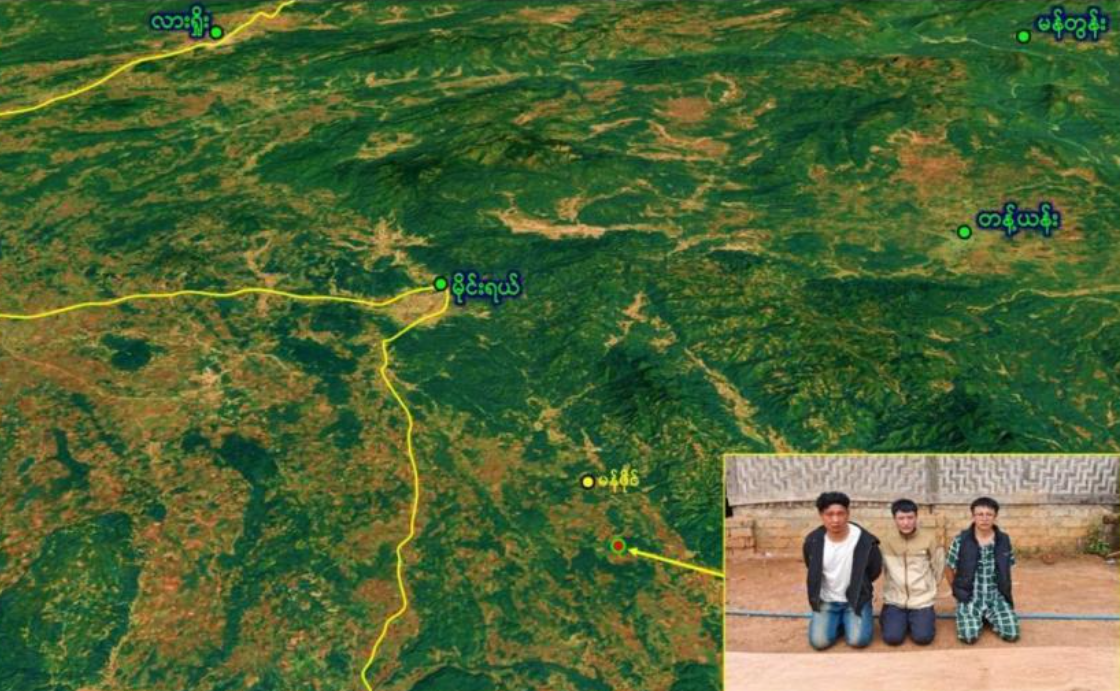
Myanmar's security forces have intensified their campaign against transnational cybercrime networks, capturing three Chinese nationals suspected of orchestrating online gambling scams from a remote encampment in Mongyai Township, Shan State. The August 26 operation represents a significant escalation in efforts to dismantle illegal digital operations that leverage border regions to evade detection and prosecution. This arrest underscores the growing problem of cross-border criminal activity in Southeast Asia, where porous boundaries and limited coordination between authorities continue to facilitate illicit operations targeting victims across multiple countries.
The discovery of the operation came after local residents reported suspicious activity in the area, prompting military columns to conduct investigative sweeps across the territory. Intelligence gathering revealed that the suspects had established a makeshift operational base designed for temporary concealment, rather than permanent infrastructure—a common tactic employed by transnational criminal syndicates seeking to minimize detection and rapidly relocate when pressure mounts. The suspects allegedly entered Myanmar through illegal border crossings, exploiting vulnerabilities in frontier security infrastructure. The location chosen, approximately 26 kilometres southeast of Mongyai town and near Manphai Village, reflected a deliberate strategy to establish operations in remote areas where government oversight remains limited and escape routes across international boundaries are readily accessible.
Myanmar's comprehensive anti-cybercrime campaign has broadened considerably in recent months, reflecting both domestic and international pressure to address the proliferation of online scam operations within the country. Government officials have prioritized border regions as focal points for enforcement action, recognising that such areas serve as crucial hubs for criminal enterprises seeking to coordinate activities across multiple jurisdictions while maintaining operational secrecy. The approach represents a more strategic response than previous ad-hoc crackdowns, incorporating intelligence gathering from community sources alongside systematic security operations. This community-focused methodology has proven effective in identifying hidden operations that might otherwise escape official detection.
The equipment recovered provides revealing insights into the scale and sophistication of the operation. Authorities seized twenty-five mobile phones, suggesting a substantial subscriber base or multiple operational streams serving various victim populations. Five all-in-one computers indicate simultaneous processing capabilities for handling multiple scams concurrently. The inclusion of a Starlink satellite communication device demonstrates considerable financial investment and technical capability—such equipment allows operators to maintain connectivity even in areas lacking conventional internet infrastructure, a feature particularly valuable in remote border zones. The ten communication radios suggest an organised hierarchical structure with distinct roles for different personnel involved in the enterprise. Two power stations point to the operation's energy demands and its preparation for extended deployment despite lacking conventional utilities.
The physical infrastructure seized—comprising one 50-by-20-foot corrugated iron-roofed building and five temporary tarpaulin shelters—reflects the hybrid approach favoured by such networks. The semi-permanent construction allowed operators to maintain a functional workspace while preserving mobility and plausible deniability, should authorities approach. This architectural approach mirrors tactics documented in Thailand, Cambodia, and Laos, where similar operations have utilised temporary structures to facilitate rapid evacuation and relocation upon discovery. The diversity of shelter types suggests operational compartmentalisation, with different functions assigned to separate structures—a counterintelligence technique reducing vulnerability to complete operational exposure should one location be breached.
The illegal status of the suspects' border crossing illustrates how transnational scam networks circumvent immigration systems. By operating outside formal entry channels, these individuals avoid creating documentary records that might facilitate international cooperation in their apprehension. This tactic exploits the tension between maintaining open borders for legitimate commerce and tourism while preventing criminal infiltration. Malaysia and other regional states face similar challenges, as porous borders enable criminal movement while enforcement authorities struggle to distinguish between legitimate cross-border movement and illicit entry by syndicate operatives. The Myanmar case demonstrates that regional governments must enhance information-sharing mechanisms and coordinate border security protocols more effectively.
Online gambling scams perpetrated from Myanmar have increasingly targeted victims across Southeast Asia, including Malaysia, where growing internet penetration has created substantial victim populations. These operations typically employ sophisticated social engineering techniques, luring targets through false investment schemes or legitimate-appearing gaming platforms before systematically extracting funds through manipulation and psychological coercion. The regional impact extends beyond direct financial losses, encompassing fraud and identity theft affecting individuals across multiple countries. Malaysian authorities have documented numerous cases where residents fell victim to scams coordinated from Myanmar-based operations, underscoring the transnational nature of the threat.
Myanmar authorities have committed to systematic destruction of illegal shelters and continued enforcement operations targeting remaining scam networks. This approach addresses both immediate criminal threats and the physical infrastructure enabling such operations. Government statements emphasise comprehensive elimination rather than temporary disruption, suggesting recognition that sustained pressure is necessary to deter new operational establishment. However, the proliferation of similar operations across the region raises questions about whether enforcement alone can address the underlying appeal of these criminal enterprises. The substantial profits generated—evidenced by significant equipment investment—create powerful incentives for continuous replenishment of operational capacity as individual networks are dismantled.
The broader regional implications extend beyond Myanmar's borders, affecting Malaysia's cybersecurity landscape and fraud prevention efforts. Cross-border criminal syndicates operate sophisticated supply chains procuring equipment, recruiting personnel, and identifying victim populations across multiple jurisdictions. Malaysian law enforcement agencies increasingly engage with regional counterparts to identify common targets, coordinate investigations, and trace money flows connecting scam proceeds to subsequent laundering operations. The Myanmar arrest provides valuable intelligence about operational methods, equipment preferences, and structural organisation that Malaysian authorities can utilise to identify and counter similar networks potentially establishing bases in regional territories.
Sustained regional cooperation represents an essential component of effective response to transnational cybercrime networks. While individual country enforcement operations yield tangible results, their impact remains incomplete without coordinated strategies addressing recruitment, equipment supply chains, victim targeting methodologies, and money laundering infrastructure. ASEAN member states have begun establishing frameworks for information sharing and joint operations, yet significant gaps remain in implementation capacity, legal harmonisation, and resource allocation. The Myanmar operation, while significant, represents one incident within a much broader problem requiring sustained political commitment and technical capacity building across the region.

