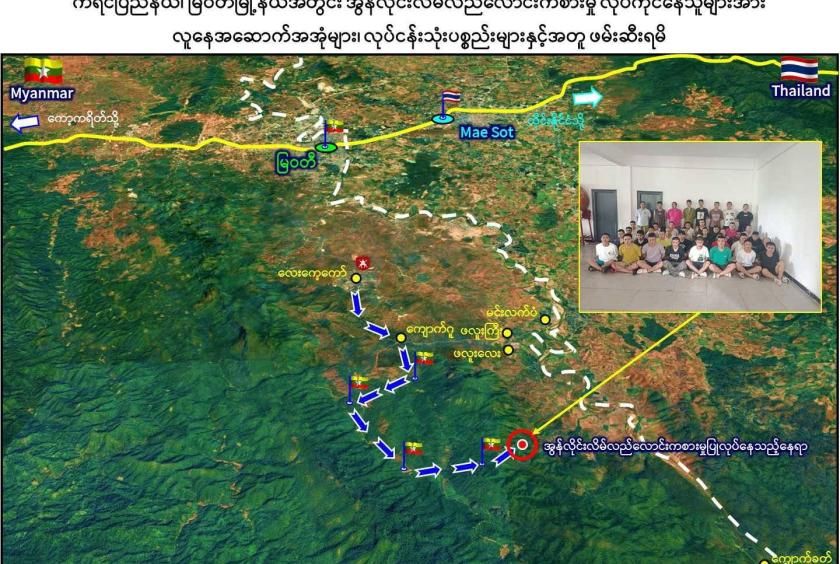
Myanmar's military and security apparatus has delivered what officials describe as a decisive blow against transnational online fraud operations, detaining 777 suspected perpetrators during a large-scale raid in the Myawaddy Township area of Kayin State. The scale of the arrest represents one of the most significant crackdowns on digital crime networks operating within Myanmar's borders, reflecting growing regional and international pressure on the country to tackle the sprawling scam industry that has flourished along its borders and drawn participants from across Asia.
The detained individuals comprise a distinctly multinational operation. Among those arrested, 631 are Chinese nationals, three are Thai citizens, and 143 are Myanmar nationals. This composition underscores a troubling pattern of transnational criminal networks exploiting Myanmar's porous borders and unstable governance structures to establish hubs for targeting victims across Southeast Asia and beyond. The dominance of Chinese nationals in these operations points to sophisticated international coordination, with established criminal syndicates leveraging Myanmar's geographic position and limited regulatory enforcement to organize fraud campaigns with global reach.
The technological infrastructure seized during the operation provides insight into the scale and sophistication of these scam networks. Authorities confiscated a Starlink satellite terminal, 85 computers, and 183 mobile phones from the compound. The presence of satellite communication equipment is particularly significant, as it suggests operators maintained independent internet infrastructure to evade conventional monitoring and maintain operational continuity despite detection risks. This level of technical investment indicates these were not opportunistic small-scale fraudsters but rather organized criminal enterprises with substantial capital and operational planning.
According to security officials, the raid was conducted following intelligence gathering that identified illegal scam compounds operating within the area. The operation represents a culmination of investigative work aimed at pinpointing the physical locations where these criminal networks coordinate their activities. However, the actual execution of the raid encountered unexpected resistance, transforming what might have been a straightforward law enforcement operation into a more volatile confrontation with armed resistance.
Clashes erupted when security forces encountered members of armed groups during the operation. The Myanmar military alleged that the Karen National Liberation Army and the People's Defence Force had been providing security protection to the scam operations in exchange for payment. This assertion, if substantiated, reveals a deeply troubling dimension of the problem: the entanglement of criminal fraud networks with armed non-state actors who derive income from protecting criminal enterprises. The alleged relationship suggests these are not isolated criminal activities but integrated components of larger systems of control and revenue generation in contested border regions where governmental authority remains contested and fragile.
The armed confrontation resulted in 13 deaths among the armed group members, while government forces captured nine firearms, ammunition supplies, bunkers, and other military-related items. The seizure of weapons and fortified positions indicates these scam compounds operated with paramilitary security arrangements, further demonstrating the organized and entrenched nature of the operations. The violence during the raid underscores the challenges Myanmar faces in reasserting security control over border regions that have become sanctuaries for transnational criminal activity.
For Southeast Asian nations, particularly those whose citizens fall victim to online fraud schemes, this operation holds significant implications. Thailand, Malaysia, the Philippines, and Vietnam have all reported substantial numbers of victims targeted by scams originating from Myanmar border regions. The arrest of 777 individuals may temporarily disrupt specific operations, but it also highlights the persistent challenge posed by organized fraud networks that can rapidly reconstitute themselves in the absence of comprehensive governance reforms and cross-border law enforcement coordination. Victims across the region who have lost savings to these networks may see some measure of justice through investigations, though recovery of funds remains unlikely.
Malaysian authorities have particular interest in such operations given the country's role as a transit hub for international crime and its vulnerable population of potential victims. Malaysian banks and financial institutions have increasingly invested in fraud detection systems to identify transactions linked to scam networks operating from Myanmar. The arrest of such large numbers suggests that international intelligence sharing and regional cooperation have begun yielding results, even as the underlying conditions that allow such networks to establish themselves remain largely unchanged.
The government of Myanmar has indicated that detained individuals will undergo investigation and face prosecution under existing legal frameworks. However, questions remain about the capacity of Myanmar's justice system to process such large numbers of cases and whether convictions will result in meaningful sentences that deter future operations. The confiscation of equipment will proceed through legal channels, though the practical application of such procedures in Myanmar's currently unstable governance environment presents its own complications.
Official statements emphasize Myanmar's commitment to continuing cooperation with neighbouring countries and international partners in dismantling scam and gambling networks. This commitment faces real obstacles, given Myanmar's current international isolation stemming from the 2021 military coup and subsequent widespread violence. Regional governments and agencies such as Interpol have urged Myanmar to maintain enforcement pressure despite internal instability. The sustainability of such operations depends substantially on whether Myanmar's authorities maintain institutional focus on cross-border crime even as the country manages multiple political and security crises.
The raid demonstrates that high-profile enforcement actions remain possible even within Myanmar's fractured security environment. However, analysts caution that individual operations, however large in scale, address symptoms rather than underlying causes. The economic desperation in certain regions, corruption among officials who might ignore or facilitate criminal activity, and the profitable nature of fraud targeting vulnerable populations across Asia suggest that replacement networks will likely emerge. Long-term solutions require comprehensive governance improvements, anti-corruption measures, and sustained regional coordination that extends beyond military-style raids on individual compounds.

