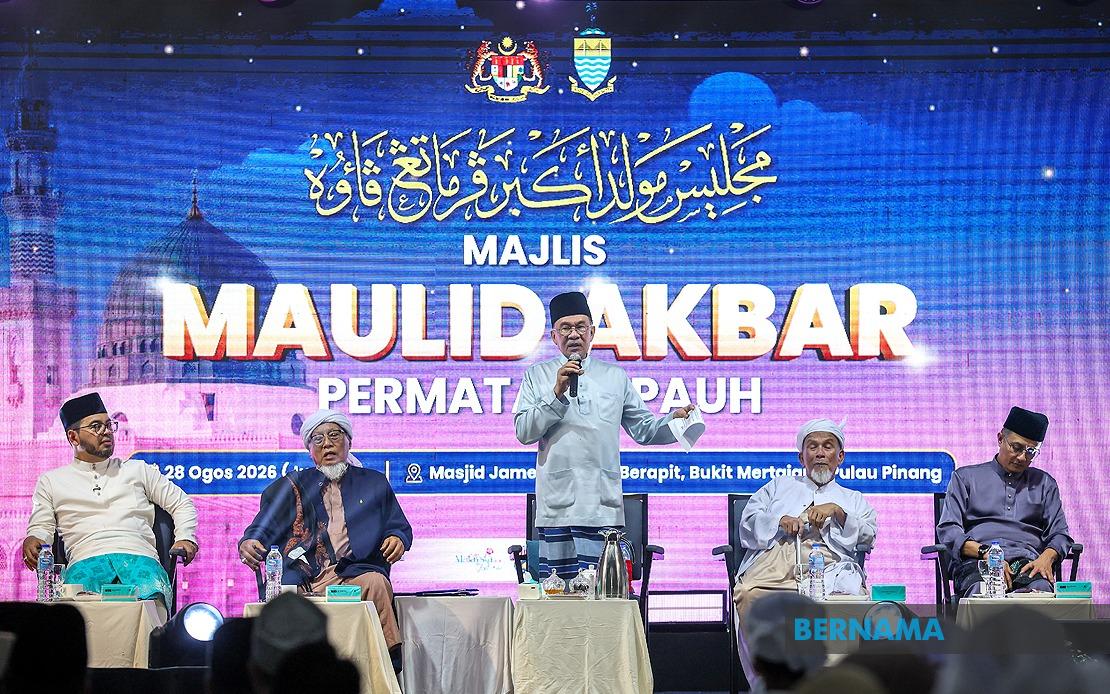
Prime Minister Datuk Seri Anwar Ibrahim has issued a call for Muslims to become exemplars of virtue and integrity in Malaysian society, linking individual moral conduct directly to broader national progress. Speaking at a Maulid Akbar ceremony honouring National Day in Bukit Mertajam, Anwar emphasised that the standing Muslims enjoy within the community should not rest on claims or institutional authority, but rather on the visible evidence of ethical behaviour displayed in everyday interactions and professional conduct. This framing positions personal morality as a form of public testimony, suggesting that each Muslim individual serves as an ambassador for Islamic values through their actions.
Anwar articulated a comprehensive vision of exemplary conduct that extends beyond avoiding obvious transgressions. The Prime Minister highlighted that genuine respect flows from demonstrating diligence in work, honouring commitments made to others, and refusing to exploit positions of authority for personal gain. In the Malaysian context, where concerns about institutional integrity and public sector accountability remain persistent issues, this emphasis on restraint and trustworthiness carries particular weight. Anwar's framing suggests that ethical conduct represents an active choice rather than passive compliance, requiring deliberate effort and consistency across multiple spheres of life.
Central to Anwar's message is the interconnection between Islamic principles and social cohesion across Malaysia's multicultural landscape. He underscored that Islam's core message centres on compassion and beneficence for all people, a characterisation that implicitly argues for inclusive interpretations of religious duty. This approach appears designed to counter sectarian or exclusionary readings of religious identity, instead positioning Islamic values as foundations for community welfare that transcend ethnic and religious boundaries. For a nation where interfaith relations remain sensitive, such messaging from the Prime Minister signals an inclusive vision of religious leadership.
The Prime Minister articulated a holistic conception of human development that balances multiple dimensions of existence. According to Anwar, Muslims must cultivate knowledge alongside faith, spiritual growth alongside material advancement, and moral development alongside physical wellbeing. This multidimensional framework resists reducing Islamic practice to either purely spiritual contemplation or secular achievement-seeking, instead proposing their integration. In the context of Malaysia's development aspirations, this represents an attempt to harmonise modernisation with traditional values, addressing longstanding tensions about how rapidly developing nations can preserve cultural identity.
Anwar connected this personal moral framework to the Malaysia MADANI initiative, the government's overarching development philosophy. He contended that policies, economic growth, and technological capability alone cannot sustain national progress without undergirding ethical foundations. This positioning effectively elevates moral and spiritual considerations from peripheral cultural concerns to central requirements for sustainable development. By linking individual virtue to macro-level policy outcomes, Anwar argues that Malaysia's development trajectory depends not merely on institutional structures or resources, but on the collective character of its population.
The Prime Minister employed vivid metaphorical language to express this interconnection, suggesting that while Malaysia must aspire toward ambitious goals, it simultaneously requires deep rootedness in foundational values. This imagery of reaching skyward while remaining grounded encapsulates a central tension in contemporary Malaysian governance: the desire to compete economically and technologically with developed nations while maintaining distinctive cultural and religious identity. Anwar's formulation proposes these are not contradictory but mutually reinforcing, with moral grounding actually enabling rather than impeding ambitious development.
Anwar's address also emphasised the institutional role of Islamic scholars and religious leadership in providing guidance to political and administrative leaders. He called for strengthened connections between these communities, specifically through candid counsel and exchange of perspectives. This articulation reflects a particular vision of governance in which religious authorities serve as advisors and moral check on political power, rather than either being subordinate to secular authority or seeking direct political control. For Malaysia's complex governance structure, where religious institutions operate within a constitutional framework established by civil law, this positioning attempts to define a meaningful collaborative role.
The Prime Minister reiterated that Malaysia MADANI must simultaneously pursue economic expansion and technological mastery while ensuring that values and morality remain structural pillars of national development. This dual emphasis acknowledges that Malaysia cannot simply retreat from competitive engagement in the global economy, while insisting that such engagement must be guided by ethical principles. In practical terms, this suggests frameworks for development that incorporate considerations of social justice, environmental sustainability, and cultural preservation alongside conventional economic indicators.
Anwar's remarks were delivered in the presence of Minister in the Prime Minister's Department (Religious Affairs) Dr Zulkifli Hasan, indicating coordination between the highest political leadership and religious affairs institutions in this messaging. The choice of venue—a major mosque during a significant religious observance—and timing during National Day celebrations positioned this moral exhortation within both religious and national contexts. For Malaysian audiences, this simultaneity of religious and civic framing signals that the government views moral and spiritual renewal as integral to national strengthening rather than as separate domains.

