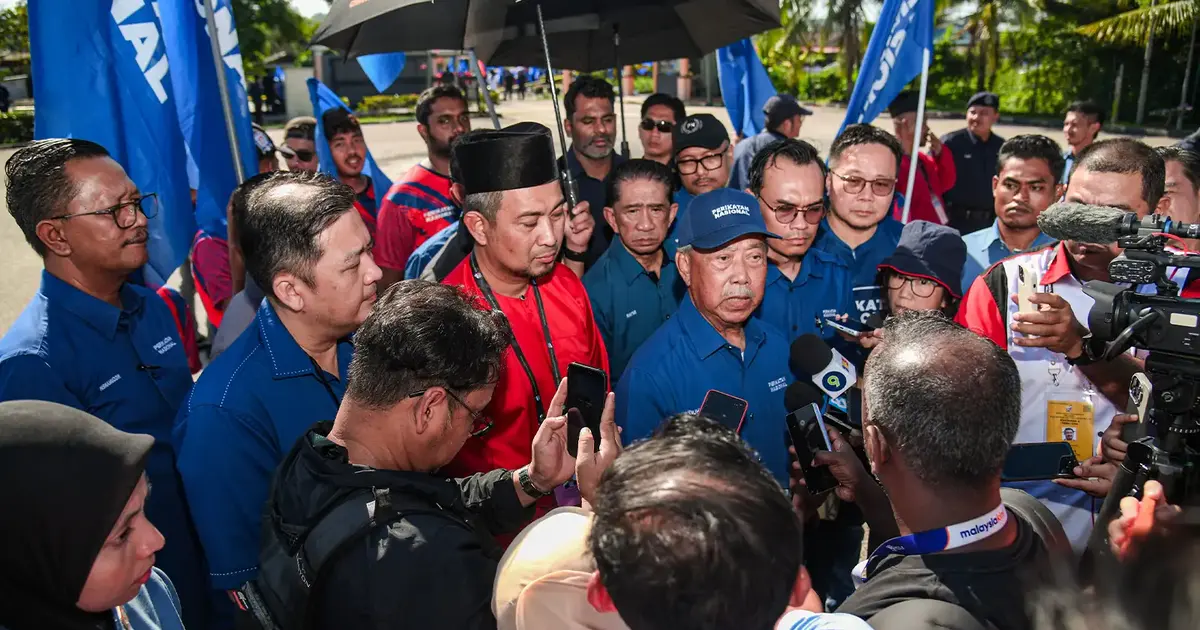
Perikatan Nasional's ability to form the next state government remains viable despite recent political setbacks, according to Bersatu president Muhyiddin Yassin, who believes the coalition commands adequate parliamentary numbers and enjoys backing from sympathetic lawmakers positioned outside its formal membership. His optimism reflects PN's strategic calculations ahead of potential state-level political realignments, a concern that has gained traction across Malaysia's fragmented political landscape where coalition mathematics determine governmental outcomes.
Muhyiddin's assertion hinges partly on PN's established component strength within several state assemblies, bolstered by informal support networks that extend beyond the three-party coalition structure of Bersatu, Parti Islam Se-Malaysia (PAS), and Parti Pribumi Bersatu Malaysia. These external relationships, he suggests, provide additional leverage when arithmetic becomes critical during government formation, particularly in states where no single political force commands an outright majority. The Bersatu leader's characterisation of these alliances underscores how state-level politics increasingly depends on fluid, issue-based cooperation rather than rigid coalition discipline.
Among the notable allies Muhyiddin referenced is Muda, the youth-focused reformist party founded in 2021 that has positioned itself as a kingmaker in several state contexts. Muda's parliamentary footprint, though modest compared to established parties, carries disproportionate weight in tightly contested assemblies where individual seats determine outcomes. The party's willingness to negotiate with ideologically diverse partners has made it an attractive coalition partner for multiple political blocs, creating the kind of flexible alignment that Muhyiddin appears to be banking upon. This flexibility reflects Muda's strategy to maximise influence without surrendering independence through merger or full coalition integration.
The timing of Muhyiddin's confidence-building statement appears designed to counteract perceptions of PN weakness following recent electoral disappointments and internal coordination challenges. By emphasising potential state-government formation, the Bersatu president signals to party members and supporters that political viability extends beyond federal parliamentary representation and that PN retains credible pathways to executive power at the subnational level. This messaging matters particularly in maintaining internal morale and preventing defections to competing coalitions during periods of electoral uncertainty.
PN's political strategy intersects with broader Malaysian dynamics where state governments control substantial resources, patronage networks, and policy-making capacity across crucial portfolios including education, agriculture, and local administration. Control of state assemblies thus represents not merely symbolic victories but concrete opportunities to demonstrate governance competence, consolidate constituency support, and build political machinery for future contests. The coalition's emphasis on state-level formation therefore reflects rational political calculus rather than mere optimism.
The involvement of Muda in PN's calculations highlights how newer political players have fundamentally altered Malaysia's coalition dynamics. Unlike the binary configurations that dominated politics during the Barisan Nasional and Pakatan Harapan eras, contemporary state-level contests frequently involve three, four, or more significant players whose votes become essential for achieving majority. This multiplication of players increases both possibilities for coalition-building and risks of governmental instability when alliances rest on narrow numerical margins. Muhyiddin's acknowledgement of Muda specifically suggests PN recognises which newer entrants wield consequential leverage.
Regionally, PN's state-government prospects carry implications for Southeast Asian politics more broadly, particularly given Malaysia's role as a democratic competitor to authoritarian models in the region. Successful governance at state level by opposition-oriented coalitions demonstrates functional democratic practice and peaceful power rotation, reinforcing regional narratives about democratic resilience. Conversely, failures to govern effectively or maintain coherent coalitions can discredit democratic alternatives to incumbent structures, indirectly influencing how neighbouring societies evaluate political systems.
Yet Muhyiddin's confidence faces real constraints that complicate formation scenarios. Internal PN tensions, particularly between Bersatu's cosmopolitan Bumiputera nationalism and PAS's Islamic governance vision, periodically surface and erode coalition unity. State assemblies where PN might govern would require managing these doctrinal differences while delivering results that satisfy diverse voting blocs. The presence of external allies like Muda sometimes intensifies rather than resolves such tensions, as their participation introduces additional policy preferences into already complex coalition governance.
The Bersatu president's emphasis on existing allies and potential new supporters also reflects recognition that PN cannot rely solely on internal component strength. This acknowledgement validates that Malaysian political fragmentation has reached proportions where no single coalition consistently commands assembly majorities without coalition-building and securing sympathetic independents. Rather than representing PN weakness, however, Muhyiddin frames this as the coalition's adaptability, arguing that PN's willingness to work with allies demonstrates political maturity and cooperative spirit.
Prospects for PN state government formation remain contingent on electoral performance in forthcoming state polls and the willingness of aligned parties like Muda to prioritise coalition formation over exploring alternative arrangements with competing blocs. Both variables remain uncertain, particularly given the incentive structures facing smaller parties that can extract substantial concessions by remaining uncommitted until formation negotiations commence. Muhyiddin's confidence therefore represents political positioning as much as electoral forecasting, framed to maintain coalition cohesion and signal continuing relevance to both internal stakeholders and external observers.

