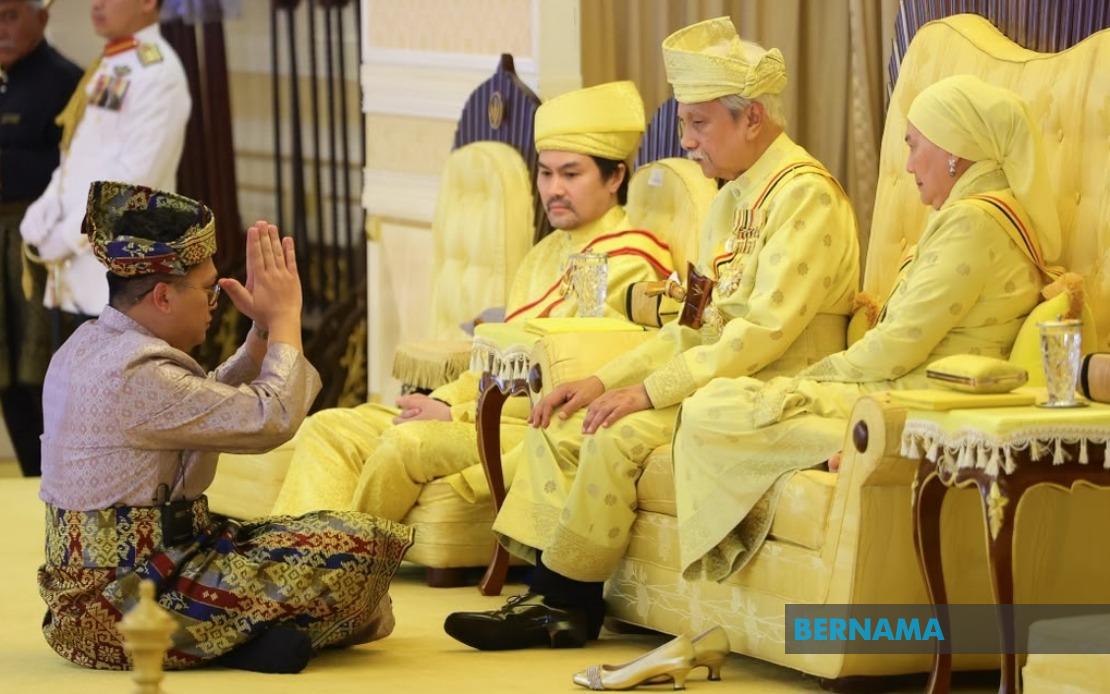
In a solemn ceremonial affirmation of customary leadership in Negeri Sembilan, the Yang Dipertuan Besar, Tuanku Muhriz Tuanku Munawir, has officially installed Muhammad Faris Johari as the 11th Undang of Luak Sungei Ujong. The formal installation took place this morning at Istana Besar Seri Menanti in Kuala Pilah, marking an important transition within the state's traditional administrative hierarchy that dates back centuries.
The installation ceremony itself followed the intricate protocols embedded within Negeri Sembilan's customary governance framework. The proceedings began with the Orang Empat Istana—the four palace elders who serve as custodians of royal protocol—approaching the Yang Dipertuan Besar to seek his formal consent to commence the installation rituals. Following this procedural step, the newly appointed Undang took an oath pledging his allegiance and dedication to the ruler, reaffirming the constitutional relationship between traditional chieftains and the paramount authority of the Yang Dipertuan Besar.
Upon completion of the pledge ceremony, Tuanku Muhriz formally proclaimed Muhammad Faris as the 11th Undang of Luak Sungei Ujong and conferred upon him the royal title Datuk Klana Petra. This title, passed down through the centuries, carries with it substantial ceremonial weight and represents the state's acknowledgment of his authority over the Sungei Ujong district and responsibility for upholding its traditions and welfare.
In his address to the assembled dignitaries, Tuanku Muhriz emphasised the critical importance of maintaining the integrity and sincerity of the vows undertaken during the ceremony. The ruler reminded the appointed Undang and his counterparts among the Orang Kaya—the traditional chieftains—that their pledges must be honoured with unwavering commitment, emphasizing that personal integrity and a profound sense of responsibility form the foundation of customary leadership within the state.
The Yang Dipertuan Besar elaborated on the broader philosophical underpinnings of Negeri Sembilan's governance system, stressing that relationships predicated on mutual respect, genuine trust, and consensual decision-making are indispensable to the preservation of the constitutional monarchy. He articulated that these principles extend beyond ceremonial formality to encompass the practical administration of the state and the protection of its distinctive customary traditions. Tuanku Muhriz further directed the customary leadership to maintain close and respectful relations with both the Palace and with himself as the supreme authority, making clear that institutional loyalty forms a cornerstone of the state's political structure.
The ceremony drew participation from senior members of the royal household, including Tunku Ampuan Besar Tuanku Aishah Rohani Tengku Besar Mahmud, Tunku Besar Seri Menanti Tunku Ali Redhauddin Tuanku Muhriz, and Tunku Panglima Besar Tunku Zain Al-'Abidin. The presence of these high-ranking royals underscored the ceremonial significance of the occasion and reflected the centrality of the installation within Negeri Sembilan's constitutional framework. Beyond the royal entourage, the event was witnessed by Menteri Besar Datuk Seri Aminuddin Harun and principal officers from various state government departments, demonstrating the integration of customary and administrative governance structures within the state.
Addressing the assembled gathering, Tuanku Muhriz called upon the people of Negeri Sembilan to work collaboratively with the customary leadership in the execution of their respective responsibilities. He urged society to continue honouring and preserving the values intrinsic to Adat Perpatih, the distinctive customary law system practised in Negeri Sembilan that has been transmitted through generations and remains integral to the state's cultural identity. The emphasis on this preservation reflects broader concerns across Malaysia regarding the maintenance of indigenous governance systems and customary practices in an increasingly modernised society.
Muhammad Faris, who assumes his position at the relatively young age of 28, brings professional credentials to the role. Born on October 30, 1997, he obtained a bachelor's degree in accountancy from Universiti Teknologi MARA and subsequently completed his professional qualification through the Association of Chartered Certified Accountants programme in 2022. His appointment therefore represents a generational transition within the Undang hierarchy, introducing younger individuals with contemporary educational credentials into positions traditionally held as custodians of customary authority. He is married to Sharifah Amirah Syed Ismail Ash-Shahab.
The significance of this appointment extends beyond the immediate succession within Sungei Ujong. Negeri Sembilan operates under a unique constitutional arrangement among Malaysian states, with the Yang Dipertuan Besar elected by the rulers of the constituent luaks, or districts, rather than hereditary succession. The Undangs serve as the electors in this process, making their installation and calibre matters of considerable constitutional importance. Muhammad Faris's installation thus carries implications for the state's political future and the mechanisms through which its paramount ruler is selected.
The installation ceremony underscores how Negeri Sembilan continues to balance the preservation of centuries-old customary governance structures with contemporary administrative requirements. The presence of state government officials alongside traditional chieftains at the ceremony reflects the intertwined nature of customary and statutory governance in the state. This integration represents a distinctive model within Malaysia's federal system and offers insights into how traditional institutions can remain relevant and functional within a modern constitutional democracy.
Later the same day, another royal audience was scheduled to formalise the installation of the 22nd Undang of Luak Rembau, suggesting that this period marks a transitional moment for customary leadership across multiple districts within Negeri Sembilan. The consecutive installations within a single day indicate that the state may be undertaking a more comprehensive renewal of its customary administrative hierarchy, potentially setting the stage for broader governance patterns within the state in the coming years. These developments will warrant close observation given their implications for Negeri Sembilan's political structure and the mechanisms governing its election of state leadership.

