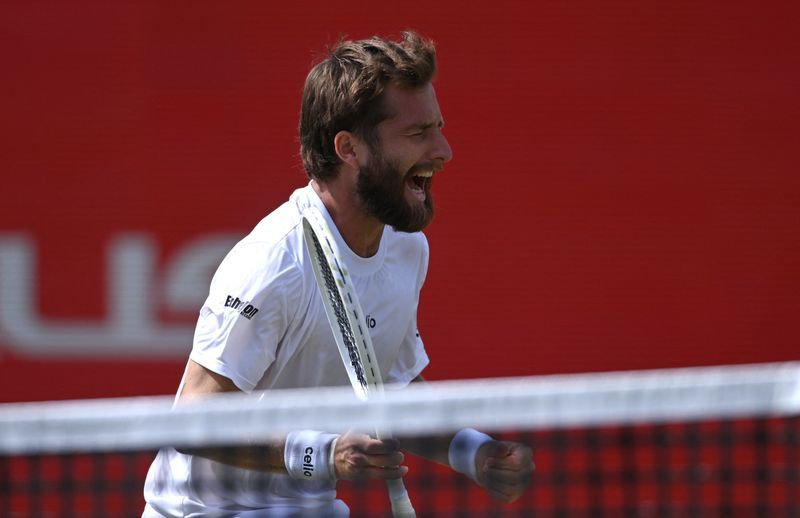
French tennis professional Corentin Moutet has forfeited nearly all his earnings from the Queen's Club Championships after incurring a substantial fine for his expletive-laden behaviour during a live broadcast interview. The 27-year-old was handed a $40,000 penalty by the ATP following his appearance on BBC television immediately after his first-round victory over fellow Frenchman Giovanni Mpetshi Perricard, with the disciplinary action effectively wiping out his tournament winnings.
Moutet's on-court interview descended into controversy when he repeatedly used strong language while discussing a pivotal moment in his match. When asked by the interviewer to refrain from using profanities after his initial outburst, the world number 36 continued swearing three additional times before the broadcaster was forced to cut short the segment and issue apologies to both the live crowd and television audience. The incident occurred shortly after Moutet had been struck by an ace on match point—a 142mph second serve that had clearly frustrated him considerably.
The ATP's formal statement classified Moutet's conduct as unsportsmanlike, a designation that carries significant financial consequences in professional tennis. Moutet earned $43,000 for advancing to the second round of the prestigious grass-court event, an amount that the fine has now almost entirely consumed. Rather than accept the penalty without challenge, the French player has signalled his intention to appeal the decision, suggesting he believes the sanction may have been disproportionate to his transgression.
Moutet's tournament run came to an end shortly after the interview incident when he lost his second-round match to Spain's Alejandro Davidovich Fokina. The defeat meant he failed to progress further and accumulate additional prize money that might have offset the substantial fine. His rapid exit from the competition underscored what had already become a frustrating week for the player, one that will likely linger in memory more for administrative consequences than sporting achievement.
This disciplinary episode represents merely the latest chapter in what has become an established pattern of behavioural concerns for Moutet throughout his professional career. His history of on-court conduct issues suggests that frustration management remains an ongoing challenge, despite presumably having received guidance from his coaching team and the professional tour regarding appropriate standards of behaviour. For a player ranked 36th in the world, accumulating fines and suspensions diverts resources that could otherwise be invested in training, travel, and other elements essential to career progression.
Moutet's previous disciplinary troubles underscore the recurring nature of these lapses. In 2022, he was defaulted from the Adelaide International tournament after directing expletives at the umpire during a match against Serbia's Laslo Djere—a far more severe sanction than a fine, as default results in complete elimination from the event with no prize money awarded whatsoever. That same year, the French Tennis Federation took the additional step of withdrawing support and access to federation resources due to what they characterised as behavioural concerns.
The Queen's Club incident also reveals the tension that exists between live broadcast requirements and the intensity of professional sports competition. Television networks broadcasting major tennis tournaments face significant pressure to maintain family-friendly programming, which can conflict with the raw emotions and occasional indiscretion of athletes competing at the highest level. While some measure of emotion is expected and even celebrated in tennis, there remains a line beyond which language becomes inappropriate for broadcast audiences.
Moutet's attempt to contextualise his behaviour through an Instagram post stating he was "just joking" appeared to lack credibility given the interviewer's visible reaction and the broadcaster's decision to end the segment prematurely. The public record of the incident contradicted any suggestion that his repeated profanities were lighthearted in intent, and such social media commentary rarely assuages tournament officials reviewing disciplinary matters.
For Malaysian and Southeast Asian tennis followers, this incident underscores the international standards and expectations that professional players must maintain across all major tours. The ATP's willingness to levy five-figure fines for on-court conduct demonstrates that financial penalties now represent a meaningful deterrent for players who might otherwise test boundaries. As tennis continues to grow throughout Asia with increasing participation and viewership, local players emerging at professional level will encounter the same unforgiving disciplinary regime that Moutet has discovered.

