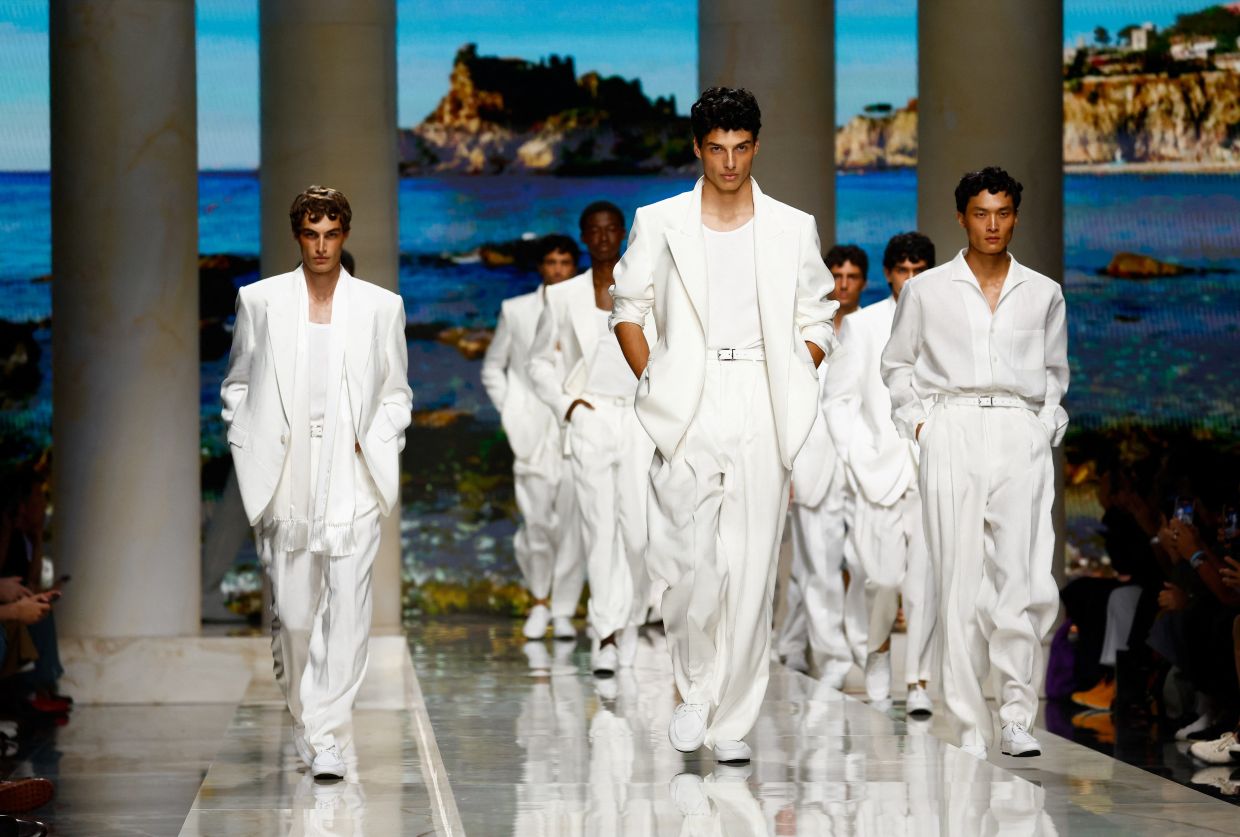
Milan's menswear designers responded to a world beset by economic uncertainty and geopolitical tensions by pursuing a counterintuitive strategy: lightness. As Fashion Week concluded on Monday, June 22, the runways revealed an industry eager to strip away excess without surrendering sophistication. The collections showcased a fundamental shift in how luxury menswear addresses both contemporary anxieties and the practical challenge of dressing for an increasingly hot planet.
Prada emerged as the aesthetic compass for the season, with co-creative directors Miuccia Prada and Raf Simons championing a philosophy centred on proportion and fabrication rather than decoration. Their argument was deceptively simple: familiarity reimagined through careful tailoring and material innovation could communicate strength without visual noise. This approach resonated across the Milanese fashion establishment, signalling a broader rejection of the conspicuous excess that dominated previous seasons. The message transcended trends; it reflected a design industry grappling with its relationship to restraint in uncertain times.
Yet the path toward simplicity proved far from straightforward. Milan's summer collections paradoxically embraced materials traditionally associated with warmth and weight. Leather in particular dominated the runways, appearing so frequently across multiple designers that its persistence became the season's defining surprise. Rather than abandoning the material entirely, designers deployed engineering solutions to reconcile luxury heritage with climatic reality. Prada's leather offering drew conceptual inspiration from denim's democratic universality, translating that lineage into slim five-pocket trousers paired with cropped flat-pocketed jackets functioning simultaneously as outerwear and shirts. Competitors pursued alternative strategies, employing woven and perforated techniques that transformed leather from an insulating barrier into a breathable second skin.
The tension between luxury aspiration and practical wearability defined much of Milan's creative conversation. After years of deliberately oversized silhouettes that obscured the body, designers largely reversed course, reinstating fitted proportions as a sign of sartorial authority. Yet this return to shape consciousness required fundamental reconsideration of how men navigate professional formality during summer months. Tailoring remained non-negotiable—across Milan's elite ateliers, consensus held that a well-dressed man invariably wears a suit. The innovation lay in rendering that suit survivable without air-conditioning.
Ventilation became the season's most pragmatic aesthetic principle. Dress shirts appeared unbuttoned across multiple collections, some rendered in transparent fabrics that preserved the visual gesture of formality while surrendering functionality. Others disappeared entirely, replaced by open necklines and simplified construction allowing maximum airflow. Trousers remained predominantly full-length, reflecting menswear's enduring formality codes, yet the overall silhouette shifted toward the body with unprecedented unanimity. Dolce & Gabbana pushed this intimacy toward its logical extreme through microshorts that foregrounded musculature, while competitors experimented with exposed torsos—a radical departure from menswear's traditional modesty.
Designer Thom Browne's return to Milan for the first time since 2008, now operating under Zegna ownership, demonstrated how established voices could reinvigorate the conversation around summer tailoring. His presentation layered unconventional materials including seersucker and pleated construction—garments historically associated with tropical climates—with the architectural precision his brand pioneered. The collection suggested that formal menswear's evolution required historical dialogue, borrowing from summer traditions while maintaining contemporary identity. This approach validated tailoring as intrinsically adaptable, capable of transformation without surrendering its essential character.
Milan's broader embrace of restraint created unusual opportunities for emerging practitioners. Copenhagen-based Martin Quad made his Milanese debut with unconventional tailoring techniques that had garnered attention in Northern European fashion circles, while Domenico Orefice explored leather and richly woven textiles through a co-ed lens that challenged gendered assumptions about material and construction. Japanese designer Shinya Kozuka's Shinyakozuka label emerged as the season's most poetic voice, presenting collections that seemed to float rather than function—exemplified by bare-chested models draped in billowing sheer coats rendered in ethereal teal, paired with generously proportioned white trousers. These emerging voices suggested that Milan's lighter calendar benefited not only established houses but also designers willing to challenge conventional categorization.
Yet not all Milan embraced this narrative of reduction. Philipp Plein presented a crystal-encrusted denim ensemble demanding days of handwork for completion, while Dolce & Gabbana deployed beaded accents evoking coral formations. These collections unapologetically advocated for maximalism, suggesting that glamour and decoration retained legitimate places within contemporary luxury discourse. The season ultimately presented not a unified direction but rather a bifurcation: one faction pursuing essential forms stripped of ornament, another celebrating abundance through labour-intensive embellishment. Both arguments possessed validity within the luxury ecosystem's broader conversation.
For Malaysian and Southeast Asian fashion consumers, Milan's Spring/Summer 2027 direction carries particular relevance. The region's tropical climate has long positioned Asian wearers as inadvertent testing grounds for how formal menswear adapts to humidity and heat. The season's emphasis on breathability, strategic ventilation, and silhouette over material weight offers practical frameworks for how international luxury might finally address equatorial realities. Moreover, the elevation of emerging designers suggests that luxury fashion's geographic centre is gradually dispersing—a development potentially favourable to Asian practitioners seeking international validation beyond traditional European gatekeeping structures. The shift toward proportion and fabrication over decoration also aligns with aesthetic sensibilities increasingly prevalent in East and Southeast Asian design traditions, potentially opening space for cross-cultural dialogue within luxury menswear.

