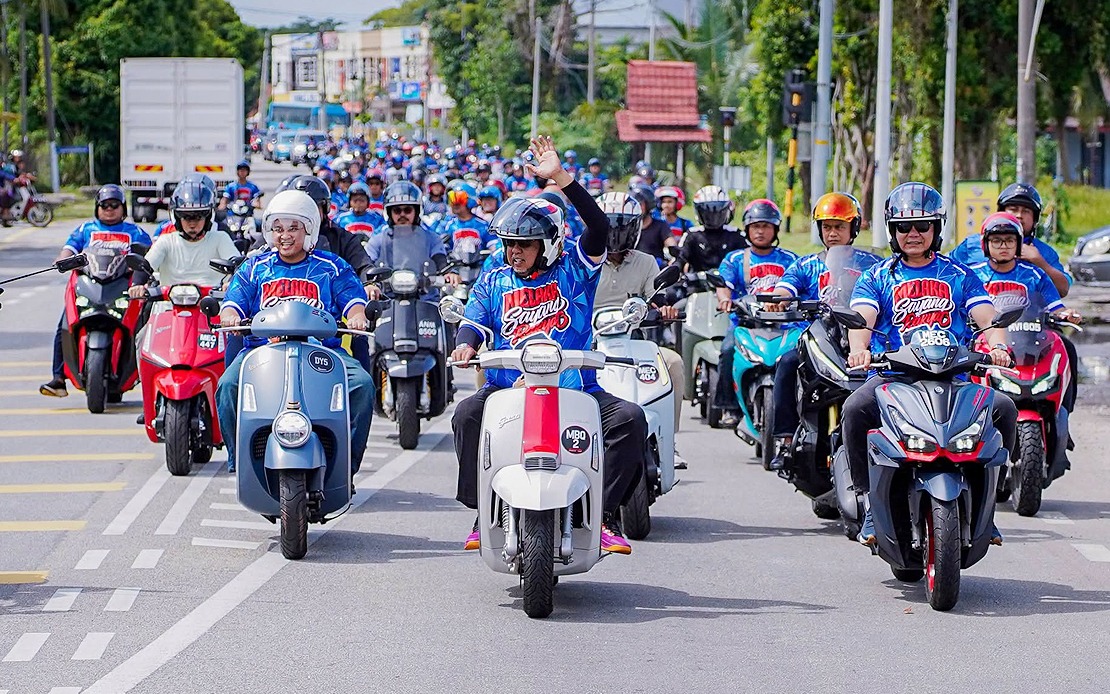
Melaka Chief Minister Datuk Seri Ab Rauf Yusoh has launched an expanded phase of the Tangga Batu parliamentary WRUR programme, targeting residents across the Pantai Kundor and Paya Rumput state constituencies with a comprehensive slate of initiatives designed to address long-standing community concerns. The two-phase rollout represents a significant scaling-up of the state government's grassroots engagement model, which has become increasingly central to Melaka's administrative approach to problem-solving at the neighbourhood level.
The expanded initiative will encompass more than 200 distinct programmes spanning multiple sectors critical to community wellbeing. These include targeted welfare support, community development projects, educational initiatives, youth-focused activities, and entrepreneurship schemes, alongside dedicated efforts to resolve persistent local grievances. This breadth of coverage reflects a strategic approach to governance that recognises the interconnected nature of community challenges—poverty, education gaps, skills deficits, and infrastructure problems often require multifaceted responses rather than single-issue interventions.
During his address at the programme launch, Ab Rauf characterised the WRUR initiative as fundamentally distinct from seasonal or one-off government campaigns. Instead, he positioned it as an institutionalised component of the state government's continuous engagement with constituents, built upon two years of sustained ground-level operations. This framing carries particular significance for Malaysian governance, where accusations of performative politics and campaign-driven policymaking remain common criticisms. By explicitly claiming consistency and permanence, the Chief Minister is attempting to shift public expectations around government accessibility and responsiveness.
The track record underpinning this expansion appears substantive. Across 23 prior implementation cycles, the programme has collected more than 4,000 formal complaints from residents, achieving a resolution rate approaching 70 per cent. Within the Tangga Batu parliamentary constituency specifically, previous WRUR activities in the Sungai Udang and Kelebang state constituencies generated 359 recorded complaints, with 328 successfully addressed and 31 remaining under active follow-up. These figures suggest a functioning complaint mechanism, though the 30 per cent unresolved rate across the broader programme merits scrutiny regarding whether outstanding issues reflect genuine complexity, resource constraints, or administrative delays.
The sixth phase of the programme distributed over RM150,000 in various forms of assistance to affected community segments, demonstrating the financial commitment underpinning the initiative. Fisheries support proved particularly substantial, with RM22,000 channelled to 220 fishermen and RM1,500 provided to five boat owners affected by vessel losses. Small and medium enterprise entrepreneurs received RM14,000 worth of business equipment, while additional resources reached religious education institutions, houses of worship, students facing financial hardship, and homeowners requiring assistance. This targeted distribution acknowledges Melaka's economic structure, where traditional livelihoods such as fishing remain significant despite broader urbanisation and economic diversification.
Recent environmental crises have elevated the programme's relevance within the Pantai Kundor constituency, where flash flooding damaged 73 houses and prompted accelerated government intervention. The Department of Irrigation and Drainage is undertaking RM50,000 in cleaning and maintenance work at Sungai Seberang Gajah, with completion expected within weeks. Simultaneously, the department has initiated procurement procedures for RM100,000 in improvement works at Sungai Lereh, indicating recognition that flood vulnerability requires sustained investment rather than reactive emergency responses. These drainage infrastructure projects address a recurring Southeast Asian challenge—the combination of aging water management systems and intensifying rainfall patterns creates mounting flood risk in low-lying coastal areas.
Larger-scale infrastructure improvements are progressing through federal approval channels. The Public Works Department has sought central government endorsement for a RM16 million project to upgrade the crossing culvert structure along Jalan Tangga Batu-Tanjung Minyak, a project reflecting the substantial investments needed to modernise road and drainage infrastructure in rapidly developing constituencies. For Malaysian readers accustomed to infrastructure bottlenecks caused by overlapping state and federal jurisdictions, the involvement of multiple government layers underscores both the complexity and the potential delays characterising such projects.
The WRUR model itself warrants examination as a governance innovation potentially relevant beyond Melaka. By institutionalising complaint reception and demonstrating measurable resolution rates, the programme provides a template for responsive local government that moves beyond periodic townhalls or manifestos unveiled during election seasons. The emphasis on quantifiable metrics—complaint numbers, resolution percentages, distributed assistance amounts—creates a system nominally susceptible to public evaluation and accountability. However, the absence of independent verification regarding complaint authenticity, resolution quality, or satisfaction levels means public trust ultimately depends on perception and trust in the administrator.
For Malaysian voters increasingly sceptical of political institutions, programmes like WRUR represent attempts to rebuild confidence through demonstrated action at the constituency level. The emphasis on diverse programme categories—welfare, education, entrepreneurship, infrastructure—acknowledges that electoral support is built not on single issues but on sustained government presence and responsiveness across multiple dimensions of community life. Whether such initiatives genuinely transform governance or constitute sophisticated political management techniques remains a question that extends well beyond Melaka, touching on fundamental questions about electoral politics and administrative accountability throughout Malaysia and the broader region.

