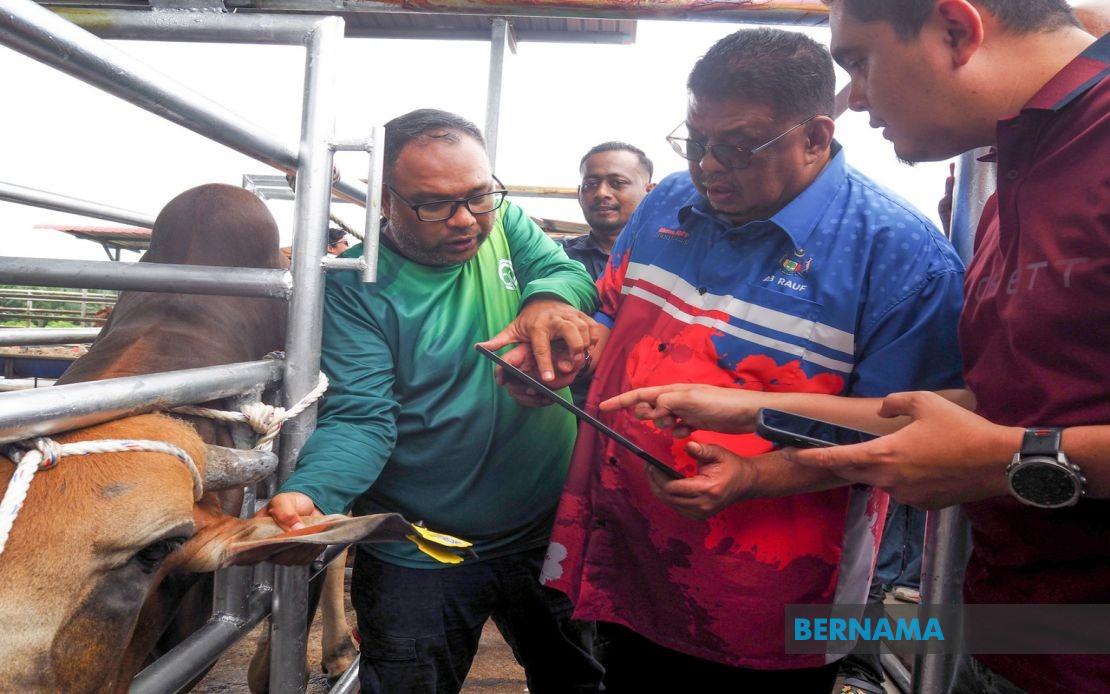
Melaka's state government has rolled out an innovative approach to livestock management through the introduction of QR Tag technology, reflecting a broader push towards digitalisation across Malaysian state administrations. The system, developed through collaboration between the Melaka Chief Minister Department (JKMM) and the Melaka Veterinary Services Department (JPV), emerged from Chief Minister Datuk Seri Ab Rauf Yusoh's vision to modernise how the state monitors and regulates its farming sector. This initiative represents more than a simple identification tool; it signals how Southeast Asian governments are beginning to harness digital solutions to address persistent rural management challenges that directly affect urban residents and road users alike.
At its core, the QR Tag system functions as a unique identifier for each registered animal, embedding both a QR code and individual identification number that can be instantly accessed by scanning with a smartphone. When authorities or concerned citizens encounter livestock, they can immediately retrieve the breeder's name, premises identification, and farm location without requiring manual record checks or time-consuming phone calls to veterinary offices. This streamlined access to ownership information fundamentally changes how quickly authorities can respond to stray animal incidents and hold livestock owners accountable for their animals' whereabouts. The technology essentially transfers the burden of accountability from overwhelmed government inspectors to a decentralised, smartphone-accessible database that can function 24/7.
The urgency underlying this initiative becomes clear when examining Melaka's recent livestock-related statistics. Since 2023, the state has documented 835 accidents involving stray livestock on its roads, alongside more than 50 formal complaints about wandering animals. These numbers reflect a genuine public safety crisis that extends beyond inconvenience; collisions involving cattle and buffaloes can cause serious injury or death to vehicle occupants, particularly on rural highways where large animals may appear suddenly. For Malaysian readers, this problem resonates across the peninsula, where similar incidents regularly appear in local news reports and social media complaints. By implementing the QR Tag system, Melaka addresses both the immediate safety concern and the underlying governance challenge of tracking responsibility in an increasingly complex agricultural landscape.
Currently, the system remains in its early phases, with approximately 2,000 livestock tagged as of early June. This represents merely a fraction of Melaka's registered animal population, estimated at over 32,000 head of cattle and buffaloes. The state government has set an ambitious expansion target to eventually encompass the entire registered livestock population, though the timeline for achieving this goal remains unspecified in official statements. The phased rollout approach appears sensible from an implementation perspective, allowing the JPV and local authorities to identify technical issues, gather feedback from farmers, and refine procedures before statewide deployment. However, for the system to meaningfully reduce stray animal incidents, coverage must eventually reach substantially higher penetration rates, since untagged animals would continue to pose the same enforcement challenges that currently plague authorities.
The financial structure supporting the rollout reveals government commitment while attempting to balance cost with farmer participation. Until the end of this year, Melaka will subsidise the entire installation cost of RM6.50 per tag, effectively placing no financial burden on breeders who voluntarily register their livestock with the JPV. This zero-cost registration period functions as an incentive mechanism to encourage rapid adoption before the programme transitions to cost-recovery operations in 2027, when farmers will pay RM5 per head for new installations or replacement tags. This two-phase pricing strategy allows the state to build momentum and achieve critical mass without initially alienating the farming community, while providing clear notice that future participation will entail modest direct costs. For Malaysian agribusiness observers, this model offers a template for how government can introduce technology-dependent regulatory systems while managing farmer resistance and ensuring equitable cost distribution.
Beyond simple identification, the QR Tag system strengthens livestock disease control and movement monitoring, capabilities that extend the technology's value beyond stray animal management. The ability to track livestock movements becomes particularly relevant during disease outbreaks, enabling veterinary authorities to rapidly identify which farms have contacts with infected animals and implement targeted quarantine measures. In a region where foot-and-mouth disease and other livestock illnesses periodically emerge as transnational threats, improved movement tracking at the state level contributes to broader biosecurity objectives. The system integrates with the eVetPermit Malaysia platform, meaning ownership changes need only be recorded once in a centralised database rather than through multiple manual processes. This integration approach reduces administrative friction while maintaining data accuracy, a critical concern when information quality directly affects public health decision-making.
Farmer attitudes toward the scheme have reportedly been positive, with breeders viewing the technology as protective of their interests rather than merely punitive regulation. This perception is crucial for sustained programme success, since voluntary compliance and enthusiasm from the agricultural community significantly ease implementation compared to top-down enforcement. Farmers understand that rapid identification of their animals—whether lost, stolen, or involved in incidents—serves their economic interests. The permanence of the QR tag throughout an animal's lifetime, coupled with the ease of updating ownership information in digital systems, addresses farmer concerns about bureaucratic complexity while maintaining data integrity. This farmer buy-in distinguishes the Melaka initiative from purely enforcement-oriented regulatory programmes that often face community resistance and compliance challenges.
The collaboration between the UKT, JPV, and local authorities (PBT) at multiple administrative levels indicates recognition that effective livestock management requires coordination across different governance domains. Local authorities handle day-to-day stray animal complaints and road safety incidents, while the veterinary department manages disease surveillance and animal welfare, and the Chief Minister's office provides strategic direction and resource allocation. This multi-agency approach, though seemingly straightforward, often proves difficult to execute in practice due to competing priorities and jurisdictional ambiguities. Melaka's explicit commitment to close cooperation suggests the state has either learned from previous coordination failures or benefited from national guidance on implementing integrated systems. For other Malaysian states considering similar initiatives, the emphasis on inter-agency cooperation provides valuable guidance, since technological capability alone proves insufficient without aligned institutional processes.
Placing Melaka's initiative within the broader Southeast Asian context reveals interesting patterns in how regional governments are adapting digital solutions to agricultural challenges. While large-scale livestock operations in developed countries have utilised tracking systems for decades, implementation in Southeast Asia must account for diverse farmer sophistication levels, variable smartphone penetration in rural areas, and existing informal governance networks that often supersede official channels. Melaka's approach acknowledges these realities by designing a system accessible via simple QR code scanning rather than requiring farmers to operate complex software or maintain subscription services. The decision to absorb technology costs during the rollout period recognises that small-scale farmers operating on thin margins would otherwise exclude themselves from compliance, undermining the programme's effectiveness.
Looking forward, the Melaka QR Tag system's success will depend fundamentally on achieving sufficient livestock coverage to make the technology genuinely useful for authorities responding to incidents. If a substantial portion of stray animals remain untagged, police and veterinary personnel will continue experiencing the same identification delays that currently frustrate enforcement efforts. This creates a threshold effect where the programme's value proposition only crystallises once coverage reaches perhaps 60-70 percent of the livestock population. The state government's recognition of this dynamic is evidenced by the subsidised rollout period, though ongoing promotion and occasional enforcement incentives may become necessary if adoption plateaus before reaching critical mass. The integration with national systems like eVetPermit Malaysia also positions this initiative as a potential building block for larger-scale livestock tracking networks potentially covering multiple states or the entire peninsula.
For Malaysian policymakers and administrators observing this initiative, Melaka's experience offers practical lessons about introducing technology-dependent regulatory systems in agricultural contexts. The combination of subsidised initial adoption, integration with existing digital infrastructure, farmer engagement, and explicit multi-agency coordination creates conditions more likely to succeed than purely technical approaches. The realistic acknowledgment of why the problem requires solving—safety, public complaints, enforcement inefficiency—grounds the initiative in tangible community benefits rather than technology for its own sake. As other states face similar challenges with stray livestock and enforcement capability, they may increasingly draw inspiration from Melaka's framework, potentially leading to interconnected systems that enhance livestock management across the region while building capacity for future agricultural sector digitisation.

