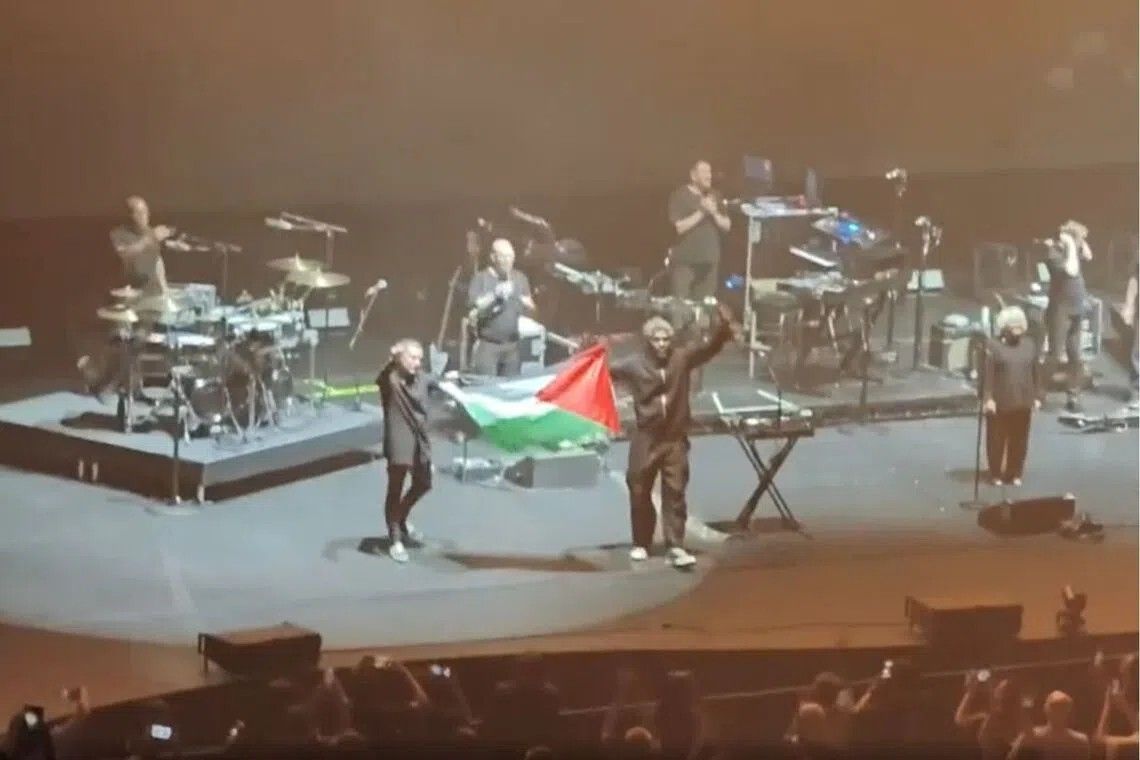
Singapore's police force has moved to prevent British trip-hop pioneers Massive Attack from ever performing within the city-state again, following an incident at a recent concert where two band members unfurled a Palestinian flag before a cheering audience. The decision represents a rare instance of a major international music act facing such severe restrictions, reflecting Singapore's uncompromising approach to managing political expression in public spaces, particularly when foreign affairs are involved.
The incident unfolded during a Wednesday evening performance, where video footage captured two musicians holding aloft the Palestinian flag while another member of the group shouted "Free Palestine" to sustained applause from concert-goers. The subsequent police investigation, which concluded by late Friday, determined that the band had breached Singapore's licensing conditions and contravened the nation's strict regulations governing the display of foreign flags and national symbols without explicit government authorization. The two individuals involved were issued stern warnings and, more significantly, received permanent entry bans that prevent them from returning to Singapore.
Singapore's regulatory framework around public speech and assembly has long been characterized by strict enforcement mechanisms designed, according to official statements, to preserve social cohesion and uphold the rule of law. The city-state maintains a blanket prohibition on the public display of any foreign flag, national emblem, or banner unless the organizer has obtained prior written permission from authorities. This legal structure differs markedly from many Western democracies, where such political expression is generally protected as a fundamental right. Notably, the concert organizer had previously acknowledged these licensing conditions in writing, making the breach a deliberate act rather than an oversight.
The involvement of Singapore's media regulator adds another layer to the enforcement action. In addition to police warnings and entry bans, regulators are investigating whether the performers violated the terms of their entertainment license. Officials have signaled that the media regulator will not approve any future applications for Massive Attack to perform in Singapore, effectively creating a permanent performance blacklist for the band. This dual-pronged approach—combining police action with regulatory intervention—underscores the seriousness with which the authorities have treated the incident.
Massive Attack has established itself as one of the West's most politically outspoken musical acts, particularly regarding Middle Eastern affairs. The band's broader advocacy work includes criticism of Israeli military operations in Gaza, making the flag display consistent with the group's long-standing activism. Frontman Robert Del Naja has personally participated in pro-Palestinian demonstrations, including an April arrest during a protest in London's Trafalgar Square alongside more than 200 others supporting Palestine Action, a group designated as banned by British authorities. This history illustrates that the Singapore incident reflects not an isolated gesture but rather a continuation of the band's deliberate political engagement.
The timing and context of the Singapore action carry particular significance for regional observers. Southeast Asia, and Singapore in particular, has cultivated a carefully balanced diplomatic approach to Middle Eastern conflicts, seeking to maintain relationships with both Israeli and Arab interests without appearing to favor one side. Public displays of political solidarity with contested causes—whether Palestinian or Israeli—are viewed by Singapore's leadership as threats to this delicate equilibrium. The police statement explicitly urged both residents and foreign visitors to "refrain from importing foreign politics," framing such actions as destabilizing to the multicultural society that Singapore has worked to construct.
For the global music industry, the ban represents a notable moment highlighting the tensions between artistic freedom and the legal constraints governing performances in different jurisdictions. Singapore has positioned itself as a premier concert destination for Southeast Asia, hosting headline performances by artists including Taylor Swift, Coldplay, Ed Sheeran, and Bruno Mars. These high-profile shows have reinforced the city-state's reputation as an economic powerhouse with world-class entertainment infrastructure. However, the Massive Attack incident reveals the boundary conditions within which performers must operate—a boundary drawn far more restrictively than in many comparable international venues.
The concert promoter, who had organized the event, has declined to comment on the police findings or the broader situation, leaving questions about whether additional penalties or fines might follow. The silence from the promoter's side may reflect an acknowledgment that public disputation with Singapore's authorities on such matters is typically unproductive. Industry observers have noted that event organizers in Singapore generally adhere strictly to regulatory requirements precisely because the consequences of breaches can include loss of future licensing privileges and reputational damage.
For Malaysian audiences and cultural observers across Southeast Asia, the Singapore action offers a instructive case study in how different national systems govern political expression at cultural events. Malaysia's own regulations around public assembly and political speech operate according to distinct legal frameworks, creating a patchwork of rules across the region. The Massive Attack case demonstrates that touring artists must navigate not just artistic choices but complex jurisdictional landscapes where the tolerance for political messaging varies significantly between neighboring countries.
The decision also raises broader questions about the relationship between commerce, culture, and politics in the region's growing entertainment sector. As Southeast Asian cities compete to attract major international acts and establish themselves as cultural capitals, they simultaneously maintain restrictions that reflect their particular political values and concerns. This creates an inherent tension: the desire to be perceived as cosmopolitan and open to global culture sits uneasily alongside regulations that limit certain forms of expression. Singapore's explicit stance—that foreign politics have no place in entertainment venues—represents one extreme of this spectrum, but it illustrates how national governments continue to assert control over political messaging in nominally apolitical spaces.
Looking forward, the Massive Attack case may influence how other politically engaged artists approach performances in Singapore and similar jurisdictions. Some acts may choose to avoid such venues entirely to prevent compromising their activism, while others might self-censor their public statements to access lucrative markets. The long-term implications for artistic freedom in the region remain to be seen, particularly as generational attitudes toward political expression continue evolving among audiences and performers alike.

