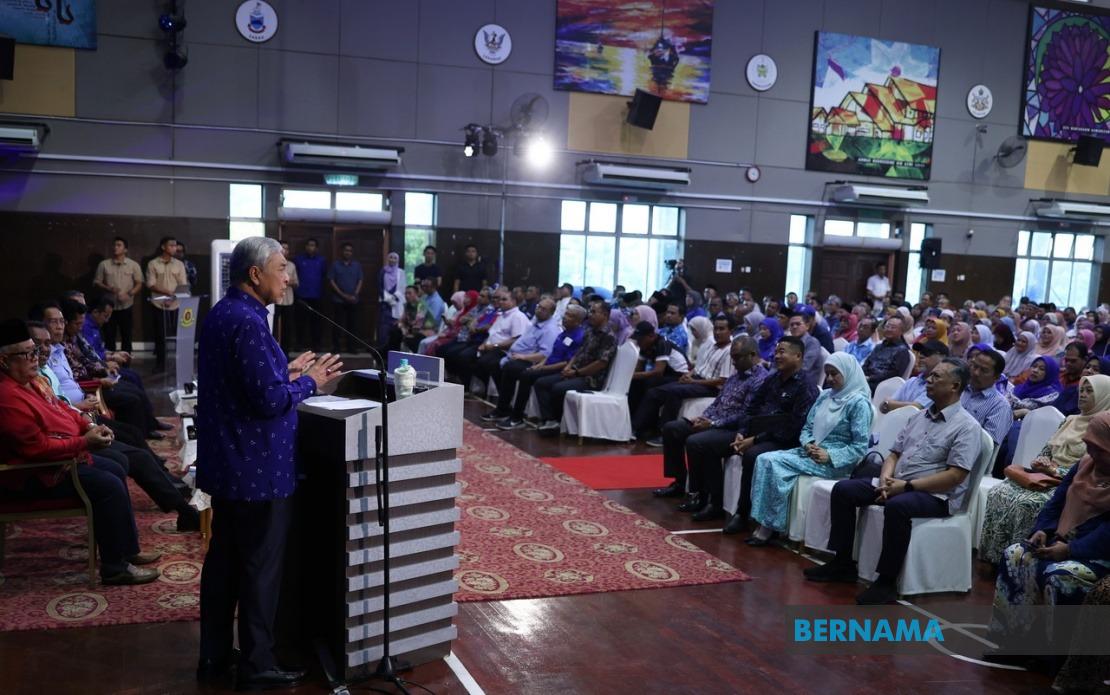
Deputy Prime Minister Datuk Seri Dr Ahmad Zahid Hamidi has raised concerns about the inconsistency of Majlis Amanah Rakyat (MARA) policies across successive governments, insisting that the statutory body's core mission to safeguard Bumiputera interests must transcend the inevitable transitions of political leadership in Malaysia. Speaking during a community engagement session at Gemencheh Maktab Rendah Sains Mara in Tampin on July 30, Zahid stressed that MARA's foundational policies ought to operate independently of ministerial reshuffles or changes in the organisation's chairmanship.
The Deputy Prime Minister articulated a persistent institutional problem that has plagued Malaysia's development agencies: the vulnerability of long-term policy objectives to short-term political cycles. He highlighted that whenever a new MARA chairman assumes office or a minister overseeing Bumiputera affairs takes the portfolio, the agency's operational direction and policy priorities frequently shift, undermining continuity and long-term strategic planning. This pattern, Zahid suggested, weakens the coherence of efforts to advance Bumiputera economic participation and protection across decades.
Zahid's remarks reflect a broader governance challenge in Southeast Asia's largest economies, where institutional policy frameworks often lack sufficient statutory protection against political churn. Malaysia's experience with MARA illustrates how development mandates can become hostage to factional interests and leadership preferences if not embedded in legislation with sufficient rigidity. The Deputy Prime Minister's implicit criticism signals frustration with the practice of using ministerial authority to reshape agency direction, a common pattern that can dilute institutional effectiveness.
To address this structural vulnerability, Zahid announced that his government intends to pursue comprehensive amendments to the MARA Act 1966, the foundational legislation governing the organisation. These amendments are designed to embed Bumiputera protection objectives directly into the Act itself, making it legislatively binding rather than administratively discretionary. By elevating core MARA functions to statutory obligation, future governments and leadership would find it considerably more difficult to unilaterally alter the organisation's strategic orientation.
The timeline for legislative action is ambitious. Zahid indicated that amendments to the MARA Act 1966 would be tabled in the Dewan Rakyat before the close of 2024, with expectations that parliamentary approval could be secured within two months of tabling. This accelerated schedule reflects the political priority placed on the issue, though it also raises questions about the legislative resources required to draft, review, and pass comprehensive amendments to a foundational statute. MARA chairman Datuk Dr Asyraf Wajdi Dusuki, present at the event, has been apprised of this legislative intention.
The proposed amendments carry significance beyond MARA's administrative operations. They represent an attempt to constitutionalise a policy commitment without pursuing a formal constitutional amendment, effectively using ordinary legislation to create enhanced legal barriers to policy reversal. This approach reflects pragmatic governance in Malaysia's parliamentary system, where constitutional amendments require supermajority support and are difficult to engineer. By strengthening statutory obligations, the government seeks to achieve institutional resilience without triggering the political controversy that constitutional amendments would entail.
For Malaysian stakeholders in Bumiputera development and economic policy, the amendments could provide genuine reassurance that core protections and advancement programmes will not become collateral damage in future political transitions. Small and medium Bumiputera enterprises, Bumiputera scholarship recipients, and those benefiting from MARA's vocational training programmes would theoretically enjoy more predictable institutional support across electoral cycles. The implications extend to long-term strategic planning by private corporations and state governments that coordinate with MARA on development initiatives.
Beyond the substance of Bumiputera policy, Zahid's intervention signals the government's recognition that institutional coherence and policy continuity have become salient political issues in Malaysia. As the country navigates increasingly fragmented coalition politics and shorter ministerial tenures, concerns about governmental discontinuity and strategic incoherence resonate with both business communities and constituencies dependent on public programmes. Demonstrating capacity to protect long-term institutional mandates from political volatility could strengthen public confidence in state capacity.
The Deputy Prime Minister also used the Tampin engagement to appeal to citizens residing outside Negeri Sembilan to return for the state election held on Saturday, emphasising the importance of voting participation. He encouraged parents to facilitate their adult children's travel home to discharge electoral obligations, highlighting how voter mobilisation remains a central concern even during discussions of institutional governance. This duality reflects the integrated nature of Malaysian political discourse, where technical administrative improvements often intertwine with immediate electoral imperatives.
The specific choice to advance these comments during a MRSM community session underscores MARA's educational mission and its significance as a vehicle for Bumiputera advancement. MRSM institutions, established to provide residential secondary education to capable Bumiputera students, exemplify MARA's operational reach into human capital development. Zahid's emphasis on policy consistency directly affects countless students and families reliant on these educational pathways, making the institutional reform discussion locally relevant rather than abstractly bureaucratic.
Looking ahead, the success of MARA Act amendments will depend on whether they can establish sufficient statutory clarity and protection while remaining flexible enough for operational adaptation. Overly rigid legislation might inhibit necessary modernisation and efficiency improvements, whereas insufficient statutory safeguards could fail to achieve the intended protection against political interference. The legislative drafting process will require careful calibration of these competing imperatives.
Regionally, Malaysia's experience with institutionalising Bumiputera protection policies may attract attention from other Southeast Asian governments pursuing affirmative action or preferential economic policies for defined constituencies. Thailand's bureaucratic aristocracy, Indonesia's pribumi protections, and the Philippines' indigenous peoples' policies all face similar tensions between political continuity and institutional mandate. Malaysia's legislative approach could serve as a model or cautionary tale, depending on implementation outcomes.

