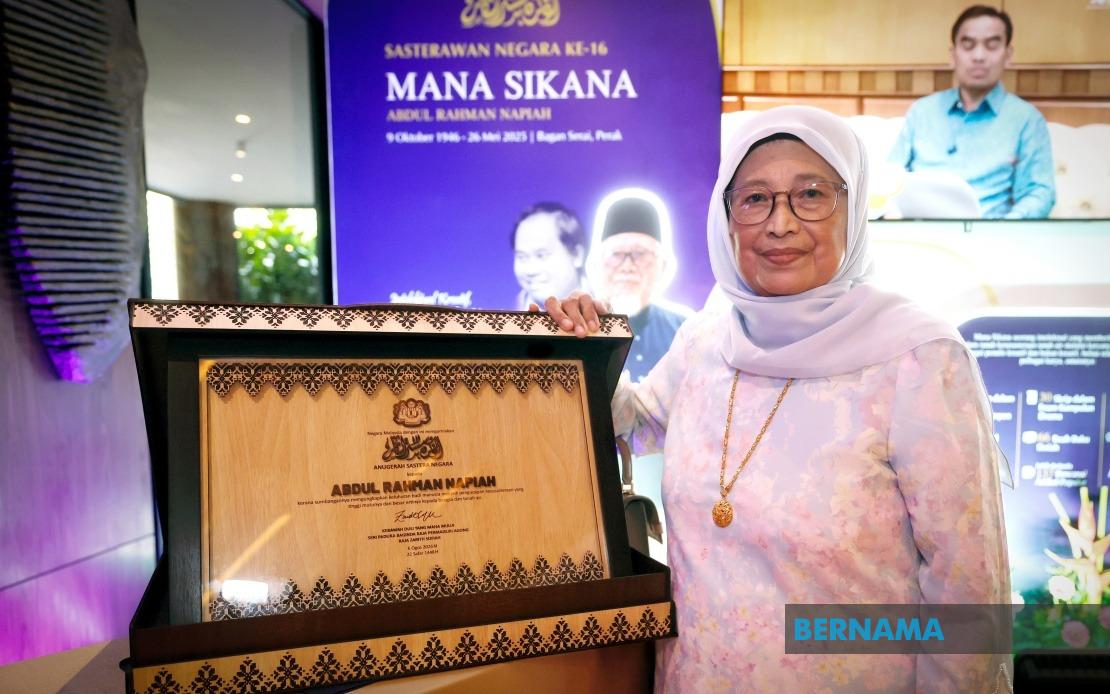
Malaysia's literary community has formally recognised one of its most prolific figures with the posthumous conferment of the National Laureate title. Dr Abdul Rahman Napiah, who spent decades crafting Malay literature under the pen name Mana Sikana, has been named the 16th recipient of this prestigious accolade. His widow, Salmah Ali, received the honour at a ceremony in Kuala Lumpur on behalf of her late husband, presented by Queen Raja Zarith Sofia with Education Minister Fadhlina Sidek in attendance.
Salmah Ali, now 82 years old, spoke candidly about the profound emotion surrounding the moment. Her husband had long anticipated this recognition, she explained, having dedicated his entire professional life to advancing Malay language literature and theatre. The timing of the award carries a bittersweet quality—Mana Sikana passed away in May last year at the age of 80 from heart complications, just as discussions about his eligibility for the National Laureate honour were intensifying within literary circles. What makes the recognition particularly poignant is that her husband had been informed of the possibility before his death, giving him some comfort in his final months.
The circumstances surrounding his passing underscore his unwavering commitment to his craft. On the day he suffered the health crisis that would ultimately prove fatal, Mana Sikana was actively engaged in his professional responsibilities, presenting a working paper to Dewan Bahasa dan Pustaka, the national language and literary body. It was only after completing this intellectual labour that he experienced the stomach pain and vomiting that necessitated emergency hospital admission that evening. For someone whose life revolved around the written and spoken word, continuing to contribute right until illness intervened seemed entirely characteristic.
Mana Sikana's career trajectory reflected the diverse possibilities available to writers who pursued multiple creative avenues simultaneously. Born in Bagan Serai, Perak on October 9, 1946, he began his working life as an educator before transitioning into the academic sphere. His range extended far beyond the printed page—during his years in Johor Bahru, he actively produced dramatic works for Singaporean radio and television stations, while simultaneously crafting scripts for Malaysian broadcasting networks. This multimedia approach to storytelling positioned him at the intersection of popular entertainment and serious literary culture during a formative period for both mediums in Southeast Asia.
His academic credentials eventually reached professorial level, a trajectory that took him through several prestigious institutions across the region. Mana Sikana spent significant time at Universiti Kebangsaan Malaysia, where he developed his scholarly expertise in literary theory and criticism. His influence extended across borders—he served as a visiting lecturer at universities in Indonesia, cementing his status as a regional intellectual figure rather than merely a national one. This cross-border engagement reflected how Malaysian literature, when produced at the highest levels, contributes to broader conversations within Southeast Asian cultural discourse.
The formal citation for the National Laureate recognition emphasised Mana Sikana's multifaceted contributions to strengthening national literature. Education Minister Fadhlina Sidek highlighted his significant role in developing creative writing, literary theory, and critical analysis within an academic context. His body of work demonstrated that serious literary merit and public engagement need not exist in separate spheres—he had managed to be simultaneously a popular dramatist creating content for mass audiences and a rigorous scholar advancing theoretical understanding of his discipline.
What emerges from Salmah Ali's reflections is a portrait of someone who regarded literary contribution as a form of generational stewardship. He continued imparting his accumulated knowledge about writing and literature to his immediate family until the very end—sharing insights with their four children and twelve grandchildren. This domestic transmission of intellectual values suggests that his influence will persist not only through published works and academic legacies but through familial relationships that value cultural sophistication.
The conferment of the National Laureate title carries particular significance for Malaysian literary culture at a moment when sustaining serious engagement with Malay-language literature presents genuine challenges. The award recognises not simply past achievement but establishes a benchmark for what constitutes exceptional contribution to the national literary canon. By honouring Mana Sikana, the nation signals that writers who combine popular appeal with scholarly rigour, who work across multiple genres and media, and who maintain regional intellectual networks deserve the highest recognition.
For Southeast Asian readers observing Malaysian cultural institutions, this award reflects how the region's older literary figures continue shaping contemporary discourse even in their absence. Mana Sikana's generation witnessed the emergence of independent Malaysia and helped establish what Malay-language literature could become in a newly sovereign nation. His work bridged print and broadcast media during a transitional era, and his academic contributions shaped how subsequent generations would theorise their own writing practices.
Salmah Ali concluded her remarks by expressing gratitude that her husband's lifetime of service had finally received formal acknowledgment at the nation's highest level. That gratitude, tinged with the sadness of his physical absence, encapsulates what this award represents—not merely honouring what has been accomplished, but affirming the enduring value of literary culture itself at a national level. The National Laureate recognition ensures that Mana Sikana's contributions will remain part of Malaysia's official cultural record, accessible to students and scholars for generations to come.

