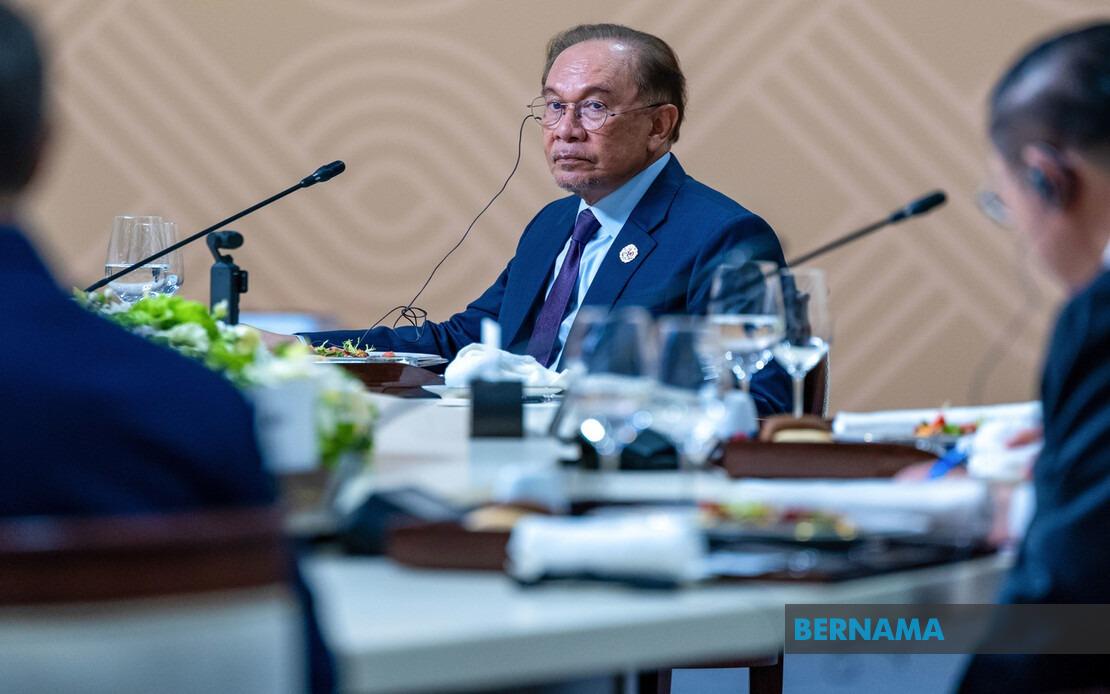
Prime Minister Datuk Seri Anwar Ibrahim's whirlwind four-day tour spanning Tashkent, Kazan, and Ashgabat represents far more than routine diplomatic protocol. The journey encapsulates Malaysia's deliberate recalibration of its international economic engagement at a moment when the global order itself is undergoing profound structural change. Each destination served a distinct strategic purpose, yet together they reveal a coherent vision: building a more resilient economy through diversified partnerships in an increasingly fragmented world.
The international environment in which Malaysia operates has shifted dramatically. The post-Cold War consensus favouring open trade and investment flows has fractured under the weight of great-power competition. Tariffs, sanctions regimes, export controls, and state-directed industrial policies have become standard instruments of statecraft rather than exceptions. For a trading nation whose prosperity depends fundamentally on economic connectivity, these developments pose existential questions about how to secure growth, protect supply chains, and maintain strategic autonomy simultaneously.
Malaysia's position as a middle power makes this challenge particularly acute. The country cannot retreat into isolationism, nor can it afford to align exclusively with any single bloc or major power. Instead, economic survival requires threading a needle: maintaining relationships with established partners while cultivating new ones, all without appearing to abandon commitments or sacrifice independence. This balancing act explains the deliberate geographic spread of Anwar's itinerary and the substantive nature of engagements in each location.
The Tashkent stopover initially appeared ceremonial—a courtesy call on President Shavkat Mirziyoyev following prior contact in 2024. Yet it evolved into substantive discussions encompassing multiple sectors of economic cooperation, with deliverables extending months into the future. This transformation reflects a broader pattern: bilateral relationships that Malaysian officials have carefully nurtured are now yielding concrete returns. Central Asia, often overlooked in Southeast Asian strategic calculations, represents an emerging frontier for Malaysian economic activity, from investment opportunities to technology partnerships.
Kazan served as the platform for Malaysia's engagement with Russia at the ASEAN-Russia Commemorative Summit, but the city itself proved equally significant. As capital of the Republic of Tatarstan, Kazan exemplifies how contemporary economic diplomacy operates beyond traditional state-to-state channels. Tatarstan has positioned itself as Russia's technological and industrial hub, with particular strength in biotechnology, advanced manufacturing, and Islamic finance. Discussions with regional leaders uncovered opportunities that Moscow-centric diplomacy might easily overlook—particularly in halal industries and maritime capabilities, sectors where Malaysian expertise is globally recognised.
This emphasis on sub-national actors reflects a crucial evolution in international economic engagement. Cities, regions, and industrial clusters have become independent nodes in global networks, capable of negotiating directly with foreign partners and generating opportunities that complement traditional diplomatic channels. Malaysia's willingness to engage Tatarstan directly, rather than channelling all interaction through Russian federal authorities, demonstrates sophistication in understanding how modern economies actually function. The practical result is access to innovation hubs and sectoral expertise that might otherwise remain compartmentalised within rigid governmental structures.
The ASEAN-Russia Strategic Programme on Trade and Investment Cooperation 2026-2035 agreed in Kazan underscores a key principle: ASEAN's commitment to engaging diverse external partners while preserving strategic autonomy. This doctrine of non-alignment—framed more diplomatically as "centrality"—has long been ASEAN's defining characteristic and greatest vulnerability. By maintaining channels to competing powers rather than choosing sides, ASEAN maximises flexibility but risks appearing irrelevant or opportunistic. Malaysia's participation in deepening this framework signals that the principle remains viable, even as its execution requires constant calibration.
Turkmenistan presented a different calculus entirely. Petronas's presence there spans three decades and represents a cumulative investment approaching USD12 billion. This is not speculative capital seeking quick returns but patient, long-term commitment that has generated infrastructure development, technological transfer, and human capital advancement alongside profit. The recent agreements expanding Petronas's stake in major gas fields represent not a new departure but the maturation of a relationship that has survived geopolitical shifts, sanctions pressures, and market volatility. For Malaysia, this represents proven competence in managing complex energy partnerships in challenging environments.
Energy diversification holds particular resonance in a world where supply disruptions in one region rapidly cascade globally. Recent geopolitical crises have demonstrated how vulnerable concentrated energy partnerships can become. By deepening engagement with Turkmenistan's hydrocarbon sector, Malaysia—through Petronas—secures long-term supply relationships, production-sharing arrangements, and exploration opportunities that buffet against volatility elsewhere. This is resilience constructed methodically over decades rather than assembled hastily during crises.
Yet reducing these engagements to commodity flows and trade statistics fundamentally misses their character. Anwar's repeated emphasis during bilateral discussions on broadening cooperation beyond purely commercial dimensions reveals that contemporary economic diplomacy operates simultaneously across multiple domains. Food security, technological capability, educational exchange, and financial services innovation all intersect with traditional trade considerations. Discussions encompassed Islamic finance frameworks, halal ecosystem development, and research collaboration—areas where Malaysia possesses distinctive expertise and competitive advantage.
This multidimensional approach reflects recognition that future economic competitiveness increasingly depends on innovation capacity, technological sophistication, and adaptive capability rather than mere volume of goods exchanged. A nation's resilience flows from its ability to participate across multiple value chains, attract diverse talent and investment, and maintain flexibility as technologies and market preferences shift. Malaysia's cultivation of partnerships in biotechnology, digital technologies, and advanced manufacturing aligns with this reality more directly than traditional resource extraction or commodity export relationships.
The soft power dimension—the personal credibility and leadership style that Anwar brings to these engagements—should not be underestimated. Economic relationships depend ultimately on trust between decision-makers. Consistent, principled engagement, combined with demonstrated capacity to deliver on commitments, builds the foundation upon which formal agreements rest. The success of Malaysia's expansion into Central Asia and the Caucasus reflects not merely structural economic opportunity but also the effectiveness of diplomatic presence and negotiating skill at the highest levels.
As the global economy evolves toward a genuinely multipolar configuration, Malaysia's strategy of broadening partnerships across multiple regions and sectors offers a template for other middle powers navigating comparable challenges. The approach accepts that exclusive alignments impose costs—in terms of lost opportunities, reduced flexibility, and strategic vulnerability. Instead, it emphasises building resilience through diversity, depth, and deliberate cultivation of relationships at multiple levels of governance and economic activity. The four-day tour from Tashkent through Kazan to Ashgabat thus signals not simply tactical repositioning but a fundamental reimagining of how Malaysia maintains prosperity in an era of intensifying competition and fragmentation.

