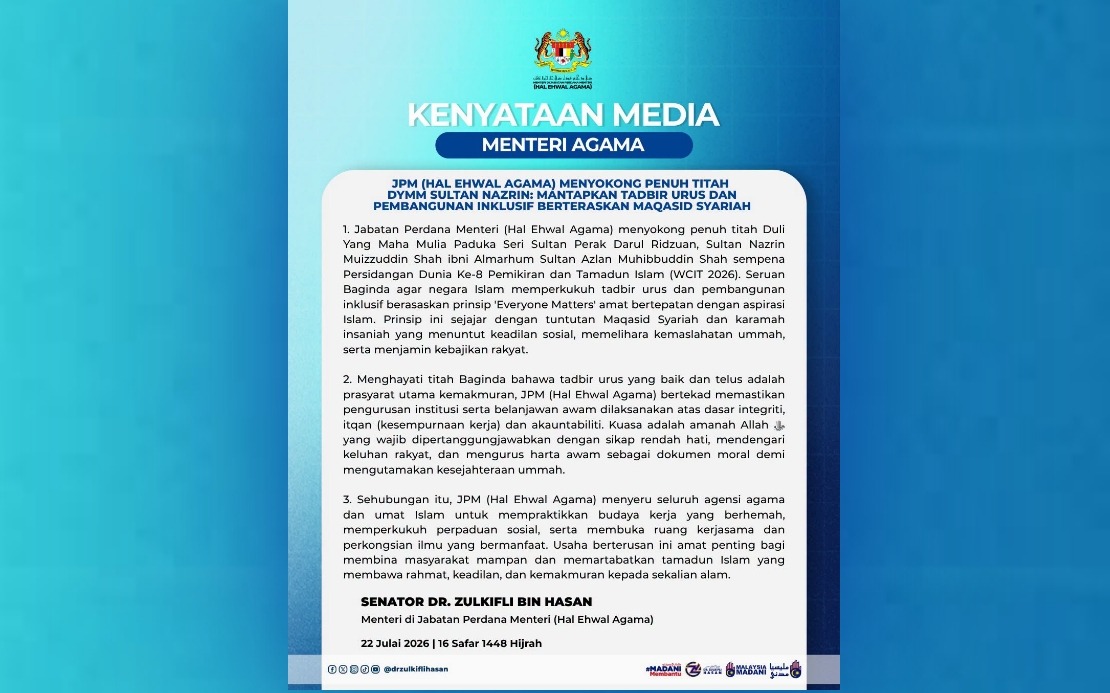
The Prime Minister's Department (Religious Affairs) has pledged to restructure its governance framework around principles of transparency and public accountability, drawing directly from Sultan Nazrin Shah's recent call for Muslim-majority nations to prioritise inclusive development and institutional excellence. The commitment represents a significant pivot toward embedding ethical governance standards across Malaysia's religious bureaucracy, an area historically subject to inconsistent oversight and varying implementation standards across states.
Minister in the Prime Minister's Department (Religious Affairs) Dr Zulkifli Hasan articulated this shift during a statement released on July 22, emphasising that Sultan Nazrin's "Everyone Matters" principle transcends mere administrative convenience to reflect core Islamic jurisprudential concepts. The minister positioned the framework as entirely consonant with Maqasid Syariah, the objectives underlying Islamic law, and the Islamic concept of karamah insaniah, which encompasses human dignity and the preservation of inherent human worth regardless of status or circumstance.
Sultan Nazrin delivered his foundational address at the 8th World Conference on Islamic Thought and Civilisation, where he articulated a vision of governance fundamentally rooted in universal representation. His Royal Highness emphasised that authentic public service must extend equitably to all citizens irrespective of ethnicity, faith tradition, or political affiliation—a statement carrying particular resonance in Malaysia's multi-religious, multi-ethnic context where religious institutions sometimes face perceptions of partiality or narrow constituency focus.
The Sultan's remarks positioned humble, listening-based leadership as prerequisite to legitimate lawmaking, arguing that administrative authority derives legitimacy from responsiveness to citizen needs rather than unilateral institutional prerogative. This conceptual framework challenges bureaucratic silos that can insulate religious agencies from accountability mechanisms or public feedback loops, a persistent governance challenge across Southeast Asia where religious authorities sometimes operate with minimal external oversight.
Dr Zulkifli expanded upon the prosperity dimension of Sultan Nazrin's argument, which emphasised that development cannot succeed through autarchic approaches. The minister acknowledged the Sultan's observation that regardless of domestic resource endowments, no nation can sustain prosperity in isolation—trade flows, capital investment, knowledge transfer, and technological advancement all require cross-border engagement and institutional reliability. This framing carries particular significance for Malaysia's aspirations to maintain its position as a regional financial and educational hub, where institutional trustworthiness directly influences investor confidence and knowledge-sector competitiveness.
The religious affairs portfolio specifically committed to embedding integrity, itqan—an Islamic principle denoting excellence and meticulousness in work execution—and rigorous accountability throughout institutional management and public budgeting processes. This three-pillar approach addresses a recurring tension within Southeast Asia's religious governance structures, where financial stewardship of wakaf (religious endowment) assets and zakat (alms) distributions sometimes lacks transparent accounting mechanisms accessible to contributing publics or independent auditors.
Dr Zulkifli framed institutional authority itself as fundamentally fiduciary in character, invoking the Islamic concept that all authority constitutes divine trust requiring humble execution. He positioned public fund management as a moral rather than merely technical responsibility, with the welfare of the ummah—the global Muslim community—as the normative metric for evaluating administrative decisions. This rhetorical move realigns religious governance away from purely procedural or hierarchical legitimacy toward outcomes-based evaluation emphasising demonstrable public benefit.
The minister's statement additionally called upon religious agencies and the broader Muslim community to cultivate refined workplace cultures emphasising courtesy and professionalism. This cultural dimension reflects recognition that governance frameworks succeed or fail partly through implementation quality and interpersonal dynamics within bureaucratic systems. The call for strengthened social cohesion and collaborative knowledge-sharing acknowledges that Malaysia's plural society requires religious institutions capable of bridging sectarian divides rather than reinforcing them through institutional silos or competitive resource struggles.
For Malaysian readers and Southeast Asian observers, this commitment signals potential recalibration of how religious authorities operate within pluralist democracies. The explicit endorsement of universal public service regardless of religious identity represents meaningful pushback against religious nationalism or exclusionary institutional cultures that have periodically generated interfaith tensions across the region. Implementation will prove decisive: genuine embedding of these principles requires resource allocation, training programmes, accountability infrastructure, and cultural change extending well beyond ministerial statements into daily institutional practice and documented outcomes.
The framework also carries implications for Malaysia's soft power positioning within the Islamic world. Sultan Nazrin's articulation of governance excellence as compatible with Islamic principles—and the government's visible embrace of this position—potentially strengthens Malaysia's claim to represent a moderate, inclusive Islamic governance model at a moment when global perceptions of religious administration in Muslim-majority nations remain contested and polarised. Whether this articulated vision translates into observable institutional transformation across Malaysia's federal and state religious bureaucracies will substantially determine both public trust in religious institutions and the credibility of claims regarding Islamic governance compatibility with inclusive democracy.

