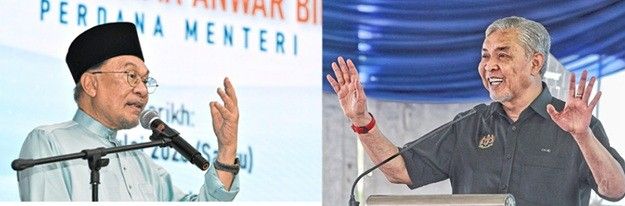
Malaysia's political theatre has shifted to an unlikely stage: the ancient art of the pantun. As the Negri Sembilan state campaign intensifies, the country's senior leaders are deploying four-line verses to communicate messages that conventional political rhetoric cannot safely convey. This week, PKR's president posted a pantun on social media alongside photographs from a federal Cabinet meeting, a seemingly gentle reminder that despite state-level electoral rivalry, the national unity government must hold firm. Within hours, Umno's president responded in kind with his own carefully crafted verse, initiating a poetic exchange that speaks volumes about the intricate dance between Malaysia's competing political coalitions.
The pantun, far from being mere decorative language, functions as a sophisticated instrument of strategic indirectness rooted in Malay political culture. By framing sensitive messages within traditional verse, leaders can test boundaries, signal warnings, or offer olive branches without violating the unspoken codes of political decorum. A well-constructed four-line stanza allows figures to deliver pointed criticism or extend peace offerings while maintaining plausible deniability and preserving the veneer of respectability that Malaysian politics demands. This approach proves particularly valuable during periods of coalition tension, when explicit confrontation could destabilise governing arrangements but silence would invite misinterpretation.
The PKR president's opening pantun carried a straightforward message: electoral competition at the state level need not rupture the foundations of national consensus. The verse acknowledged that coalition partners may diverge tactically while insisting that friendship and consensus must endure. The imagery evoked different paths converging toward the same destination—a political aspiration rather than a statement of fact. Yet Umno's response introduced a markedly different tone. The counter-pantun acknowledged that the governing roof, though weathered by state-level turbulence, could remain standing provided both sides exercise responsible management. However, the final line struck a cautionary note, hinting that should mismanagement occur, the entire structure faced genuine peril. The exchange thus functioned as simultaneous reassurance and warning, allowing both parties to demonstrate commitment to the unity government while subtly threatening the consequences of its collapse.
To understand contemporary pantun political warfare in Malaysia, one must examine the Raja Pantun himself: Datuk Seri Dr Ahmad Maslan, Umno's Pontian MP and Deputy Minister of Works. This legendary figure has elevated pantun composition from cultural flourish to political weapon, embedding four-line verses into campaign speeches with precision and humour. During the March 2022 Johor state elections, Ahmad deployed a pantun warning voters about deception and wrong political choices, recycling a verse he had originally used during the November 2019 Tanjung Piai parliamentary by-election. The original version explicitly named Pakatan Harapan as the target, but when electoral circumstances shifted, Ahmad simply replaced the explicit reference with the ambiguous "that party," maintaining his satirical punch while adapting to fluid multicoalition dynamics. This flexibility demonstrated how pantun could function as political weaponry that survives changing circumstances and rival configurations.
The Negri Sembilan contest presents a particularly complex scenario that pantun exchanges struggle to fully illuminate. Bersatu, the Perikatan Nasional component party, occupies an anomalous position by competing aggressively against both its formal allies in Barisan Nasional and its former partner Pakatan Harapan. Across 24 seats, Bersatu faces three-way contests that could inadvertently benefit Pakatan by fragmenting the opposition vote. This paradox creates what political analysts describe as Bersatu functioning as opposition to the opposition—a dynamic that raises uncomfortable questions about whether the party's electoral strategy serves its purported allies or undermines them. The possibility that Bersatu's aggressive stance might hand Pakatan unexpected advantages could force the party to recalculate its political positioning and reassess whether alignment with Pakatan rather than Barisan/Perikatan might better serve its long-term interests.
Demographic and electoral mathematics further complicate the unity government's position in Negri Sembilan. The 2023 state elections revealed Pakatan's structural advantages in the state, with the coalition capturing 17 seats despite facing considerable headwinds elsewhere in Malaysia. Notably, DAP secured 11 of those 17 seats, demonstrating the party's electoral dominance while simultaneously creating a strategic vulnerability. DAP's strength derives partly from non-Malay voters, but this electoral foundation creates friction with Malay-majority constituencies that remain suspicious of the party's secular orientation and sometimes confrontational rhetoric toward Islamic institutions. When DAP sharpens its attacks on Umno and PAS, particularly regarding religious governance or federal policy, it risks driving fence-sitting Malay voters toward consolidation behind the Barisan/Perikatan bloc. This dynamic suggests that DAP's electoral strength in urban and mixed areas may inadvertently weaken Pakatan's capacity to compete effectively in Malay-majority districts.
The broader implications of these coalition dynamics extend well beyond Negri Sembilan's 36 state seats. The unity government, formed after the 2022 general election, represents an unprecedented configuration in Malaysian politics—a governing arrangement between parties that spent decades as mortal enemies. The arrangement has delivered relative governmental stability and prevented the political paralysis that threatened Malaysia during the Sheraton Move crisis and its aftermath. However, every state election functions as a referendum on whether the unity government can maintain coherence while allowing component parties to campaign as distinct entities with separate electoral brands. The Negri Sembilan contest will test whether the coalition can manage this balancing act without fracturing.
Pantun exchanges serve as early warning systems for coalition strain precisely because they allow leaders to communicate truths that must otherwise remain unspoken. When Umno responds to PKR's conciliatory verse with language invoking storms and structural damage, astute observers recognise that tensions beneath the unity government's surface run deeper than public statements suggest. The poetic register permits this candid signalling because pantun, by its nature, speaks obliquely and metaphorically. A direct statement that the government might collapse would trigger financial market reactions and international concern; a carefully composed pantun conveying the same information allows domestic audiences to calibrate expectations while maintaining superficial confidence.
The electoral mathematics in Negri Sembilan may ultimately prove decisive in determining whether the unity government emerges strengthened or weakened. Should Pakatan make significant gains, particularly at Bersatu's expense, questions will inevitably arise about whether the coalition configuration requires recalibration. Conversely, if Barisan/Perikatan consolidates support despite the unity government's governance record, it might signal that state-level tribal loyalties and ethnic voting patterns override considerations of federal-level partnership. The outcome will likely determine not only Negri Sembilan's governance but also whether the unprecedented unity government experiment can sustain itself through a full electoral cycle.

