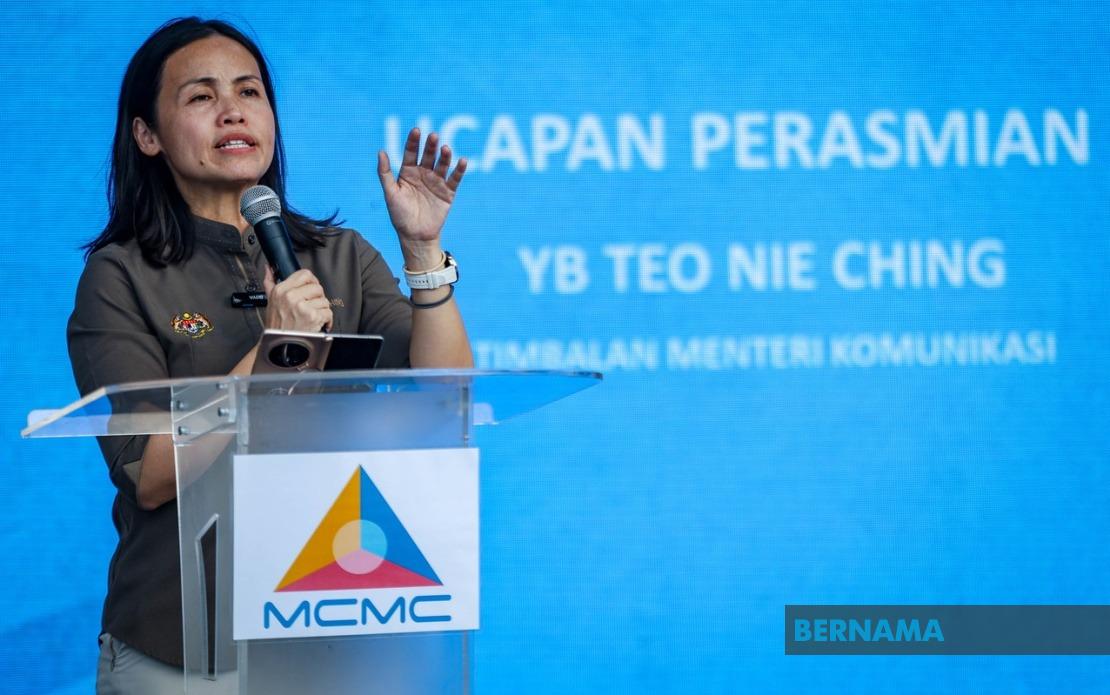
The National Scam Response Centre has documented nearly 6,000 online fraud cases during the first four months of this year, according to data presented by Deputy Communications Minister Teo Nie Ching at a community safety event in Kulai. The figures underscore a persistent and evolving threat landscape that continues to trap Malaysian consumers across multiple fraud categories, from counterfeit transactions to elaborate schemes promising quick financial returns.
Breaking down the composition of reported incidents, e-commerce fraud emerged as the most prevalent category, accounting for 2,566 cases or roughly 43 percent of the total volume. Telecommunication scams comprised the second-largest segment with 1,369 reported cases, representing about 23 percent of complaints. The remaining portion encompassed fabricated loan offerings and fraudulent investment schemes that have become increasingly sophisticated in their targeting of vulnerable populations, particularly the elderly and financially inexperienced individuals seeking rapid wealth accumulation.
Teo emphasised that the substantial reporting volume, while reflecting heightened public awareness of the 997 hotline dedicated to scam victim assistance, simultaneously demonstrates the alarming prevalence of actual fraud victimisation across Malaysian society. The Deputy Minister articulated concern that documented cases represent merely the visible portion of a broader problem, with numerous victims either unaware of proper reporting channels or reluctant to come forward due to shame or mistrust of authorities. She stressed that the true scope of online fraud likely exceeds official statistics considerably.
The government's response has evolved beyond reactive victim support toward preventive community education. Teo highlighted that the Safe Internet Campaign, originally established in 2025 with an institutional focus, has undergone strategic recalibration to reach broader population segments. Initial iterations concentrated on formal educational settings including primary and secondary schools, tertiary institutions, and teacher training establishments under the Malaysian Institute of Teacher Education. This narrow scope reflected an assumption that digital literacy deficits primarily affected younger demographics requiring foundational instruction.
Recognising that fraud victimisation spans all age groups and socioeconomic strata, the campaign has shifted toward comprehensive community engagement that acknowledges the diverse vulnerabilities across Malaysian society. The expanded approach explicitly incorporates parents, senior citizens, and working-age adults whose digital skills may have developed organically without formal training in cybersecurity awareness. This demographic expansion recognises that older populations, often targeted by scammers exploiting technological unfamiliarity and social engineering tactics, require tailored educational interventions distinct from schoolroom instruction.
Kulai served as the inaugural location for the Safe Internet Campaign Community Carnival, a format designed to deliver interactive education within accessible community settings rather than formal institutional environments. This event model facilitates hands-on learning opportunities where residents encounter fraud scenarios, understand warning indicators, and practise protective responses in low-pressure environments. The carnival approach acknowledges that effective scam prevention requires experiential engagement rather than abstract information delivery, particularly for populations with limited technological confidence.
The campaign's planned expansion across nine additional Johor districts represents a carefully sequenced rollout rather than simultaneous nationwide deployment. Following Kulai's inaugural hosting, the initiative will progress through Kluang, Muar, Kota Tinggi, Pontian, Segamat, Batu Pahat, Mersing, Tangkak, and Johor Bahru, with proceedings scheduled to conclude on December 19. This methodical geographic expansion allows programme organisers to refine messaging and delivery based on community feedback and local fraud pattern variations, while maintaining momentum throughout the extended campaign period.
Johor's selection for the initial pilot reflects both the state's significant urban and rural population concentration and the substantial fraud reports originating from its residents. The state encompasses diverse communities ranging from developed commercial hubs to agricultural regions, presenting varied fraud vulnerabilities requiring context-specific educational approaches. Rural populations may encounter investment fraud targeting agricultural enterprises, while urban consumers face sophisticated e-commerce deceptions and romance scams conducted through social media platforms.
Teo's observations regarding the relationship between awareness levels and actual victimisation statistics merit careful interpretation by policymakers and enforcement agencies. Increased reporting reflects positive public confidence in the 997 hotline and institutional fraud response mechanisms, yet simultaneously signals that heightened awareness has not prevented continued victimisation. This pattern suggests that knowledge of scam existence and reporting procedures proves insufficient protection against increasingly persuasive fraudulent schemes that exploit psychological vulnerabilities, time pressure, and sophisticated technological impersonation techniques.
The dominance of e-commerce fraud within reported cases reflects Malaysia's rapidly expanding digital commerce ecosystem, where transaction volumes have accelerated significantly during the post-pandemic period. As consumers increasingly complete purchases through online platforms, payment gateways, and delivery services, scammers have proportionately adapted methodologies to intercept transactions, counterfeit products, impersonate legitimate businesses, and manipulate shipping documentation. The convenience that digital commerce provides consumers simultaneously creates friction points exploitable by determined fraudsters.
Telecommunication scams represent a distinct but related threat category that often functions as an entry point for broader fraud schemes. Fraudsters employ SMS spoofing, caller identification falsification, and phishing links embedded in messages to establish initial contact with targets, subsequently building fabricated scenarios justifying financial transfers or personal data disclosure. The accessibility of telecommunications infrastructure and relatively low detection barriers enable perpetrators to conduct large-volume campaigns with modest success rates sufficient to generate substantial illicit proceeds.
Effective fraud prevention within Malaysian society requires coordinated action spanning individual digital literacy, family and community awareness, institutional reporting and investigation capacity, and regulatory oversight of payment systems and telecommunications providers. The expanding Safe Internet Campaign represents important progress on the awareness dimension, yet enforcement agencies must simultaneously strengthen investigative capabilities, enhance cross-border coordination given the international nature of many scam operations, and implement technological solutions that disrupt fraudster access to legitimate communication channels and financial infrastructure.

