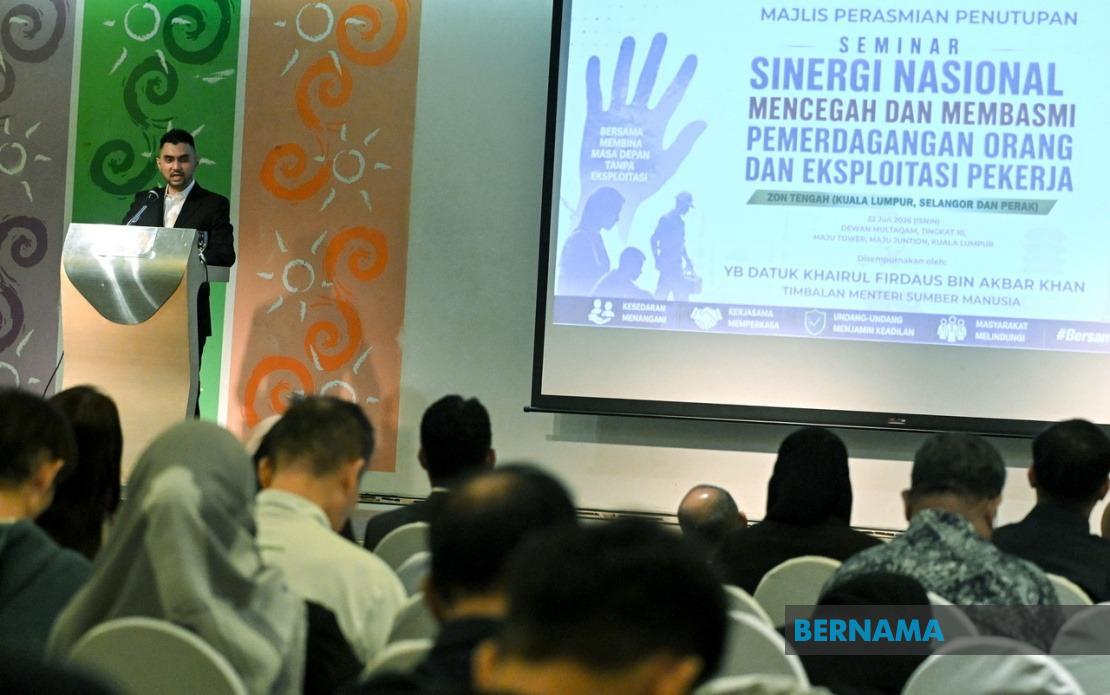
The steady decline in documented human trafficking cases across Malaysia since 2023 marks a potential turning point in the country's fight against labour exploitation, though government officials stress that falling numbers may mask a deeper problem of unreported victimisation. Deputy Human Resources Minister Datuk Khairul Firdaus Akbar Khan revealed the trends while addressing the closing ceremony of the National Synergy Seminar on Preventing and Eradicating Human Trafficking and Labour Exploitation in the Central Zone 2026 in Kuala Lumpur, highlighting both progress and persistent challenges in combating this transnational criminal activity.
According to data compiled by the Peninsular Malaysia Manpower Department (JTKSM), the trajectory of documented rescues presents a mixed picture. The department recorded 70 victims freed in 2023, followed by a dramatic drop to just 10 individuals in 2024. However, 2025 saw a slight uptick to 17 cases, with only four victims identified and rescued through May of the current year. These figures suggest that while enforcement mechanisms may be producing results, the volatility in year-on-year numbers also indicates the unpredictable nature of trafficking detection and rescue operations.
Malaysia's vulnerability to human trafficking stems from its position as both a transit nation and a destination for victims exploited in industries including manufacturing, agriculture, domestic work, and construction. The country's rapid economic development and significant wage differentials with neighbouring nations create powerful pull factors for migrant workers, some of whom fall prey to traffickers offering false employment promises. The declining rescue figures could reflect either genuine improvements in prevention efforts or, as officials cautiously suggest, growing sophistication by criminal networks in concealing their activities from authorities.
Datuk Khairul Firdaus expressed guarded optimism about the downward trend while emphasising the critical importance of remaining vigilant. His remark that "we may not see things that are not reported" underscores a fundamental challenge facing anti-trafficking initiatives globally: many victims never come forward due to fear, shame, language barriers, immigration status concerns, or coercion by traffickers. In Malaysia's context, undocumented migrant workers and those in debt-bondage situations are particularly vulnerable to remaining hidden from official systems.
The enforcement response has been substantial in scale if not yet fully effective in scope. From January through May of this year, labour authorities nationwide conducted 386 enforcement operations, resulting in the initiation of 311 investigation papers. These operations represent a systematic approach to identifying potential trafficking situations within workplaces, though the number of actual rescues remains relatively small relative to enforcement activity. This gap suggests either that many investigations do not result in confirmed trafficking cases or that rescue operations occur at a slower pace than initial investigations commence.
Government commitment to addressing forced labour has been reinforced through Malaysia's obligations under international frameworks, particularly the protocols ratified under the International Labour Organisation (ILO). These international commitments have shaped domestic policy agendas and enforcement priorities, though implementing and sustaining effective action against deeply entrenched criminal networks remains resource-intensive. The ILO's 2024 global estimate of 27.9 million people in situations of forced labour worldwide contextualises Malaysia's challenge within a much larger regional and global crisis.
The National Synergy Seminar series represents a deliberate strategy to build awareness and coordination across Malaysia's three main geographical zones. The Central Zone programme in Kuala Lumpur followed earlier seminars held in the North Zone at Sungai Petani, Kedah on May 18 and the South Zone in Kluang, Johor on June 8. Nearly 1,000 participants engaged across these three events, bringing together government agencies, labour department officials, civil society organisations, and private sector representatives to exchange knowledge and develop coordinated responses.
These awareness initiatives serve multiple purposes within Malaysia's anti-trafficking architecture. They educate enforcement personnel on identifying trafficking indicators, train community stakeholders on recognising victims and reporting mechanisms, and create forums where government, industry, and civil society can align on prevention strategies. For a country with millions of migrant workers and complex supply chains spanning manufacturing, agriculture, and services sectors, such coordination mechanisms are essential for identifying trafficking patterns that cross jurisdictional and sectoral boundaries.
The geographic concentration of seminar efforts across Malaysia's three zones reflects the country's distinct regional challenges. Peninsular Malaysia's industrial centres, plantation economies, and domestic service industries each present unique trafficking vulnerabilities. Sarawak and Sabah, despite their significance in Malaysia's labour landscape, were not mentioned in the seminar schedule, potentially indicating either separate coordination mechanisms for East Malaysia or gaps in awareness-raising efforts that merit attention.
From a regional perspective, Malaysia's progress in reducing documented trafficking cases could have implications for ASEAN anti-trafficking collaboration. The Association of Southeast Asian Nations has identified human trafficking as a serious transnational challenge, and country-level improvements contribute to collective efforts. However, traffickers displaced by enforcement in one jurisdiction often simply redirect operations to neighbouring countries with weaker institutional capacity or enforcement presence, meaning Malaysia's success must be sustained and complemented by parallel efforts across Thailand, Indonesia, Cambodia, and other regional neighbours.
For Malaysian employers, particularly in sectors reliant on migrant labour, the enforcement emphasis carries both risks and opportunities. Increased inspections and investigation papers signal that non-compliance with labour standards will face greater detection and consequences. Simultaneously, legitimate employers have incentive to strengthen supply chain transparency and worker protections, as reputational damage from trafficking associations increasingly affects business operations and investor relations in an era of corporate social responsibility scrutiny.
Moving forward, the sustainability of declining trafficking numbers will depend on maintaining enforcement capacity, preventing criminal networks from adapting to new detection methods, and crucially, building trust with potential victims and communities where trafficking occurs. Unless hidden cases are systematically brought into the open through enhanced community reporting mechanisms and victim support services, Malaysia's actual progress in eliminating trafficking will remain unmeasurable. The government's cautious tone reflects appropriate awareness that numbers alone cannot capture the full scope of this crime.

