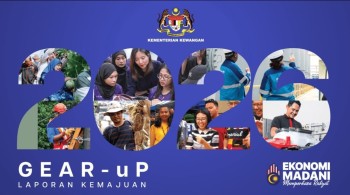
The Government-Linked Enterprises Activation and Reform Programme (GEAR-uP) has entered a decisive phase, with Malaysia's principal state-owned investment vehicles committing RM20.3 billion in domestic deployment during 2025 — a threefold acceleration compared to the RM6.6 billion deployed in 2024. This dramatic scaling-up signals a significant shift in how Malaysia's government intends to channel public capital toward productive economic transformation, moving beyond traditional passive investment models toward strategic wealth creation with explicit national objectives.
Launched in 2024 under the Ministry of Finance's direction, GEAR-uP represents an ambitious attempt to mobilise RM120 billion across a five-year horizon to fundamentally reshape Malaysia's economic architecture. The programme draws on the collective resources of six major GLICs: Khazanah Nasional Bhd, the Employees Provident Fund, Permodalan Nasional Bhd, Kumpulan Wang Persaraan (Diperbadankan), Lembaga Tabung Angkatan Tentera, and Lembaga Tabung Haji. Prime Minister Datuk Seri Anwar Ibrahim, who doubles as Finance Minister, characterised GEAR-uP as fundamentally different from conventional capital deployment, emphasising that the programme channels "national wealth mobilised with national purpose" rather than capital searching merely for financial returns.
The scale of 2025's allocation reflects growing confidence in the programme's strategic direction, with Malaysia positioning itself to capitalise on shifting global supply chains and digital infrastructure demands. Investment flows are now concentrating across critical infrastructure and technology sectors that position the nation advantageously within regional and global economic networks. Notably, the momentum extends into the first quarter of 2026, suggesting sustained commitment regardless of potential political or economic headwinds. For Malaysian readers, this expansion carries direct implications: larger capital pools directed toward domestic opportunity typically correlate with job creation, wage growth, and expanded career pathways across multiple economic sectors.
Data centre investments exemplify this capital redeployment strategy. KWAP-backed development of Google's Selangor facility will generate 320 megawatts of additional capacity whilst creating 26,500 jobs through 2026 and 2027, complemented by Empyrion Digital's phased expansion into Johor. These infrastructure anchors create ecosystem effects that extend beyond the primary investment: they attract subsidiary services, attract talent migration, and establish supply chain networks. For the broader Southeast Asian region, Malaysia's commitment to digital infrastructure raises competitive pressures on neighbouring economies to similarly upgrade their data centre and technology capabilities.
The venture capital pipeline represents another critical dimension of GEAR-uP's evolution. Multiple specialised funds — Dana Impak, Dana Perintis, Dana Pemacu, and Ekuinas — increasingly channel companies through the venture-to-growth-stage transition, addressing a persistent financing gap that historically constrained Malaysian entrepreneurship. Khazanah's planned Dana Ciptawan injection of RM200 million specifically targets Bumiputera enterprises and mid-tier Malaysian firms, addressing both wealth distribution objectives and the genuine business case for supporting emerging Malaysian champions. This layered approach — combining both returns-focused and social-outcome-focused capital — reflects pragmatic recognition that purely commercial discipline and equity access cannot be divorced from broader development goals.
Capital markets represent the strategic foundation for this extended investment architecture. Government-linked companies remain positioned to achieve RM100 billion in additional market value by 2028, whilst the MY Value Up initiative extends market discipline across Malaysia's 88 largest listed companies. These interrelated programmes work toward the Capital Market Masterplan's ambitious target of RM5.8 trillion to RM6.3 trillion in market capitalisation by 2030. For foreign and domestic investors alike, this represents a credible commitment to deepening Malaysia's equity markets and creating larger, more liquid pools for capital deployment. The programme's success directly determines whether Malaysia can sustain regional investment competitiveness against rival hubs in Singapore and Thailand.
Energy infrastructure investments crystallise Malaysia's commitment to balancing growth acceleration with environmental transition. Tenaga Nasional Bhd's grid investment programme, expanding from RM12 billion in 2025 toward RM15 billion in 2027, directly supports the national target of 70 per cent renewable energy in installed capacity by 2050. Aviation infrastructure equally commands substantial capital: Malaysia Airports' five-year RM11 billion upgrade programme includes capacity enhancements targeting over 100 million annual passengers at Kuala Lumpur International Airport. These investments, spanning energy and transport connectivity, establish foundational capabilities that enable subsequent industrial development and tourism growth.
Bumiputera wealth creation emerges as a distinct pillar within GEAR-uP's architecture, reflecting political economy realities whilst advancing genuine development objectives. The report projects ten Bumiputera company listings across 2026-2027, supported by the 10 Bumiputera Champions Programme designed to scale firms beyond startup phase toward competitive scale. Zakat Wakalah, a faith-aligned capital mechanism, targets RM100 million deployment in 2026 — a notable expansion from RM28 million previously. These mechanisms acknowledge that inclusive growth requires not merely general market access but tailored financial instruments and mentorship ecosystems designed around specific community circumstances.
Minister of Finance II Datuk Seri Amir Hamzah Azizan articulated the programme's core conviction: capital itself creates nothing without the complementary human and institutional infrastructure required to convert investment into sustainable prosperity. His emphasis on living wages, graduate employment placement, Bumiputera firm scaling, and supply chain localisation reflects recognition that ringgit figures mask the actual question confronting policymakers — whether capital generates dignified employment, builds local capability, and distributes gains widely. This framing signals that GEAR-uP's success will ultimately be measured by employment quality, wage trajectories, and skill development rather than purely financial returns to government shareholders.
The external environment constraining Malaysia's economic policy remains persistently turbulent, with global volatility and reshaping trade relationships creating both risks and opportunities. The government argues that earlier 2023 reforms enabled Malaysia to weather external headwinds, creating space for GEAR-uP's three-year runway to demonstrate tangible delivery. However, success requires sustained political commitment across potential government transitions, bureaucratic execution capacity adequate to manage RM120 billion deployment effectively, and market conditions allowing the projected returns to materialise. The programme's structure — with momentum already into early 2026 and most major initiatives already mobilised — suggests significant momentum irreversibility, though execution risks remain substantial.
For Malaysian workers and enterprises, GEAR-uP's ambition carries profound implications. Successful execution could establish virtuous cycles where public capital investments create quality employment, attract private capital, develop local supply chains, and build indigenous champions capable of global competition. Conversely, if execution falters or capital deploys inefficiently, scarce public resources could simply transfer wealth to politically-connected entities without generating proportionate employment or capability gains. The programme's transparent framing around living wages, job quality, and supply chain localisation suggests genuine commitment to inclusive growth, yet converting rhetoric into sustained delivery across complex projects spanning years remains the authentic test ahead.

