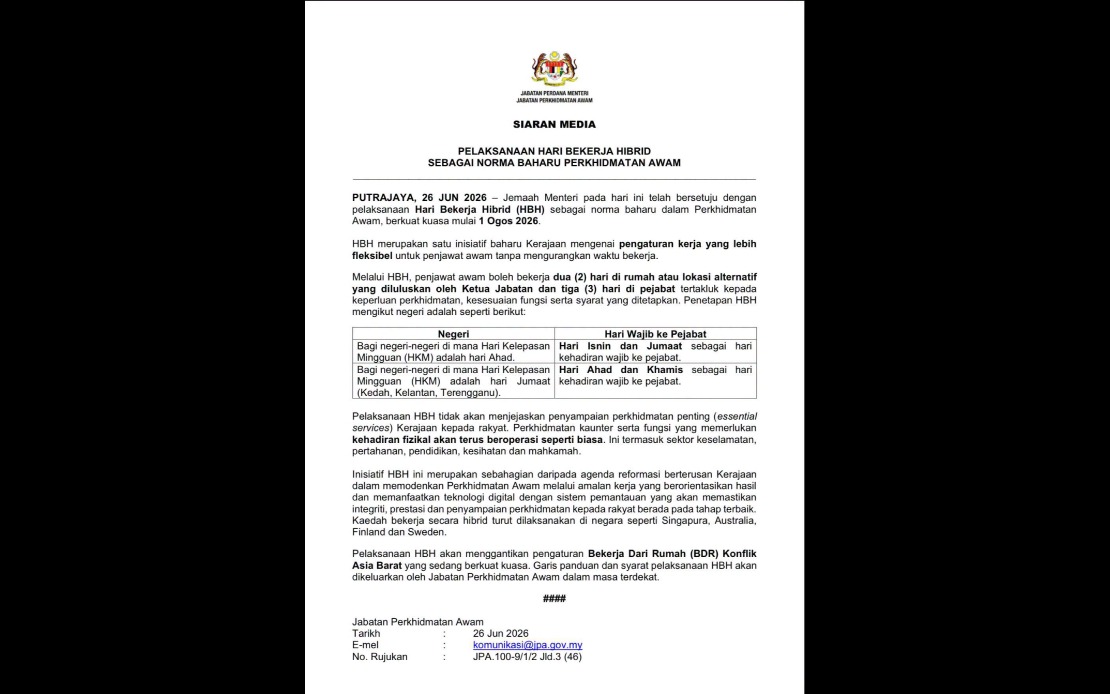
Malaysia's government has formally approved a hybrid work model for its entire civil service, marking a significant shift in how the nation's public sector approaches workplace arrangements. The Public Service Department announced the decision on June 26, with the Hybrid Work Day framework set to commence on August 1. This move replaces the existing Work From Home arrangement that has been in place since the pandemic, introducing what officials describe as a more structured and balanced approach to flexible working.
Under the new system, civil servants across Malaysia will operate on a consistent schedule: two days working remotely from their homes or at department-approved alternative locations, coupled with three mandatory days at physical office premises. The arrangement remains subject to operational requirements, functional suitability of roles, and departmental conditions. This two-three split differs from entirely flexible models adopted elsewhere, reflecting the government's intent to maintain consistent office presence while recognising modern workplace preferences. The framework applies across federal and state administrations, though implementation details account for varying weekly rest days across different states.
Geographic variations in Malaysia's public service necessitate tailored arrangements. States observing Sunday as their weekly rest day—the majority of the country—will designate Monday and Friday as compulsory office attendance dates. Conversely, Kedah, Kelantan, and Terengganu, which observe Friday as their weekly holiday, will require staff presence on Sundays and Thursdays. This careful calibration ensures that the hybrid model accommodates constitutional and administrative differences across Malaysia's federal structure while maintaining nationwide consistency in the fundamental two-days-remote principle.
Critical infrastructure and frontline services remain unaffected by this initiative. The government has explicitly guaranteed that essential public services will continue operating without disruption. Departments managing security, defence, education, healthcare, and the judiciary will maintain their existing service delivery patterns, with counter services and roles requiring physical presence continuing as normal. This carve-out recognises that certain governmental functions cannot be performed remotely and must maintain full operational capacity regardless of broader workplace policy changes.
The Public Service Department has framed this initiative as integral to a larger modernisation agenda for Malaysia's civil service. Rather than simply permitting remote work for convenience, officials characterise the hybrid model as introducing results-based work practices and encouraging greater digital technology adoption across government agencies. This positioning suggests that the shift represents more than a post-pandemic labour adjustment; it reflects an intentional strategy to enhance public sector efficiency through technological investment and performance-focused management rather than time-and-presence metrics.
International precedent has informed Malaysia's approach. The PSD statement specifically notes that comparable hybrid arrangements have been successfully implemented in Singapore, Australia, Finland, and Sweden—a diverse mix of developed and advanced economies across different regions. This reference serves dual purposes: it provides legitimacy through successful international examples and subtly positions Malaysia alongside technologically advanced nations in workforce modernisation practices. Such comparative framing may influence public and civil service perception of the policy as forward-thinking rather than experimental.
Implementation will include dedicated monitoring mechanisms designed to ensure that the transition does not compromise integrity, performance standards, or service delivery quality. The department has committed to introducing oversight systems, though detailed specifications remain pending. This emphasis on monitoring suggests departmental awareness that hybrid arrangements require active management to prevent service degradation, a particularly important consideration given Malaysia's diverse workforce and varying departmental cultures. Accountability measures will likely focus on output metrics rather than presence indicators, reinforcing the shift toward results-based assessment.
The August 1 commencement date provides public sector agencies with five weeks for preparation and communication. The Public Service Department has indicated that comprehensive guidelines and specific implementation conditions will be released subsequently, allowing departments to tailor the framework to their operational contexts. This phased approach differs from immediate implementation, reflecting recognition that Malaysia's sprawling civil service requires coordination and training to execute the transition smoothly. Departments will need to establish protocols for approving alternative work locations, defining which roles qualify for remote work, and establishing performance monitoring frameworks.
For Malaysian workers and public service observers, this policy carries implications extending beyond employment flexibility. The hybrid model addresses long-standing workplace concerns about commute times and work-life balance while attempting to preserve institutional presence and collaborative dynamics. In Kuala Lumpur and other congested urban centres where many federal civil servants work, reducing mandatory office days addresses significant commuting challenges. Simultaneously, maintaining three office days preserves departmental culture and the collaborative interactions that remote work cannot fully replicate.
The broader Southeast Asian context adds importance to Malaysia's decision. As a major economic player in the region with significant foreign investment, Malaysia's public sector modernisation signals to international business that the nation is adopting contemporary workplace practices. This positioning matters for talent retention and recruitment, particularly for digitally-skilled professionals who increasingly evaluate employment based on workplace flexibility alongside compensation. Countries that adopt modern work arrangements often find themselves more competitive in attracting and retaining technical expertise critical for digital transformation.
Challenges will inevitably emerge during implementation. Managing remote work security, ensuring consistent service delivery across different departments, maintaining organisational cohesion when staff presence varies, and addressing potential inequities between roles that permit hybrid arrangements and those requiring full-time office presence will require careful navigation. The government's monitoring mechanisms will face tests in measuring success beyond simple compliance metrics to genuinely assess whether the hybrid model achieves its stated objectives of modernisation and efficiency.
The hybrid work policy ultimately represents Malaysia's civil service adapting to post-pandemic workplace realities while attempting structured modernisation. Whether the framework successfully balances flexibility with operational demands will determine its longevity and whether further adjustments become necessary. The August 1 launch marks the beginning of Malaysia's large-scale experiment in flexible public sector work arrangements, with outcomes likely influencing both corporate sector practices and future government employment policies across the region.

