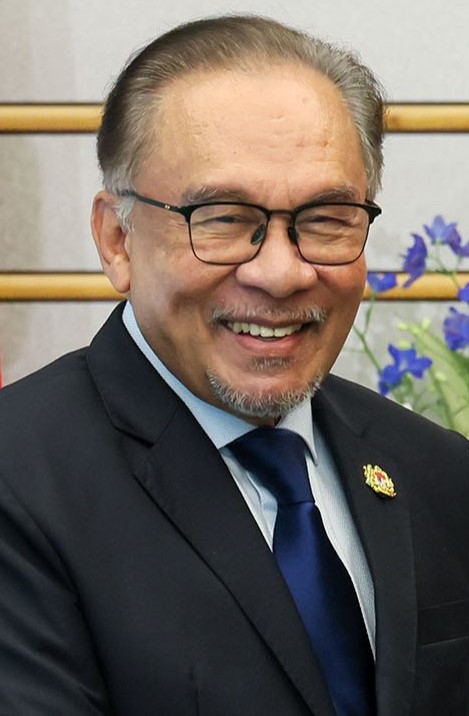
Prime Minister Datuk Seri Anwar Ibrahim addressed concerns about Malaysia's foreign policy independence during a public appearance in Muar, asserting that the country has successfully navigated its diplomatic relationships with major world powers without sacrificing core national values. His remarks come amid ongoing regional and global scrutiny over how Southeast Asian nations manage increasingly complex geopolitical relationships with Washington and Beijing, both of which seek to expand their influence across Asia.
The Prime Minister's comments reflect Malaysia's delicate diplomatic positioning in an era of intensifying great-power competition. Rather than viewing engagement with major powers as inherently compromising, Anwar framed Malaysia's approach as one rooted in pragmatism and national interest. This perspective acknowledges that for a developing nation dependent on international trade, investment, and security cooperation, complete isolation from major powers is neither feasible nor beneficial. Instead, Malaysia has positioned itself as a country capable of maintaining substantive relationships across the geopolitical spectrum while remaining faithful to its own strategic priorities.
The assertion carries particular relevance given Malaysia's historical trajectory as a non-aligned nation and its current role as a major voice within ASEAN. Since Malaysia's founding, the nation has sought to avoid becoming a client state of any single power, a principle enshrined in the country's foreign policy doctrine. Anwar's statement effectively defends Malaysia against suggestions that recent trade agreements, defence partnerships, or diplomatic initiatives represent a departure from this established position. The government appears keen to signal that economic interdependence and security collaboration do not necessitate political subordination or ideological alignment.
China represents Malaysia's largest trading partner and a major source of foreign direct investment, particularly in infrastructure and manufacturing sectors. Simultaneously, the United States remains a significant security partner and technological ally. These twin relationships, while occasionally creating friction points—particularly regarding issues like South China Sea territorial disputes and technology standards—have generally coexisted without forcing Malaysia into stark either-or choices. Anwar's remarks underline the government's conviction that this coexistence is sustainable and mutually reinforcing rather than fundamentally contradictory.
The broader context involves Malaysia's consistent advocacy for multilateralism, sovereignty, and peaceful resolution of disputes through established international legal frameworks. On matters ranging from maritime law to trade regulations, Malaysia has actively participated in shaping international norms rather than simply accepting impositions from larger powers. This proactive engagement itself constitutes a form of principle—asserting agency and voice in international affairs despite asymmetries in raw power. Anwar's comments implicitly defend this approach as legitimate and effective.
Within Southeast Asia, Malaysia's diplomatic posture reflects broader regional dynamics. ASEAN members collectively maintain relationships with both China and the United States, though with varying degrees of closeness and occasional tensions over alignment. Malaysia has generally avoided the more acute dilemmas faced by frontline states, allowing the country greater flexibility in pursuit of balanced engagement. This positioning has enabled Malaysia to serve as a moderate voice within regional forums and to broker compromises on contentious issues where consensus might otherwise prove elusive.
Domestic political considerations also inform Anwar's defence of Malaysia's foreign policy approach. Various Malaysian stakeholders hold differing views about optimal engagement with major powers, reflecting deeper concerns about economic development, cultural values, and national identity. By emphasizing that good relations with China and the United States strengthen rather than compromise Malaysia's principles, Anwar addresses concerns from constituencies worried about cultural erosion, economic exploitation, or political influence. His framing seeks to present foreign engagement as compatible with—rather than antagonistic to—Malaysian values and interests.
The technological sphere presents perhaps the most visible arena where Malaysia navigates competing great-power interests. Questions about 5G infrastructure, digital standards, and cybersecurity increasingly force countries to make choices with geopolitical implications. Anwar's statement implicitly encompasses Malaysia's approach to these challenges, suggesting that technological partnerships need not entail compromises on sovereignty or security. However, the practical reality involves difficult technical and strategic decisions that may not always align perfectly with all stated principles.
Looking forward, Anwar's remarks establish a baseline position from which Malaysia will continue managing its international relationships. As competition between major powers potentially intensifies, particularly regarding trade, technology, and regional influence in the Indo-Pacific, Malaysia's insistence on principled pragmatism will face ongoing testing. The government's demonstrated commitment to this approach suggests Malaysia will continue seeking mutually beneficial relationships while attempting to maintain strategic autonomy and consistency with its long-standing international positions.