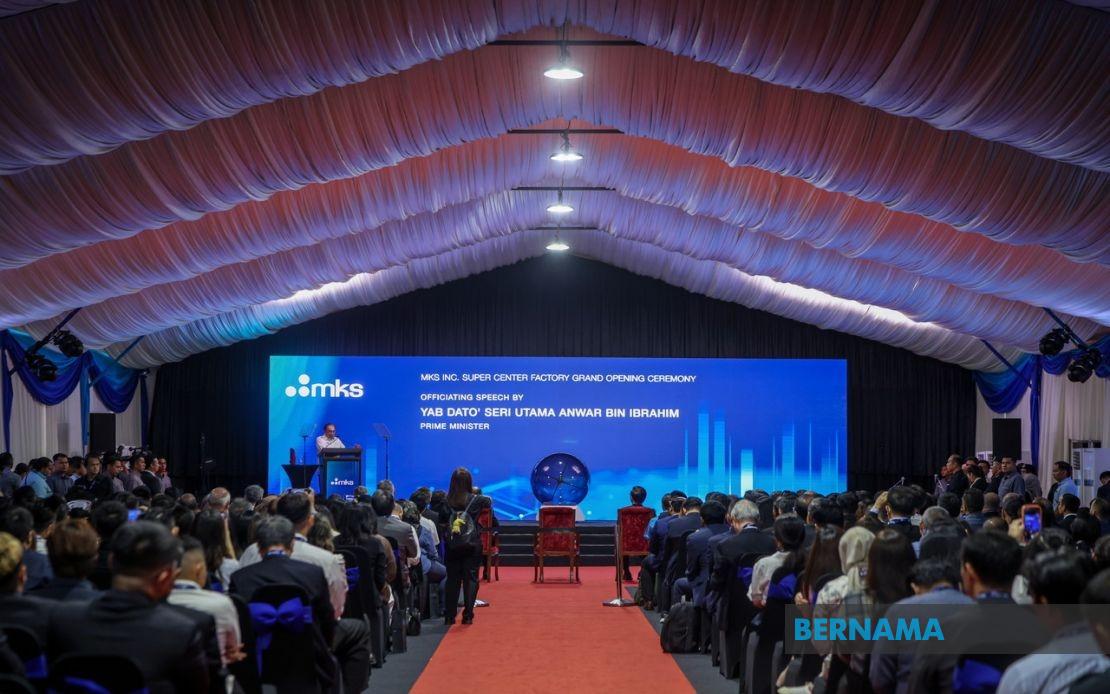
Prime Minister Datuk Seri Anwar Ibrahim has credited Malaysia's deliberate policy of engaging with nations across competing geopolitical spheres while preserving its independence and neutral stance as a strategic asset that has generated tangible economic returns and reinforced the country's standing on the world stage. Speaking at the opening of MKS Super Centre factory in Bandar Cassia Technology Park in Batu Kawan, Anwar stressed that this multifaceted diplomatic approach has fostered robust bilateral relationships and created openings for cooperation that might otherwise remain unavailable to nations perceived as aligned exclusively with any single power bloc.
The Prime Minister's remarks reflect Malaysia's longstanding commitment to a non-aligned foreign policy tradition, a principle that has guided national strategy for decades. By maintaining cordial relations with the United States, China, India, Russia, and other nations simultaneously, Anwar explained, Malaysia positions itself as a neutral arbiter and attractive partner for countries seeking diversified economic ties. This diplomatic flexibility has proven particularly valuable in a region where great power competition has intensified and where smaller nations must carefully navigate competing interests to secure their own development goals.
Anwar referenced several high-profile diplomatic engagements to illustrate this principle in action. He noted that Malaysia received United States President Donald Trump during a significant state visit last year, followed by reciprocal interactions with China, India, and more recently Russia. These varied exchanges demonstrate Malaysia's capacity to maintain productive relationships across geopolitical divides without compromising its sovereignty or independence. Rather than viewing such engagement as contradictory, Anwar framed it as evidence of Malaysia's "centrality"—positioning the nation as a bridge between different international camps rather than as a subordinate member of any particular bloc.
The economic dividends of this approach have begun materializing across multiple sectors. Anwar specifically highlighted Petroliam Nasional Bhd's recent agreement in Turkmenistan as a concrete example of how diplomatic openness translates into business opportunities. Malaysia's energy sector, historically reliant on regional partnerships, has benefited from this broader diplomatic canvas by accessing new markets, technology partnerships, and resource agreements that strengthen the nation's economic resilience. The Turkmenistan deal represents exactly the type of opportunity that emerges when a nation is perceived as trustworthy and non-threatening by countries beyond its immediate neighborhood.
For Malaysian business and investors, the implications are substantial. When the Prime Minister emphasizes Malaysia's capacity to work with all nations, he is signaling to international corporations and sovereign wealth funds that Malaysia remains a stable, predictable partner uncomplicated by Cold War-style allegiances or restrictive foreign policy constraints. This reassures multinational enterprises considering regional headquarters or manufacturing hubs that their operations will not become ensnared in geopolitical disputes or economic sanctions targeting politically aligned nations. Such confidence has likely contributed to Malaysia's continued appeal as an investment destination despite broader regional tensions.
Anwar also acknowledged that Malaysia's neutral posture does not mean silent acquiescence on global issues. The Prime Minister stated explicitly that Malaysia expresses its position on contentious international matters affecting the world, indicating that neutrality does not equate to indifference or weakness. Rather, Malaysia reserves the right to articulate clear positions on matters of principle—whether regarding Palestinian rights, Myanmar's internal conflict, or other regional concerns—while simultaneously maintaining functional relationships with all parties. This distinction is crucial because it separates genuine non-alignment from mere fence-sitting, grounding Malaysia's approach in substantive values rather than opportunistic pragmatism alone.
The factory opening event in Penang, attended by Chief Minister Chow Kon Yeow and Deputy Minister of Investment, Trade and Industry Sim Tze Tzin, underscored the geographic dimension of Malaysia's economic strategy. Penang, as a major manufacturing and technology hub, has particularly benefited from Malaysia's international openness. Companies like MKS, represented by president and chief executive officer John T.C. Lee, capitalize on Malaysia's strategic location between major Asian powers and its reputation for political stability and economic transparency. The state has leveraged this positioning to attract semiconductor, electronics, and technology investments from companies seeking to diversify supply chains beyond China or India.
Context matters here for understanding Anwar's emphasis on this theme. Malaysia operates in a region where medium-sized nations face mounting pressure to choose sides as United States-China competition intensifies. Countries like Vietnam, Thailand, and Indonesia similarly pursue non-aligned strategies, yet Malaysia's particular approach—combining active diplomatic engagement with explicit expression of principled positions—offers a model of how to maintain autonomy while engaging constructively with multiple powers. For Southeast Asia more broadly, Malaysia's approach suggests that genuine non-alignment remains viable and economically rewarding, particularly for nations with strategic geographic positions and valuable resources.
The long-term sustainability of this strategy depends on Malaysia's continued ability to balance competing demands and maintain credibility across different constituencies. As geopolitical tensions escalate, pressure on middle powers to declare exclusive allegiances will mount. Anwar's recent statements suggest the government is doubling down on its non-aligned commitments precisely because this approach has proven economically beneficial and aligned with Malaysia's historical foreign policy tradition. Whether Malaysia can sustain this equilibrium as great power competition sharpens remains among the most consequential questions facing the nation's economic and political future.

